Bacterial Diseases Branch, Division of Vector Borne Diseases, National Center for Enteric and Zoonotic Infectious Diseases, Centers for Disease Control and Prevention, 3150 Rampart Rd, Fort Collins, CO 80521, USA.
Department of Microbiology, Immunology and Molecular Genetics, University of Kentucky, MS415 Medical Center, Lexington, KY 40536, USA.
Microbiology (Reading). 2010 Jul;156(Pt 7):2216-2225. doi: 10.1099/mic.0.037952-0. Epub 2010 Apr 15.
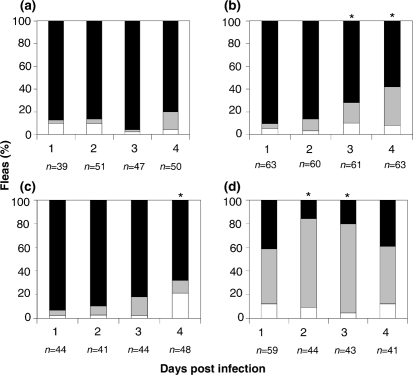
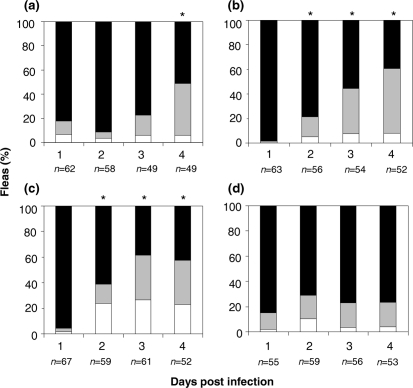
Early-phase transmission (EPT) is a recently described model of plague transmission that explains the rapid spread of disease from flea to mammal host during an epizootic. Unlike the traditional blockage-dependent model of plague transmission, EPT can occur when a flea takes its first blood meal after initially becoming infected by feeding on a bacteraemic host. Blockage of the flea gut results from biofilm formation in the proventriculus, mediated by the gene products found in the haemin storage (hms) locus of the Yersinia pestis chromosome. Although biofilms are required for blockage-dependent transmission, the role of biofilms in EPT has yet to be determined. An artificial feeding system was used to feed Xenopsylla cheopis and Oropsylla montana rat blood spiked with the parental Y. pestis strain KIM5(pCD1)+, two different biofilm-deficient mutants (Delta hmsT, Delta hmsR), or a biofilm-overproducer mutant (Delta hmsP). Infected fleas were then allowed to feed on naïve Swiss Webster mice for 1-4 days after infection, and the mice were monitored for signs of infection. We also determined the bacterial loads of each flea that fed upon naïve mice. Biofilm-defective mutants transmitted from X. cheopis and O. montana as efficiently as the parent strain, whereas the EPT efficiency of fleas fed the biofilm-overproducing strain was significantly less than that of fleas fed either the parent or a biofilm-deficient strain. Fleas infected with a biofilm-deficient strain harboured lower bacterial loads 4 days post-infection than fleas infected with the parent strain. Thus, defects in biofilm formation did not prevent flea-borne transmission of Y. pestis in our EPT model, although biofilm overproduction inhibited efficient EPT. Our results also indicate, however, that biofilms may play a role in infection persistence in the flea.
早期传播(EPT)是一种最近描述的鼠疫传播模型,它解释了在流行病期间跳蚤向哺乳动物宿主快速传播疾病的过程。与传统的鼠疫传播依赖于阻塞的模型不同,EPT 可以在跳蚤最初通过吸食菌血症宿主而感染后,在第一次吸血时发生。跳蚤肠道的阻塞是由生物膜在胃囊中形成引起的,这是由鼠疫耶尔森氏菌染色体的血红素储存(hms)基因座中的基因产物介导的。虽然生物膜是阻塞依赖传播所必需的,但生物膜在 EPT 中的作用尚未确定。使用人工喂养系统喂养感染了亲本 Y. pestis 菌株 KIM5(pCD1)+、两种不同生物膜缺陷突变体(Delta hmsT、Delta hmsR)或生物膜过度产生突变体(Delta hmsP)的 Xenopsylla cheopis 和 Oropsylla montana 大鼠血液。感染的跳蚤在感染后 1-4 天内被允许叮咬天真的瑞士 Webster 老鼠,然后监测老鼠是否有感染迹象。我们还确定了每只叮咬天真老鼠的跳蚤的细菌负荷。生物膜缺陷突变体从 X. cheopis 和 O. montana 传播的效率与亲本菌株一样高,而喂食生物膜过度产生菌株的跳蚤的 EPT 效率明显低于喂食亲本或生物膜缺陷菌株的跳蚤。感染生物膜缺陷菌株的跳蚤在感染后 4 天的细菌负荷低于感染亲本菌株的跳蚤。因此,在我们的 EPT 模型中,生物膜形成缺陷并没有阻止鼠疫耶尔森氏菌的跳蚤传播,尽管生物膜过度产生抑制了有效的 EPT。然而,我们的结果还表明,生物膜可能在跳蚤中的感染持续中发挥作用。