Uranga Romina M, Keller Jeffrey N
Instituto de Investigaciones Bioquímicas de Bahía Blanca, Universidad Nacional del Sur and Consejo Nacional de Investigaciones Científicas y Técnicas, Bahía Blanca, Argentina.
Curr Gerontol Geriatr Res. 2010;2010:219683. doi: 10.1155/2010/219683. Epub 2010 Apr 11.
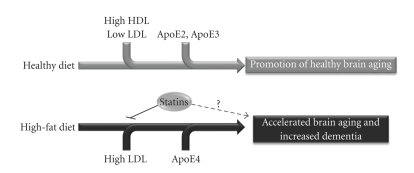
Cholesterol is an essential molecule for brain homeostasis; yet, hypercholesterolemia and its numerous complications are believed to play a role in promoting multiple aspects of brain pathogenesis. An ever increasing number of individuals in modern Western Society are regularly consuming diets high in fat which promote the development of hypercholesterolemia. Additionally, modern societies are becoming increasingly aged, causing a collision between increased hypercholesterolemia and increased aging, which will likely lead to the development of increased pathological conditions due to hypercholesterolemia, thereby promoting deleterious neurochemical and behavioral changes in the brain. Lastly, while beneficial in controlling cholesterol levels, the long-term use of statins itself may potentially promote adverse effects on brain homeostasis, although specifics on this remain largely unknown. This review will focus on linking the current understanding of diet-induced hypercholesterolemia (as well as statin use) to the development of oxidative stress, neurochemical alterations, and cognitive disturbances in the aging brain.
胆固醇是维持脑内环境稳定的必需分子;然而,高胆固醇血症及其众多并发症被认为在促进脑发病机制的多个方面发挥作用。现代西方社会中,越来越多的人经常食用高脂肪饮食,这会促进高胆固醇血症的发展。此外,现代社会老龄化程度日益加深,导致高胆固醇血症增加与老龄化加剧相互碰撞,这可能会因高胆固醇血症导致更多病理状况的发生,从而促使大脑出现有害的神经化学和行为变化。最后,虽然他汀类药物在控制胆固醇水平方面有益,但长期使用他汀类药物本身可能会对脑内环境稳定产生潜在的不良影响,不过这方面的具体情况仍大多未知。本综述将重点探讨目前对饮食诱导的高胆固醇血症(以及他汀类药物的使用)的理解与衰老大脑中氧化应激、神经化学改变和认知障碍发展之间的联系。