Suppr超能文献

舒尼替尼通过分区限制直接和差异抑制髓源性抑制细胞亚群。

Direct and differential suppression of myeloid-derived suppressor cell subsets by sunitinib is compartmentally constrained.

机构信息

Department of Immunology, Taussig Cancer Institute, and Glickman Urological Institute, Cleveland Clinic, Cleveland, Ohio, USA.

出版信息

Cancer Res. 2010 May 1;70(9):3526-36. doi: 10.1158/0008-5472.CAN-09-3278. Epub 2010 Apr 20.

Abstract

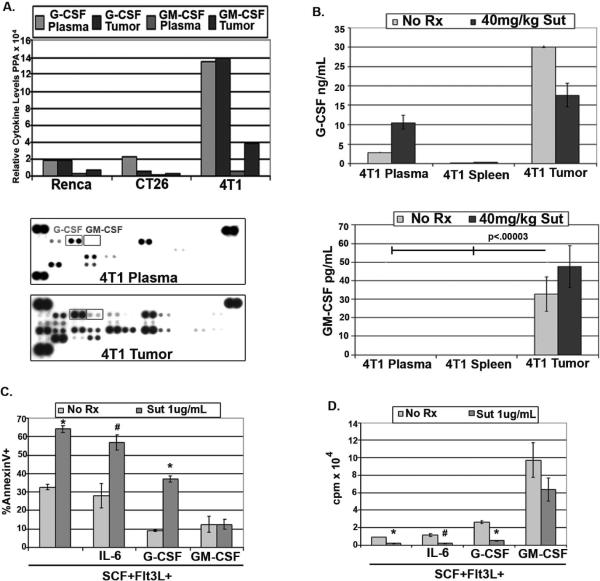
The antiangiogenic drug sunitinib is a receptor tyrosine kinase inhibitor with significant, yet not curative, therapeutic effects in metastatic renal cell carcinoma (RCC). Sunitinib is also an immunomodulator, potently reversing myeloid-derived suppressor cell (MDSC) accumulation and T-cell inhibition in the blood even of nonresponder RCC patients. We observed that sunitinib similarly prevented MDSC accumulation and restored normal T-cell function to the spleens of tumor-bearing mice, independent of the capacity of sunitinib to inhibit tumor progression (RENCA>CT26>4T1). Both monocytic and neutrophilic splenic MDSC were highly repressible by sunitinib. In contrast, MDSC within the microenvironment of 4T1 tumors or human RCC tumors proved highly resistant to sunitinib and ambient T-cell function remained suppressed. Proteomic analyses comparing tumor to peripheral compartments showed that granulocyte macrophage colony-stimulating factor (GM-CSF) predicted sunitinib resistance and recombinant GM-CSF conferred sunitinib resistance to MDSC in vivo and in vitro. MDSC conditioning with GM-CSF uniquely inhibited signal transducers and activators of transcription (STAT3) and promoted STAT5 activation. STAT5ab(null/null) MDSC were rendered sensitive to sunitinib in the presence of GM-CSF in vitro. We conclude that compartment-dependent GM-CSF exposure in resistant tumors may account for the regionalized effect of sunitinib upon host MDSC modulation and hypothesize that ancillary strategies to decrease such regionalized escape will enhance the potency of sunitinib as an immunomodulator and a cancer therapy.

摘要

抗血管生成药物舒尼替尼是一种受体酪氨酸激酶抑制剂,在转移性肾细胞癌(RCC)中具有显著但非治愈性的治疗效果。舒尼替尼也是一种免疫调节剂,能够强烈逆转骨髓来源的抑制细胞(MDSC)在血液中的积累,并抑制非应答性 RCC 患者的 T 细胞抑制。我们观察到,舒尼替尼同样可以防止 MDSC 的积累,并恢复荷瘤小鼠脾脏中正常的 T 细胞功能,而与舒尼替尼抑制肿瘤进展的能力无关(RENCA>CT26>4T1)。舒尼替尼可高度抑制单核细胞和中性粒细胞来源的脾脏 MDSC。相比之下,4T1 肿瘤或人类 RCC 肿瘤微环境中的 MDSC 对舒尼替尼具有高度抗性,周围的 T 细胞功能仍然受到抑制。比较肿瘤与外周隔室的蛋白质组学分析表明,粒细胞-巨噬细胞集落刺激因子(GM-CSF)预测了舒尼替尼的耐药性,重组 GM-CSF 赋予 MDSC 体内和体外对舒尼替尼的耐药性。GM-CSF 对 MDSC 的调理作用独特地抑制了信号转导子和转录激活子(STAT3),并促进了 STAT5 的激活。在 GM-CSF 存在的情况下,STAT5ab(null/null) MDSC 在体外对舒尼替尼变得敏感。我们得出结论,耐药肿瘤中隔室依赖性 GM-CSF 暴露可能是舒尼替尼对宿主 MDSC 调节的区域化效应的原因,并假设减少这种区域化逃逸的辅助策略将增强舒尼替尼作为免疫调节剂和癌症治疗的效力。

相似文献

1
Direct and differential suppression of myeloid-derived suppressor cell subsets by sunitinib is compartmentally constrained.
Cancer Res. 2010 May 1;70(9):3526-36. doi: 10.1158/0008-5472.CAN-09-3278. Epub 2010 Apr 20.
2
MDSC as a mechanism of tumor escape from sunitinib mediated anti-angiogenic therapy.
Int Immunopharmacol. 2011 Jul;11(7):856-61. doi: 10.1016/j.intimp.2011.01.030. Epub 2011 Feb 11.
3
Sunitinib mediates reversal of myeloid-derived suppressor cell accumulation in renal cell carcinoma patients.
Clin Cancer Res. 2009 Mar 15;15(6):2148-57. doi: 10.1158/1078-0432.CCR-08-1332. Epub 2009 Mar 10.
5
Sunitinib inhibition of Stat3 induces renal cell carcinoma tumor cell apoptosis and reduces immunosuppressive cells.
Cancer Res. 2009 Mar 15;69(6):2506-13. doi: 10.1158/0008-5472.CAN-08-4323. Epub 2009 Feb 24.
7
MEK inhibition abrogates sunitinib resistance in a renal cell carcinoma patient-derived xenograft model.
Br J Cancer. 2016 Oct 11;115(8):920-928. doi: 10.1038/bjc.2016.263. Epub 2016 Aug 25.
8
Axitinib augments antitumor activity in renal cell carcinoma via STAT3-dependent reversal of myeloid-derived suppressor cell accumulation.
Biomed Pharmacother. 2014 Jul;68(6):751-6. doi: 10.1016/j.biopha.2014.07.002. Epub 2014 Jul 12.

引用本文的文献

5
Mechanisms of myeloid-derived suppressor cell-mediated immunosuppression in colorectal cancer and related therapies.
World J Gastrointest Oncol. 2024 May 15;16(5):1690-1704. doi: 10.4251/wjgo.v16.i5.1690.
6
Translational Frontiers and Clinical Opportunities of Immunologically Fitted Radiotherapy.
Clin Cancer Res. 2024 Jun 3;30(11):2317-2332. doi: 10.1158/1078-0432.CCR-23-3632.
7
An Overview of Renal Cell Carcinoma Hallmarks, Drug Resistance, and Adjuvant Therapies.
Cancer Diagn Progn. 2023 Nov 3;3(6):616-634. doi: 10.21873/cdp.10264. eCollection 2023 Nov-Dec.
8
Primary and acquired resistance to first-line therapy for clear cell renal cell carcinoma.
Cancer Drug Resist. 2023 Aug 2;6(3):517-546. doi: 10.20517/cdr.2023.33. eCollection 2023.
10
High-Throughput Screening and Proteomic Characterization of Compounds Targeting Myeloid-Derived Suppressor Cells.
Mol Cell Proteomics. 2023 Sep;22(9):100632. doi: 10.1016/j.mcpro.2023.100632. Epub 2023 Aug 14.

本文引用的文献

1
STAT5 requires the N-domain for suppression of miR15/16, induction of bcl-2, and survival signaling in myeloproliferative disease.
Blood. 2010 Feb 18;115(7):1416-24. doi: 10.1182/blood-2009-07-234963. Epub 2009 Dec 14.
2
IL4Ralpha+ myeloid-derived suppressor cell expansion in cancer patients.
J Immunol. 2009 May 15;182(10):6562-8. doi: 10.4049/jimmunol.0803831.
3
Mechanism regulating reactive oxygen species in tumor-induced myeloid-derived suppressor cells.
J Immunol. 2009 May 1;182(9):5693-701. doi: 10.4049/jimmunol.0900092.
4
G-CSF-initiated myeloid cell mobilization and angiogenesis mediate tumor refractoriness to anti-VEGF therapy in mouse models.
Proc Natl Acad Sci U S A. 2009 Apr 21;106(16):6742-7. doi: 10.1073/pnas.0902280106. Epub 2009 Apr 3.
5
Myeloid-derived suppressor cells: linking inflammation and cancer.
J Immunol. 2009 Apr 15;182(8):4499-506. doi: 10.4049/jimmunol.0802740.
7
Sunitinib mediates reversal of myeloid-derived suppressor cell accumulation in renal cell carcinoma patients.
Clin Cancer Res. 2009 Mar 15;15(6):2148-57. doi: 10.1158/1078-0432.CCR-08-1332. Epub 2009 Mar 10.
8
Accelerated metastasis after short-term treatment with a potent inhibitor of tumor angiogenesis.
Cancer Cell. 2009 Mar 3;15(3):232-9. doi: 10.1016/j.ccr.2009.01.021.
10
Sunitinib inhibition of Stat3 induces renal cell carcinoma tumor cell apoptosis and reduces immunosuppressive cells.
Cancer Res. 2009 Mar 15;69(6):2506-13. doi: 10.1158/0008-5472.CAN-08-4323. Epub 2009 Feb 24.

文献AI研究员

20分钟写一篇综述,助力文献阅读效率提升50倍。

立即体验

用中文搜PubMed

大模型驱动的PubMed中文搜索引擎

马上搜索

文档翻译

学术文献翻译模型,支持多种主流文档格式。

立即体验