Department of Medicine, Karolinska Institutet at Karolinska University Hospital, Stockholm SE-141 86, Sweden.
Br J Cancer. 2010 May 11;102(10):1541-8. doi: 10.1038/sj.bjc.6605665. Epub 2010 Apr 20.
The regulatory gene pathways that accompany loss of adipose tissue in cancer cachexia are unknown and were explored using pangenomic transcriptome profiling.
Global gene expression profiles of abdominal subcutaneous adipose tissue were studied in gastrointestinal cancer patients with (n=13) or without (n=14) cachexia.
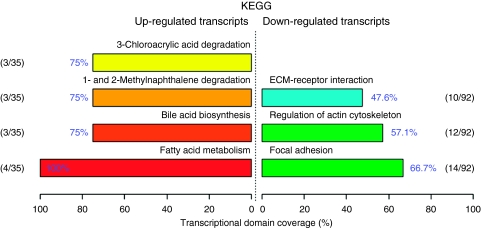
Cachexia was accompanied by preferential loss of adipose tissue and decreased fat cell volume, but not number. Adipose tissue pathways regulating energy turnover were upregulated, whereas genes in pathways related to cell and tissue structure (cellular adhesion, extracellular matrix and actin cytoskeleton) were downregulated in cachectic patients. Transcriptional response elements for hepatic nuclear factor-4 (HNF4) were overrepresented in the promoters of extracellular matrix and adhesion molecule genes, and adipose HNF4 mRNA was downregulated in cachexia.
Cancer cachexia is characterised by preferential loss of adipose tissue; muscle mass is less affected. Loss of adipose tissue is secondary to a decrease in adipocyte lipid content and associates with changes in the expression of genes that regulate energy turnover, cytoskeleton and extracellular matrix, which suggest high tissue remodelling. Changes in gene expression in cachexia are reciprocal to those observed in obesity, suggesting that regulation of fat mass at least partly corresponds to two sides of the same coin.
癌症恶病质伴随脂肪组织丢失的调控基因途径尚不清楚,本研究使用泛基因组转录组谱分析进行了探索。
研究了胃肠道癌症患者(有恶病质者 13 例,无恶病质者 14 例)腹部皮下脂肪组织的全基因组基因表达谱。
恶病质伴随脂肪组织的优先丢失和脂肪细胞体积减少,但数量不变。与能量代谢相关的脂肪组织途径上调,而与细胞和组织结构(细胞黏附、细胞外基质和肌动蛋白细胞骨架)相关的基因在恶病质患者中下调。细胞外基质和黏附分子基因启动子中肝核因子-4(HNF4)转录反应元件过度表达,脂肪组织 HNF4mRNA 在恶病质中下调。
癌症恶病质的特征是脂肪组织的优先丢失;肌肉质量受影响较小。脂肪组织丢失是由于脂肪细胞脂质含量减少引起的,与调节能量代谢、细胞骨架和细胞外基质的基因表达变化相关,提示组织重塑活跃。恶病质中基因表达的变化与肥胖中观察到的变化相反,这表明脂肪量的调节至少部分对应于同一枚硬币的两面。