An Ki Chan, Kang Sukjung, Choi Jang Suk, Seo Jin Hyuk
Department of Orthopedic Surgery, Busan Paik Hospital, College of Medicine, Inje University, Busan, Korea.
Asian Spine J. 2008 Jun;2(1):9-14. doi: 10.4184/asj.2008.2.1.9. Epub 2008 Jun 30.
We retrospectively assessed the results of percutaneous balloon kyphoplasty (KP) by clinical and radiological methods.
To evaluate the outcome of KP as a treatment for osteoporotic burst fractures.
Many surgeons are concerned about the possibility of neurological complications after percutaneous kyphoplasty for osteoporotic burst fractures, secondary to intra-canal cement leakage.
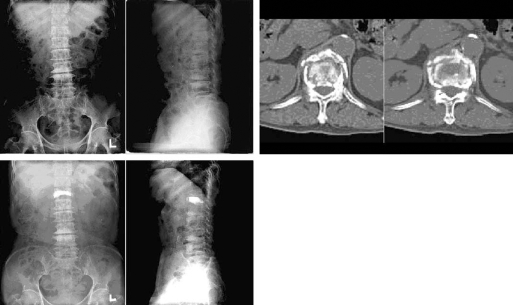
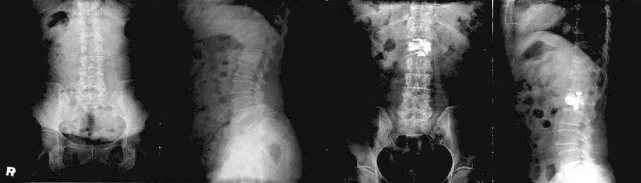
We performed KP as a treatment for osteoporotic burst fractures. We studied 12 patients/13 vertebrae. The two control groups consisted of patients who only underwent conservative treatment and those who underwent posterior instrumentation and fusion. We measured each preoperative/postoperative vertebral kyphotic deformity angle (KDA) using simple lateral spine images and checked for leakage of cement, as well. The preoperative/postoperative visual analog scale (VAS) scores for back pain, degree of daily activity, and postoperative complications were evaluated.
The mean improvement in KDA after KP was 9.7+/-2.2 degrees . The mean preoperative and postoperative VAS scores for back pain were 8.3+/-0.4 and 3.1+/-0.17, respectively. Regarding the control group, the mean postoperative VAS score for the conservative group and the posterior surgery group decreased by 4.5+/-0.17 and 3.2+/-0.19, respectively. There was no statistically significant difference between the KP and posterior surgery groups (p=0.125). However, there was a statistically significant difference between the KP and conservative treatment groups (p=0.012).
KP is safe and useful for treating osteoporotic burst fractures.
我们通过临床和放射学方法对经皮球囊椎体后凸成形术(KP)的结果进行了回顾性评估。
评估KP治疗骨质疏松性爆裂骨折的效果。
许多外科医生担心经皮椎体后凸成形术治疗骨质疏松性爆裂骨折后发生神经并发症的可能性,这是由于椎管内骨水泥渗漏所致。
我们采用KP治疗骨质疏松性爆裂骨折。我们研究了12例患者/13个椎体。两个对照组分别为仅接受保守治疗的患者和接受后路器械固定及融合术的患者。我们使用简单的脊柱侧位影像测量术前/术后每个椎体的后凸畸形角度(KDA),并检查骨水泥渗漏情况。评估术前/术后背痛的视觉模拟评分(VAS)、日常活动程度及术后并发症。
KP术后KDA的平均改善为9.7±2.2度。术前和术后背痛的VAS平均评分分别为8.3±0.4和3.1±0.17。对于对照组,保守治疗组和后路手术组术后VAS平均评分分别下降了4.5±0.17和3.2±0.19。KP组与后路手术组之间无统计学显著差异(p = 0.125)。然而,KP组与保守治疗组之间存在统计学显著差异(p = 0.012)。
KP治疗骨质疏松性爆裂骨折安全有效。