Weemhoff Mirjam, Shek Ka Lai, Dietz Hans P
Department of Obstetrics & Gynaecology, GROW, School for Oncology and Developmental Biology, Maastricht University Medical Centre, P.O. Box 5800, 6202 AZ, Maastricht, The Netherlands.
Int Urogynecol J. 2010 Sep;21(9):1137-42. doi: 10.1007/s00192-010-1150-0. Epub 2010 Apr 24.
Epidemiological data supports the hypothesis that ageing is a risk factor for pelvic organ prolapse. In this study, we intended to determine the effect of age on levator function and morphometry in women with pelvic floor disorders.
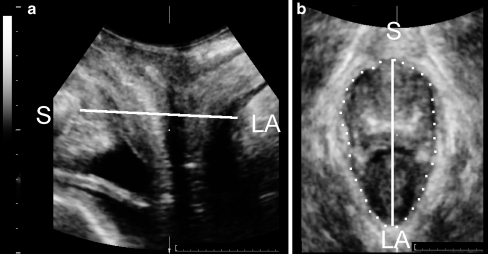
Three hundred seventy-five patients underwent an interview, physical examination and transperineal ultrasound. Clinical assessment included palpation using the Modified Oxford Scale. Ultrasonography was performed to diagnose levator defects and assess levator hiatal morphometry.
Pelvic floor muscle strength was weakly associated with patient age (r = -0.25, p < 0.01). This remained true after accounting for the confounders parity and levator defects. Morphometry of the levator hiatus was weakly positively correlated with age.
Ageing seems to have a limited effect on contractility and distensibility of the pelvic floor muscle. The small effect of ageing results in reduced contraction strength and increased hiatal diameters. This effect is partly confounded by parity and levator defects.
流行病学数据支持衰老为盆腔器官脱垂风险因素这一假设。在本研究中,我们旨在确定年龄对盆底功能障碍女性提肌功能和形态测量的影响。
375名患者接受了访谈、体格检查和经会阴超声检查。临床评估包括使用改良牛津量表进行触诊。进行超声检查以诊断提肌缺陷并评估提肌裂孔形态测量。
盆底肌肉力量与患者年龄呈弱相关(r = -0.25,p < 0.01)。在考虑混杂因素产次和提肌缺陷后,情况依然如此。提肌裂孔的形态测量与年龄呈弱正相关。
衰老似乎对盆底肌肉的收缩性和伸展性影响有限。衰老的微小影响导致收缩强度降低和裂孔直径增加。这种影响部分受到产次和提肌缺陷的混淆。