Huntsman Cancer Institute, University of Utah, Salt Lake City, Utah, USA.
Gastroenterology. 2010 Jun;138(6):2044-58. doi: 10.1053/j.gastro.2010.01.054.
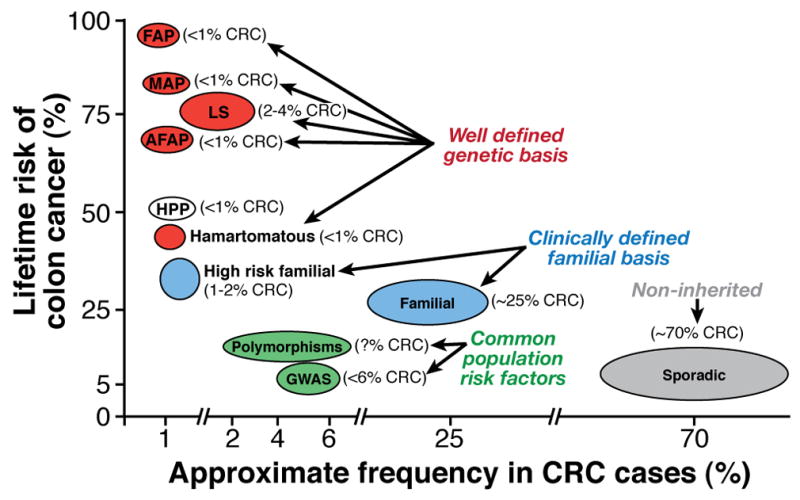
Between 2% to 5% of all colon cancers arise in the setting of well-defined inherited syndromes, including Lynch syndrome, familial adenomatous polyposis, MUTYH-associated polyposis, and certain hamartomatous polyposis conditions. Each is associated with a high risk of colon cancer. In addition to the syndromes, up to one-third of colon cancers exhibit increased familial risk, likely related to inheritance. A number of less penetrant, but possibly more frequent susceptibility genes have been identified for this level of inheritance. Clarification of predisposing genes allows for accurate risk assessment and more precise screening approaches. This review examines the colon cancer syndromes, their genetics and management, and also the common familial colon cancers with current genetic advances and screening guidelines.
所有结肠癌中有 2%至 5%发生在明确遗传性综合征的背景下,包括林奇综合征、家族性腺瘤性息肉病、MUTYH 相关息肉病和某些错构瘤性息肉病。每一种都与结肠癌的高风险相关。除了这些综合征,多达三分之一的结肠癌表现出家族性风险增加,可能与遗传有关。对于这种遗传水平,已经确定了一些外显率较低但可能更频繁的易感基因。易患基因的明确可以进行准确的风险评估和更精确的筛查方法。这篇综述检查了结肠癌综合征、它们的遗传学和管理,以及具有当前遗传进展和筛查指南的常见家族性结肠癌。