NUTRIM School for Nutrition, Toxicology and Metabolism, Department of Human Biology, Maastricht University Medical Centre, P.O. Box 616, NL6200 MD Maastricht, The Netherlands.
Diabetologia. 2010 Aug;53(8):1714-21. doi: 10.1007/s00125-010-1764-2. Epub 2010 Apr 27.
AIMS/HYPOTHESIS: We previously showed that type 2 diabetic patients are characterised by compromised intrinsic mitochondrial function. Here, we examined if exercise training could increase intrinsic mitochondrial function in diabetic patients compared with control individuals.
Fifteen male type 2 diabetic patients and 14 male control individuals matched for age, BMI and VO(2max) enrolled in a 12 week exercise intervention programme. Ex vivo mitochondrial function was assessed by high-resolution respirometry in permeabilised muscle fibres from vastus lateralis muscle. Before and after training, insulin-stimulated glucose disposal was examined during a hyperinsulinaemic-euglycaemic clamp.
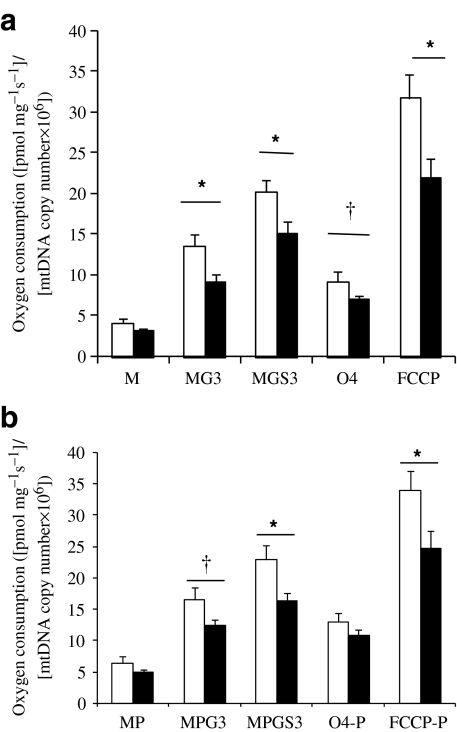
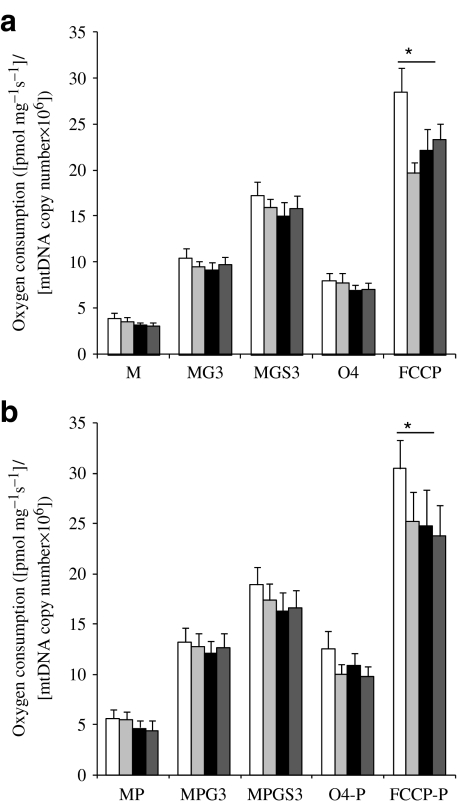
Diabetic patients had intrinsically lower ADP-stimulated state 3 respiration and lower carbonyl cyanide 4-(trifluoro-methoxy)phenylhydrazone (FCCP)-induced maximal oxidative respiration, both on glutamate and on glutamate and succinate, and in the presence of palmitoyl-carnitine (p < 0.05). After training, diabetic patients and control individuals showed increased state 3 respiration on the previously mentioned substrates (p < 0.05); however, an increase in FCCP-induced maximal oxidative respiration was observed only in diabetic patients (p < 0.05). The increase in mitochondrial respiration was accompanied by a 30% increase in mitochondrial content upon training (p < 0.01). After adjustment for mitochondrial density, state 3 and FCCP-induced maximal oxidative respiration were similar between groups after training. Improvements in mitochondrial respiration were paralleled by improvements in insulin-stimulated glucose disposal in diabetic patients, with a tendency for this in control individuals.
CONCLUSIONS/INTERPRETATION: We confirmed lower intrinsic mitochondrial function in diabetic patients compared with control individuals. Diabetic patients increased their mitochondrial content to the same extent as control individuals and had similar intrinsic mitochondrial function, which occurred parallel with improved insulin sensitivity.
目的/假设:我们之前的研究表明,2 型糖尿病患者的内在线粒体功能受损。在这里,我们研究了与对照组相比,运动训练是否可以增加糖尿病患者的内在线粒体功能。
15 名男性 2 型糖尿病患者和 14 名年龄、BMI 和 VO2max 匹配的男性对照组参加了为期 12 周的运动干预计划。通过在来自股外侧肌的通透化肌纤维中进行高分辨率呼吸测定,评估离体线粒体功能。在训练前后,通过高胰岛素-正常血糖钳夹试验检查胰岛素刺激的葡萄糖摄取情况。
糖尿病患者的 ADP 刺激状态 3 呼吸和羰基氰化物 4-(三氟甲氧基)苯腙(FCCP)诱导的最大氧化呼吸内在较低,这两种呼吸在谷氨酸和谷氨酸与琥珀酸存在的情况下都较低,并且在棕榈酰肉碱(p < 0.05)的存在下。经过训练,糖尿病患者和对照组的状态 3 呼吸在上述底物上都有所增加(p < 0.05);然而,只有糖尿病患者观察到 FCCP 诱导的最大氧化呼吸增加(p < 0.05)。线粒体呼吸的增加伴随着训练后线粒体含量增加 30%(p < 0.01)。在调整线粒体密度后,训练后两组的状态 3 和 FCCP 诱导的最大氧化呼吸相似。线粒体呼吸的改善与糖尿病患者胰岛素刺激的葡萄糖摄取改善平行,对照组也有这种趋势。
结论/解释:我们证实与对照组相比,糖尿病患者的内在线粒体功能较低。糖尿病患者增加了与对照组相同程度的线粒体含量,并且具有相似的内在线粒体功能,这与胰岛素敏感性的提高平行发生。