Stem Cell Project group, The Tokyo Metropolitan Institute of Medical Science, Tokyo Metropolitan Organization for Medical Research, Kamikitazawa, Setagaya-ku, Tokyo, Japan.
PLoS One. 2010 Apr 23;5(4):e10321. doi: 10.1371/journal.pone.0010321.
CXCL14 is a chemoattractant for macrophages and immature dendritic cells. We recently reported that CXCL14-deficient (CXCL14(-/-)) female mice in the mixed background are protected from obesity-induced hyperglycemia and insulin resistance. The decreased macrophage infiltration into visceral adipose tissues and the increased insulin sensitivity of skeletal muscle contributed to these phenotypes.
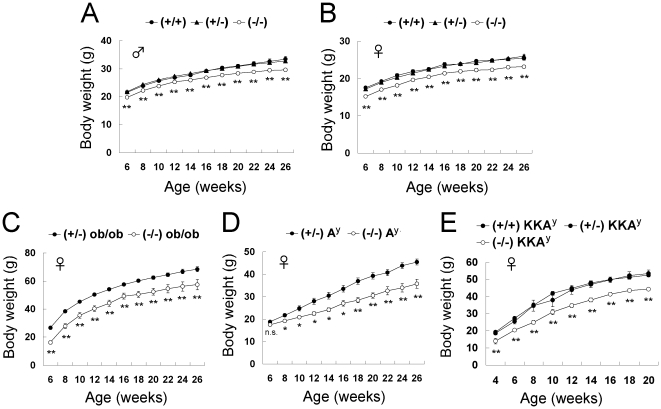
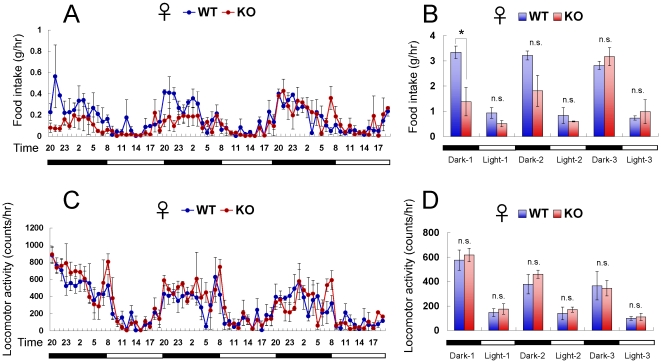
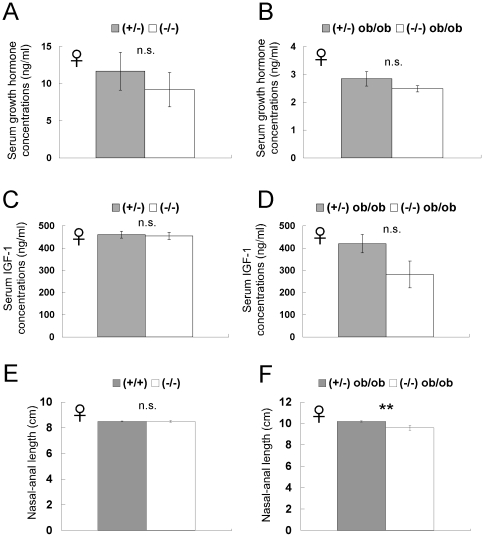
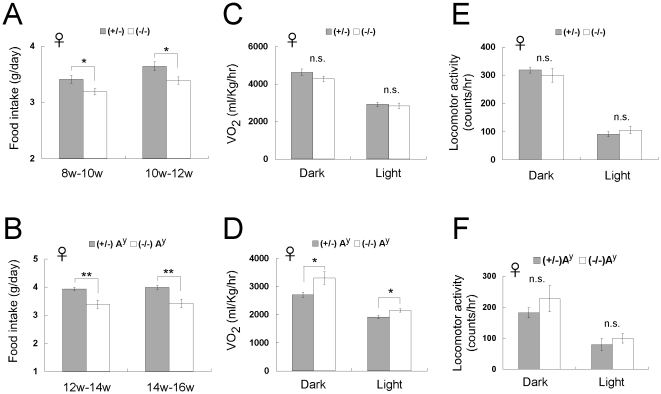
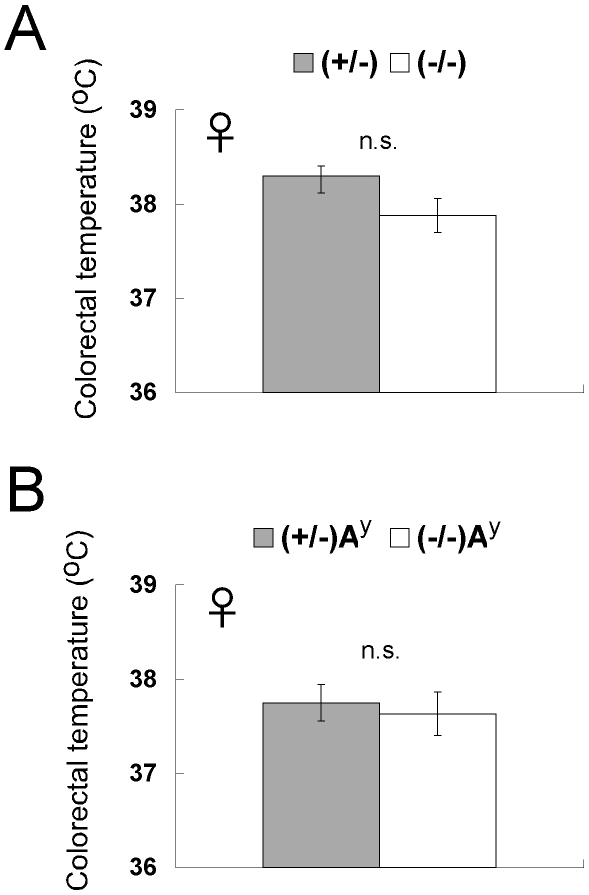
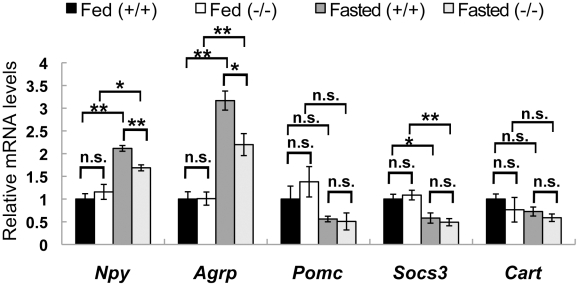
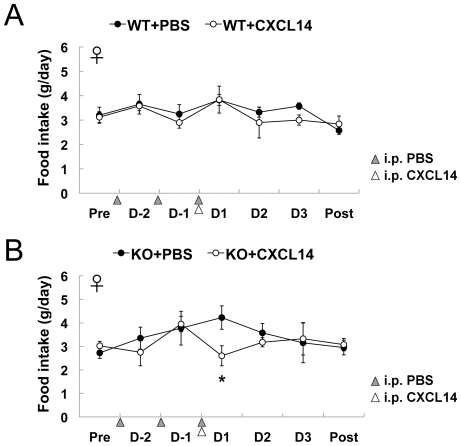
METHODOLOGY/PRINCIPAL FINDINGS: In this study, we performed a comprehensive study for the body weight control of CXCL14(-/-) mice in the C57BL/6 background. We show that both male and female CXCL14(-/-) mice have a 7-11% lower body weight compared to CXCL14(+/-) and CXCL14(+/+) mice in adulthood. This is mainly caused by decreased food intake, and not by increased energy expenditure or locomotor activity. Reduced body weight resulting from the CXCL14 deficiency was more pronounced in double mutant CXCL14(-/-)ob/ob and CXCL14(-/-)A(y) mice. In the case of CXCL14(-/-)A(y) mice, oxygen consumption was increased compared to CXCL14(+/-)A(y) mice, in addition to the reduced food intake. In CXCL14(-/-) mice, fasting-induced up-regulation of Npy and Agrp mRNAs in the hypothalamus was blunted. As intracerebroventricular injection of recombinant CXCL14 did not change the food intake of CXCL14(-/-) mice, CXCL14 could indirectly regulate appetite. Intriguingly, the food intake of CXCL14(-/-) mice was significantly repressed when mice were transferred to a novel environment.
CONCLUSIONS/SIGNIFICANCE: We demonstrated that CXCL14 is involved in the body weight control leading to the fully obese phenotype in leptin-deficient or A(y) mutant mice. In addition, we obtained evidence indicating that CXCL14 may play an important role in central nervous system regulation of feeding behavior.
CXCL14 是巨噬细胞和未成熟树突状细胞的趋化因子。我们最近报道称,在混合背景下,CXCL14 缺陷(CXCL14(-/-))雌性小鼠免受肥胖引起的高血糖和胰岛素抵抗的影响。内脏脂肪组织中巨噬细胞浸润减少和骨骼肌胰岛素敏感性增加促成了这些表型。
方法/主要发现:在这项研究中,我们对 C57BL/6 背景下 CXCL14(-/-) 小鼠的体重控制进行了全面研究。我们发现,成年雄性和雌性 CXCL14(-/-) 小鼠的体重比 CXCL14(+/-) 和 CXCL14(+/+) 小鼠低 7-11%。这主要是由于食物摄入量减少,而不是能量消耗或运动活性增加所致。CXCL14 缺失导致的体重减轻在双重突变体 CXCL14(-/-)ob/ob 和 CXCL14(-/-)A(y) 小鼠中更为明显。在 CXCL14(-/-)A(y) 小鼠中,除了食物摄入量减少外,与 CXCL14(+/-)A(y) 小鼠相比,耗氧量增加。在 CXCL14(-/-) 小鼠中,禁食诱导的下丘脑 Npy 和 Agrp mRNA 的上调被削弱。由于重组 CXCL14 脑室内注射没有改变 CXCL14(-/-) 小鼠的摄食量,因此 CXCL14 可能间接调节食欲。有趣的是,当将 CXCL14(-/-) 小鼠转移到新环境中时,其摄食量明显受到抑制。
结论/意义:我们证明了 CXCL14 参与了体重控制,导致了瘦素缺乏或 A(y) 突变小鼠的完全肥胖表型。此外,我们获得的证据表明,CXCL14 可能在中枢神经系统调节摄食行为中发挥重要作用。