Institute of Ecology, University of Jena, Jena, Germany.
Oecologia. 2010 Jul;163(3):707-17. doi: 10.1007/s00442-010-1625-1. Epub 2010 Apr 29.
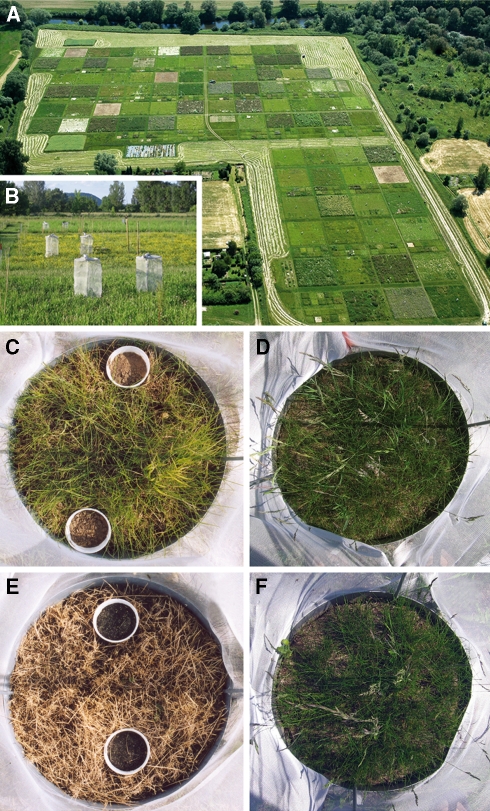
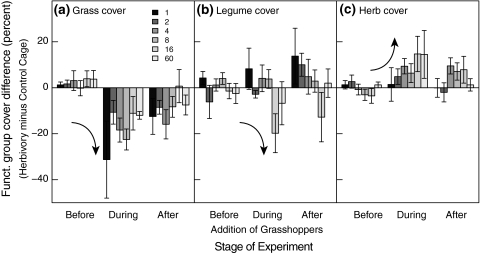
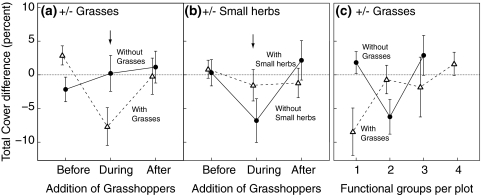
The resistance of a plant community against herbivore attack may depend on plant species richness, with monocultures often much more severely affected than mixtures of plant species. Here, we used a plant-herbivore system to study the effects of selective herbivory on consumption resistance and recovery after herbivory in 81 experimental grassland plots. Communities were established from seed in 2002 and contained 1, 2, 4, 8, 16 or 60 plant species of 1, 2, 3 or 4 functional groups. In 2004, pairs of enclosure cages (1 m tall, 0.5 m diameter) were set up on all 81 plots. One randomly selected cage of each pair was stocked with 10 male and 10 female nymphs of the meadow grasshopper, Chorthippus parallelus. The grasshoppers fed for 2 months, and the vegetation was monitored over 1 year. Consumption resistance and recovery of vegetation were calculated as proportional changes in vegetation biomass. Overall, grasshopper herbivory averaged 6.8%. Herbivory resistance and recovery were influenced by plant functional group identity, but independent of plant species richness and number of functional groups. However, herbivory induced shifts in vegetation composition that depended on plant species richness. Grasshopper herbivory led to increases in herb cover at the expense of grasses. Herb cover increased more strongly in species-rich mixtures. We conclude that selective herbivory changes the functional composition of plant communities and that compositional changes due to selective herbivory depend on plant species richness.
植物群落对草食动物攻击的抵抗力可能取决于植物物种丰富度,与物种丰富的混合群落相比,单一种群常常受到更为严重的影响。在这里,我们使用植物-草食动物系统来研究选择性草食作用对 81 个实验草地样方中消费抗性和草食后恢复的影响。群落于 2002 年用种子建立,包含 1、2、4、8、16 或 60 种植物,分为 1、2、3 或 4 个功能组。2004 年,在所有 81 个样方上设置了一对封闭笼(1 米高,0.5 米直径)。每对中的一个随机选择的笼子中放养了 10 只雄性和 10 只雌性草地蝗的若虫,Chorthippus parallelus。这些蝗虫取食了 2 个月,对植被进行了 1 年的监测。消费抗性和植被恢复被计算为植被生物量的比例变化。总体而言,蝗虫的取食平均为 6.8%。取食抗性和恢复受植物功能组身份的影响,但与植物物种丰富度和功能组数量无关。然而,取食诱导的植被组成变化取决于植物物种丰富度。蝗虫取食导致草本植物盖度增加,而草的盖度减少。在物种丰富的混合群落中,草本植物盖度增加更为强烈。我们的结论是,选择性草食作用改变了植物群落的功能组成,而由于选择性草食作用引起的组成变化取决于植物物种丰富度。