Medical Research Council (MRC), Laboratory of Molecular Biology, Hills Road, Cambridge CB2 0QH, UK.
J Biol Chem. 2010 Jun 25;285(26):19927-34. doi: 10.1074/jbc.M110.126581. Epub 2010 Apr 29.
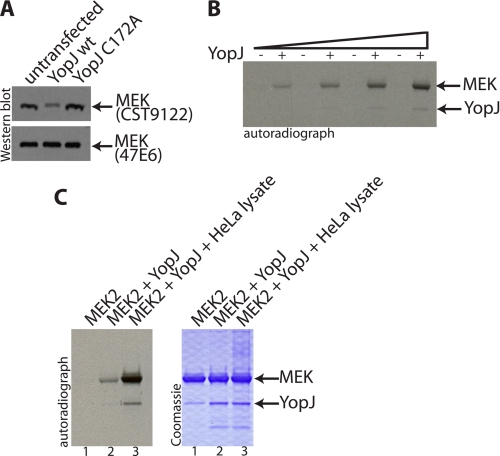
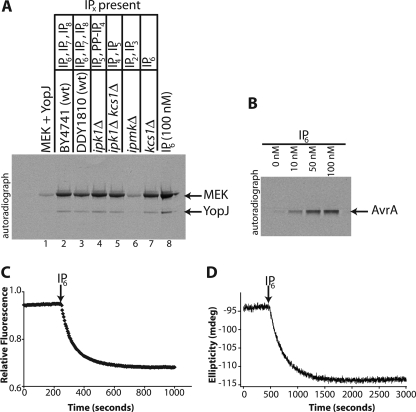
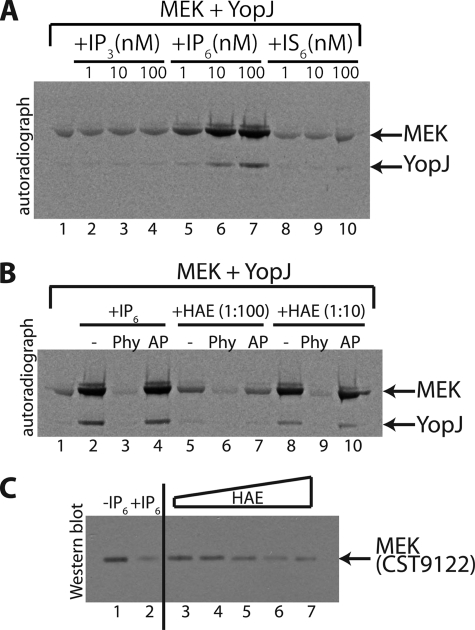
Plague, one of the most devastating diseases in human history, is caused by the bacterium Yersinia pestis. The bacteria use a syringe-like macromolecular assembly to secrete various toxins directly into the host cells they infect. One such Yersinia outer protein, YopJ, performs the task of dampening innate immune responses in the host by simultaneously inhibiting the MAPK and NFkappaB signaling pathways. YopJ catalyzes the transfer of acetyl groups to serine, threonine, and lysine residues on target proteins. Acetylation of serine and threonine residues prevents them from being phosphorylated thereby preventing the activation of signaling molecules on which they are located. In this study, we describe the requirement of a host-cell factor for full activation of the acetyltransferase activity of YopJ and identify this activating factor to be inositol hexakisphosphate (IP(6)). We extend the applicability of our results to show that IP(6) also stimulates the acetyltransferase activity of AvrA, the YopJ homologue from Salmonella typhimurium. Furthermore, an IP(6)-induced conformational change in AvrA suggests that IP(6) acts as an allosteric activator of enzyme activity. Our results suggest that YopJ-family enzymes are quiescent in the bacterium where they are synthesized, because bacteria lack IP(6); once injected into mammalian cells by the pathogen these toxins bind host cell IP(6), are activated, and deregulate the MAPK and NFkappaB signaling pathways thereby subverting innate immunity.
鼠疫是人类历史上最具破坏性的疾病之一,由鼠疫耶尔森菌引起。细菌使用类似注射器的大分子组装体将各种毒素直接分泌到感染的宿主细胞中。这种耶尔森氏菌外蛋白之一,YopJ,通过同时抑制 MAPK 和 NFkappaB 信号通路来抑制宿主固有免疫反应。YopJ 催化乙酰基转移到靶蛋白的丝氨酸、苏氨酸和赖氨酸残基上。丝氨酸和苏氨酸残基的乙酰化阻止它们被磷酸化,从而阻止它们所在的信号分子的激活。在这项研究中,我们描述了宿主细胞因子对 YopJ 乙酰转移酶活性的完全激活的要求,并将这种激活因子鉴定为肌醇六磷酸 (IP(6))。我们将研究结果的适用性扩展到表明 IP(6) 也刺激沙门氏菌 YopJ 同源物 AvrA 的乙酰转移酶活性。此外,AvrA 的 IP(6) 诱导的构象变化表明 IP(6) 作为酶活性的别构激活剂。我们的研究结果表明,YopJ 家族酶在细菌中处于静止状态,因为细菌缺乏 IP(6);一旦病原体将这些毒素注射到哺乳动物细胞中,它们就会与宿主细胞的 IP(6)结合,被激活,并使 MAPK 和 NFkappaB 信号通路失活,从而颠覆固有免疫。