Patel Deepak T, Stogios Peter J, Jaroszewski Lukasz, Urbanus Malene L, Sedova Mayya, Semper Cameron, Le Cathy, Takkouche Abraham, Ichii Keita, Innabi Julie, Patel Dhruvin H, Ensminger Alexander W, Godzik Adam, Savchenko Alexei
Department of Microbiology, Immunology and Infectious Diseases, University of Calgary, Calgary, AB, T2N 4N1, Canada.
BioZone, Department of Chemical Engineering and Applied Chemistry, University of Toronto, Toronto, ON, M5S 1A4, Canada.
Mol Syst Biol. 2025 Jan;21(1):59-89. doi: 10.1038/s44320-024-00076-z. Epub 2024 Nov 19.
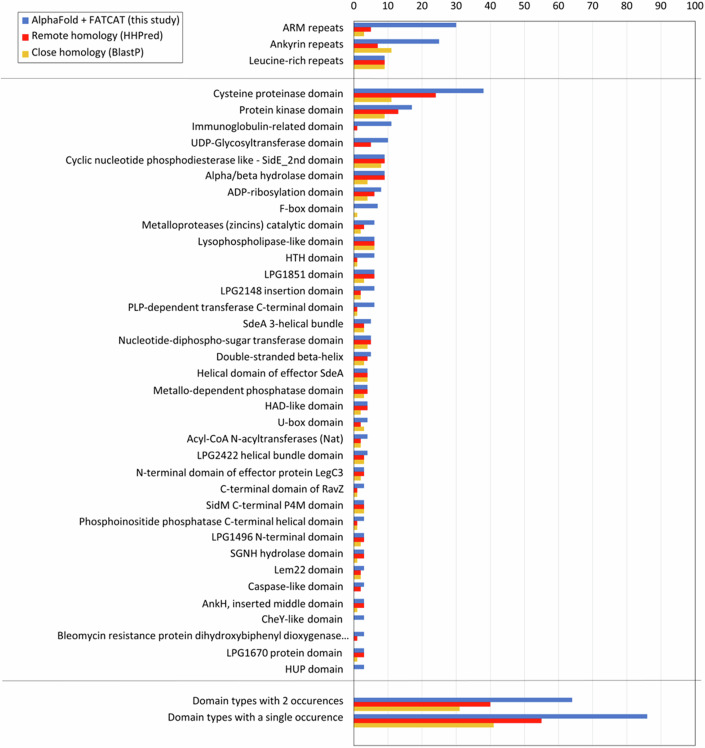
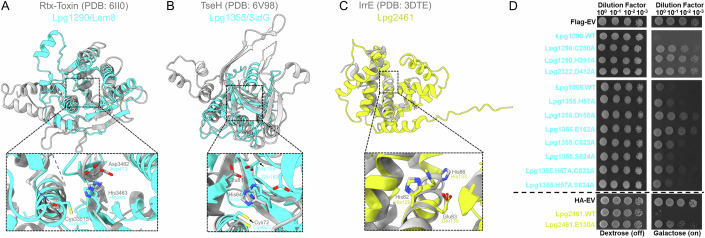
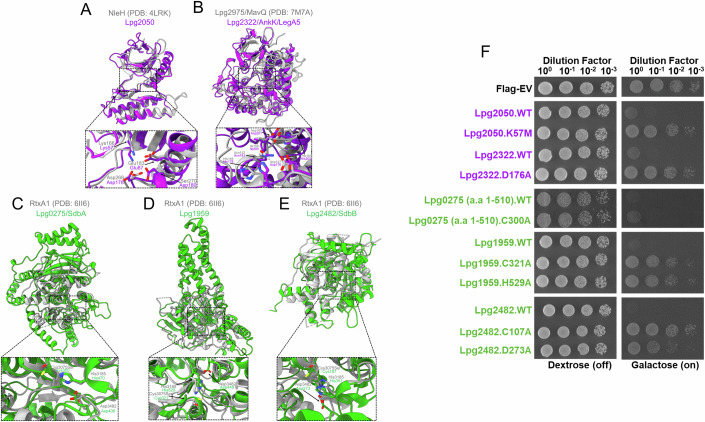
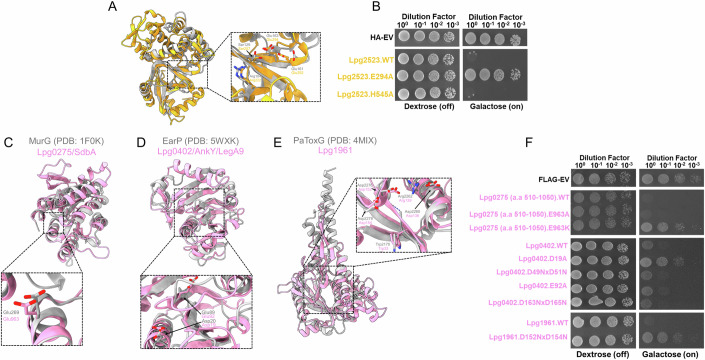
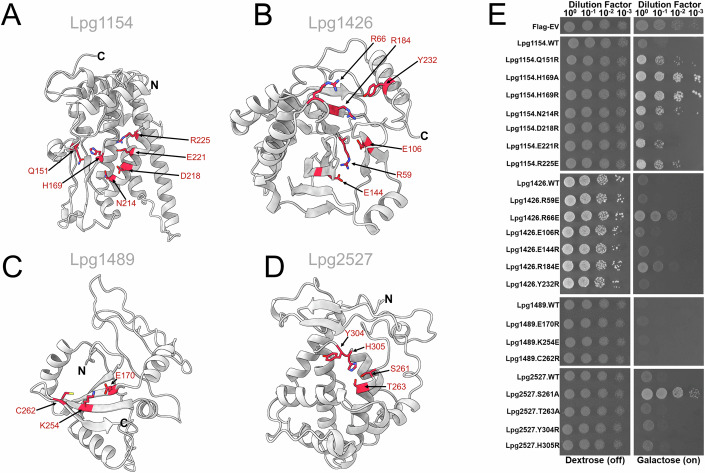
Legionella pneumophila utilizes the Dot/Icm type IVB secretion system to deliver hundreds of effector proteins inside eukaryotic cells to ensure intracellular replication. Our understanding of the molecular functions of the largest pathogenic arsenal known to the bacterial world remains incomplete. By leveraging advancements in 3D protein structure prediction, we provide a comprehensive structural analysis of 368 L. pneumophila effectors, representing a global atlas of predicted functional domains summarized in a database ( https://pathogens3d.org/legionella-pneumophila ). Our analysis identified 157 types of diverse functional domains in 287 effectors, including 159 effectors with no prior functional annotations. Furthermore, we identified 35 cryptic domains in 30 effector models that have no similarity with experimentally structurally characterized proteins, thus, hinting at novel functionalities. Using this analysis, we demonstrate the activity of thirteen functional domains, including three cryptic domains, predicted in L. pneumophila effectors to cause growth defects in the Saccharomyces cerevisiae model system. This illustrates an emerging strategy of exploring synergies between predictions and targeted experimental approaches in elucidating novel effector activities involved in infection.
嗜肺军团菌利用Dot/Icm IVB型分泌系统将数百种效应蛋白输送到真核细胞内,以确保其在细胞内复制。我们对细菌界已知的最大致病武器库的分子功能的了解仍然不完整。通过利用三维蛋白质结构预测技术的进步,我们对368种嗜肺军团菌效应蛋白进行了全面的结构分析,形成了一个预测功能域的全球图谱,并汇总在一个数据库(https://pathogens3d.org/legionella-pneumophila)中。我们的分析在287种效应蛋白中鉴定出157种不同的功能域,其中包括159种以前没有功能注释的效应蛋白。此外,我们在30个效应蛋白模型中鉴定出35个隐秘结构域,它们与实验确定结构的蛋白质没有相似性,因此暗示了新的功能。通过这项分析,我们展示了在嗜肺军团菌效应蛋白中预测的13个功能域的活性,包括3个隐秘结构域,这些功能域会在酿酒酵母模型系统中导致生长缺陷。这说明了一种新兴策略,即在阐明感染中涉及的新效应蛋白活性时,探索预测和靶向实验方法之间的协同作用。