Agarwal Ankit, Singh Dinesh K, Singh Anil P
Department of Anaesthesiology and Intensive Care, BHU, Varanasi, India.
Indian J Crit Care Med. 2009 Oct;13(4):213-6. doi: 10.4103/0972-5229.60174.
Portable ultrasound machines are highly valuable in ICUs, where a patient's condition might not permit shifting the patient to the USG department for imaging. Traditionally central lines are put blindly using anatomical landmarks, which often result in complications such as difficulty in access, misplaced lines, pneumothorax, bleeding from inadvertent arterial punctures, etc. Ultrasonography provides "real time" imaging, i.e., the needle can be visualized entering the vein.
We performed a study to compare USG guided central venous cannulation (CVC) and conventional anatomical landmark approach to CVC, in terms of ease of cannulation, time consumed, and associated complications.
The study was performed in a 16-bed open ICU. Eighty patients were randomly divided in two groups.
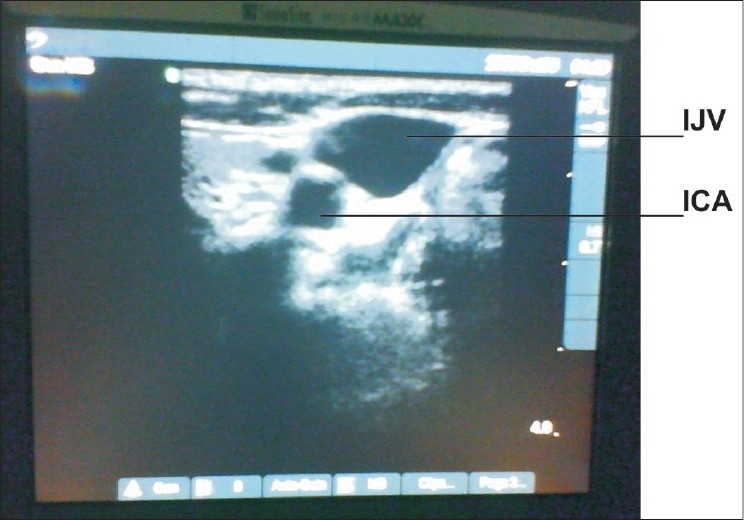
The right internal jugular vein (IJV) was cannulated in all. In Group I, a portable ultrasound machine was used during cannulation. The vessels were visualized in the transverse section with the internal carotid artery (ICA) identified as a circular pulsatile structure, while the IJV as a lateral, oval nonpulsatile structure). The needle was inserted perpendicular to the skin under visualization on the US screen. Central venous line was then inserted by the Seldinger technique. In Group II, CVC was performed by the conventional landmark approach. The parameters studied included time for insertion, attempts required, and complications encountered.
The database of all parameters was analyzed using SPSS software version 10.5.
The mean time to successful insertion was 145 and 176.4 sec in groups I and II, respectively (p = 0.00). An average of 1.2 attempts per cannulation was required for group I, while 1.53 for group II (p = 0.03): 10% witnessed arterial puncture and 2.5% pneumothorax in group I and none in group II.
USG-guided CVC is thus easier, quicker, and safer than landmark approach.
便携式超声机在重症监护病房(ICU)中具有很高的价值,因为患者的病情可能不允许将其转移到超声检查科室进行成像。传统上,中心静脉置管是盲目利用解剖标志进行的,这常常导致诸如穿刺困难、置管位置不当、气胸、意外动脉穿刺出血等并发症。超声检查可提供“实时”成像,即可以看到针头进入静脉。
我们进行了一项研究,比较超声引导下中心静脉置管(CVC)和传统解剖标志法进行CVC在置管的难易程度、耗时及相关并发症方面的差异。
该研究在一个拥有16张床位的开放式ICU中进行。80名患者被随机分为两组。
所有患者均进行右颈内静脉置管。在第一组中,置管过程中使用便携式超声机。在横断面上观察血管,将颈内动脉(ICA)识别为圆形搏动结构,而颈内静脉为外侧椭圆形无搏动结构。在超声屏幕可视下将针头垂直于皮肤插入。然后采用Seldinger技术插入中心静脉导管。在第二组中,采用传统的解剖标志法进行CVC。研究的参数包括插入时间、所需尝试次数和遇到的并发症。
使用SPSS 10.5软件对所有参数的数据库进行分析。
第一组和第二组成功插入的平均时间分别为145秒和176.4秒(p = 0.00)。第一组每次置管平均需要1.2次尝试,而第二组为1.53次(p = 0.03):第一组有10%发生动脉穿刺,2.5%发生气胸,第二组均未发生。
因此,超声引导下的CVC比解剖标志法更容易、更快且更安全。