Takashima Mari, Ray-Barruel Gillian, Ullman Amanda, Keogh Samantha, Rickard Claire M
Alliance for Vascular Access Teaching and Research (AVATAR) group, Menzies Health Institute Queensland, Griffith University, Nathan, Queensland, Australia.
School of Nursing & Institute of Health and Biomedical Innovation (IHBI), Queensland University of Technology, Brisbane, Australia.
PLoS One. 2017 Mar 21;12(3):e0174164. doi: 10.1371/journal.pone.0174164. eCollection 2017.
Randomized controlled trials evaluate the effectiveness of interventions for central venous access devices, however, high complication rates remain. Scoping reviews map the available evidence and demonstrate evidence deficiencies to focus ongoing research priorities.
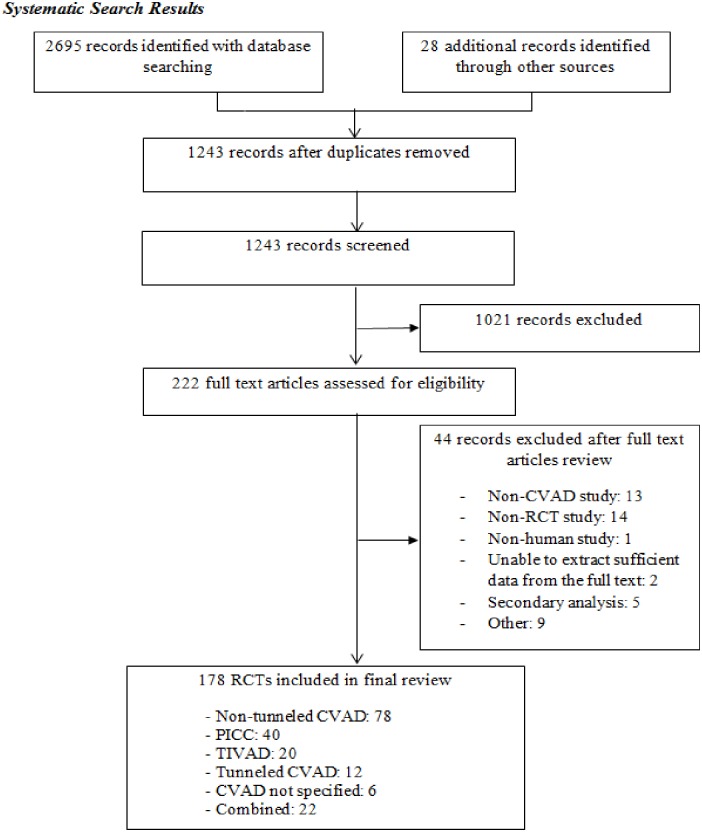
A scoping review (January 2006-December 2015) of randomized controlled trials evaluating the effectiveness of interventions to improve central venous access device outcomes; including peripherally inserted central catheters, non-tunneled, tunneled and totally implanted venous access catheters. MeSH terms were used to undertake a systematic search with data extracted by two independent researchers, using a standardized data extraction form.
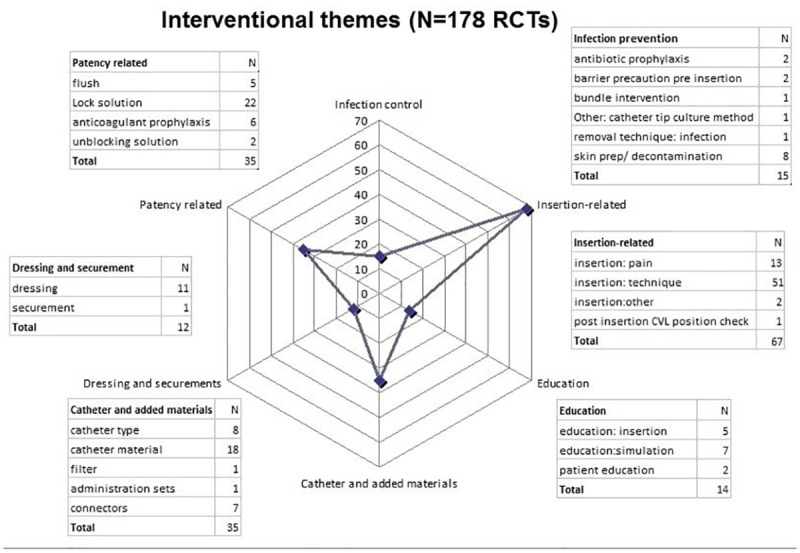
In total, 178 trials were included (78 non-tunneled [44%]; 40 peripherally inserted central catheters [22%]; 20 totally implanted [11%]; 12 tunneled [6%]; 6 non-specified [3%]; and 22 combined device trials [12%]). There were 119 trials (68%) involving adult participants only, with 18 (9%) pediatric and 20 (11%) neonatal trials. Insertion-related themes existed in 38% of trials (67 RCTs), 35 RCTs (20%) related to post-insertion patency, with fewer trials on infection prevention (15 RCTs, 8%), education (14RCTs, 8%), and dressing and securement (12 RCTs, 7%). There were 46 different study outcomes reported, with the most common being infection outcomes (161 outcomes; 37%), with divergent definitions used for catheter-related bloodstream and other infections.
More high quality randomized trials across central venous access device management are necessary, especially in dressing and securement and patency. These can be encouraged by having more studies with multidisciplinary team involvement and consumer engagement. Additionally, there were extensive gaps within population sub-groups, particularly in tunneled devices, and in pediatrics and neonates. Finally, outcome definitions need to be unified for results to be meaningful and comparable across studies.
随机对照试验评估了中心静脉通路装置干预措施的有效性,然而,并发症发生率仍然很高。范围综述梳理现有证据,并揭示证据不足,以确定当前的研究重点。
对2006年1月至2015年12月期间评估改善中心静脉通路装置结局的干预措施有效性的随机对照试验进行范围综述;包括外周静脉穿刺中心静脉导管、非隧道式、隧道式和完全植入式静脉通路导管。使用医学主题词进行系统检索,由两名独立研究人员使用标准化数据提取表提取数据。
共纳入178项试验(78项非隧道式[44%];40项外周静脉穿刺中心静脉导管[22%];20项完全植入式[11%];12项隧道式[6%];未明确类型的6项[3%];22项联合装置试验[12%])。119项试验(68%)仅涉及成年参与者,18项(9%)为儿科试验,20项(11%)为新生儿试验。38%的试验(67项随机对照试验)存在与插入相关的主题,35项随机对照试验(20%)与插入后通畅性相关,而预防感染(15项随机对照试验,8%)、教育(14项随机对照试验,8%)以及敷料和固定(12项随机对照试验,7%)方面试验较少。共报告了46种不同的研究结局,最常见的是感染结局(161种结局;37%),对于导管相关血流感染和其他感染采用了不同的定义。
需要更多关于中心静脉通路装置管理的高质量随机试验,尤其是在敷料和固定以及通畅性方面。多学科团队参与和消费者参与的更多研究可对此起到促进作用。此外,人群亚组之间存在广泛差距,特别是在隧道式装置以及儿科和新生儿方面。最后,为使研究结果有意义且具有可比性,结局定义需要统一。