Cha Stem Cell Institute, CHA University, School of Medicine, Seoul, Korea.
J Korean Med Sci. 2010 May;25(5):663-70. doi: 10.3346/jkms.2010.25.5.663. Epub 2010 Apr 21.
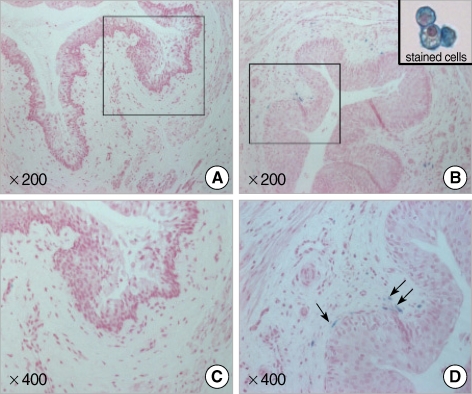
To evaluate the effectiveness of the human umbilical cord blood (HUCB) transplantation for the treatment of intrinsic sphincter deficiency (ISD), we analyzed the short term effects of HUCB mononuclear cell transplantation in rats with induced-ISD. ISD was induced in rats by electro-cauterization of periurethral soft tissue with HUCB mononuclear cell injection after 1 week. The sphincter function measured by mean leak point pressure was significantly improved in the experimental group compared to the control group at 4 weeks. (91.75+/-18.99 mmHg vs. 65.02+/-22.09 mmHg, P=0.001). Histologically, the sphincter muscle was restored without damage while in the control group it appeared markedly disrupted with atrophic muscle layers and collagen deposit. We identified injected HUCB cells in the tissue sections by Di-I signal and Prussian blue staining. HUCB mononuclear cell injection significantly improved urethral sphincter function, suggesting its potential efficacy in the treatment of ISD.
为了评估人脐血(HUCB)移植治疗内在括约肌缺陷(ISD)的效果,我们分析了 HUCB 单核细胞移植治疗诱导性 ISD 大鼠的短期效果。通过电灼尿道周围软组织,1 周后向大鼠注射 HUCB 单核细胞,诱导 ISD。实验组的平均漏点压测量的括约肌功能在 4 周时明显优于对照组(91.75+/-18.99mmHg 比 65.02+/-22.09mmHg,P=0.001)。组织学上,括约肌肌肉得到了修复,没有损伤,而对照组的肌肉层明显受损,出现萎缩,并有胶原沉积。我们通过 Di-I 信号和普鲁士蓝染色在组织切片中鉴定了注射的 HUCB 细胞。HUCB 单核细胞注射显著改善了尿道括约肌功能,提示其在治疗 ISD 方面具有潜在疗效。