Department of Neurology, Howard Hughes Medical Institute, Beth Israel Deaconess Medical Center, Harvard Medical School, Boston, MA 02115, USA.
Ann Neurol. 2010 Apr;67(4):516-25. doi: 10.1002/ana.21923.
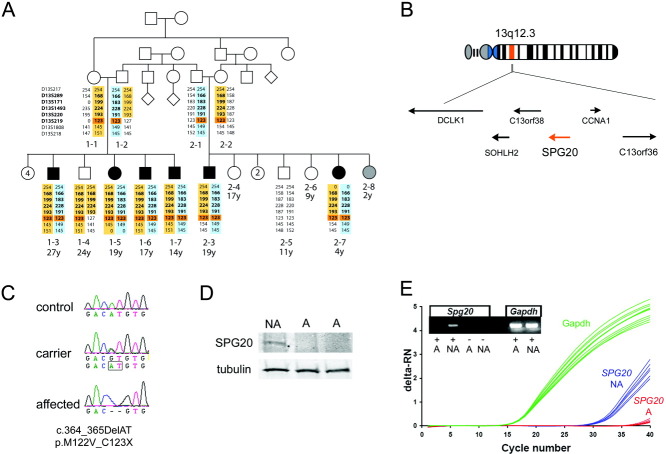
We sought to explore the genetic and molecular causes of Troyer syndrome, one of several complicated hereditary spastic paraplegias (HSPs). Troyer syndrome had been thought to be restricted to the Amish; however, we identified 2 Omani families with HSP, short stature, dysarthria and developmental delay-core features of Troyer syndrome-and a novel mutation in the SPG20 gene, which is also mutated in the Amish. In addition, we analyzed SPG20 expression throughout development to infer how disruption of this gene might generate the constellation of developmental and degenerative Troyer syndrome phenotypes.
Clinical characterization of 2 non-Amish families with Troyer syndrome was followed by linkage and sequencing analysis. Quantitative polymerase chain reaction and in situ hybridization analysis of SPG20 expression were carried out in embryonic and adult human and mouse tissue.
Two Omani families carrying a novel SPG20 mutation displayed clinical features remarkably similar to the Amish patients with Troyer syndrome. SPG20 mRNA is expressed broadly but at low relative levels in the adult brain; however, it is robustly and specifically expressed in the limbs, face, and brain during early morphogenesis.
Null mutations in SPG20 cause Troyer syndrome, a specific clinical entity with developmental and degenerative features. Maximal expression of SPG20 in the limb buds and forebrain during embryogenesis may explain the developmental origin of the skeletal and cognitive defects observed in this disorder.
我们试图探索 Troyer 综合征的遗传和分子病因,Troyer 综合征是几种复杂遗传性痉挛性截瘫(HSP)之一。Troyer 综合征曾被认为仅限于阿米什人;然而,我们在 2 个阿曼家庭中发现了 HSP、身材矮小、构音障碍和发育迟缓——这些都是 Troyer 综合征的核心特征——以及 SPG20 基因的一个新突变,该突变也存在于阿米什人中。此外,我们分析了 SPG20 在整个发育过程中的表达情况,以推断该基因的破坏如何产生发育和退行性 Troyer 综合征表型的组合。
对 2 个非阿米什 Troyer 综合征家系进行临床特征分析,然后进行连锁和测序分析。对胚胎和成人人类及小鼠组织中的 SPG20 表达进行定量聚合酶链反应和原位杂交分析。
携带新 SPG20 突变的 2 个阿曼家系表现出与阿米什 Troyer 综合征患者非常相似的临床特征。SPG20 mRNA 在成人脑中广泛表达,但相对水平较低;然而,在早期形态发生过程中,它在四肢、面部和大脑中强烈且特异性表达。
SPG20 中的无义突变导致 Troyer 综合征,这是一种具有发育和退行性特征的特定临床实体。SPG20 在胚胎期肢体芽和前脑中的最大表达可能解释了该疾病中观察到的骨骼和认知缺陷的发育起源。