Department of Rheumatology, Diakonhjemmet Hospital, P,O, Box 23 Vinderen, 0319 Oslo, Norway.
Arthritis Res Ther. 2010;12(3):R76. doi: 10.1186/ar2995. Epub 2010 May 5.
We wanted to assess the importance of the levels of anti-citrullinated peptide antibody (anti-CCP) and immunoglobulin M (IgM) rheumatoid factor (RF) in predicting development of persistent arthritis from undifferentiated arthritis (UA), and to investigate whether there is an added predictive value for persistent arthritis in testing for both anti-CCP and IgM RF.
Patients with UA (exclusion of definite non-rheumatoid arthritis (RA) diagnoses) included in the Norwegian very early arthritis clinic were assessed for development of persistent arthritic disease. The effect of antibody level on the likelihood of persistent arthritis was investigated, and the sensitivity and specificity for persistent arthritis for anti-CCP and IgM RF, separately and combined, was determined.
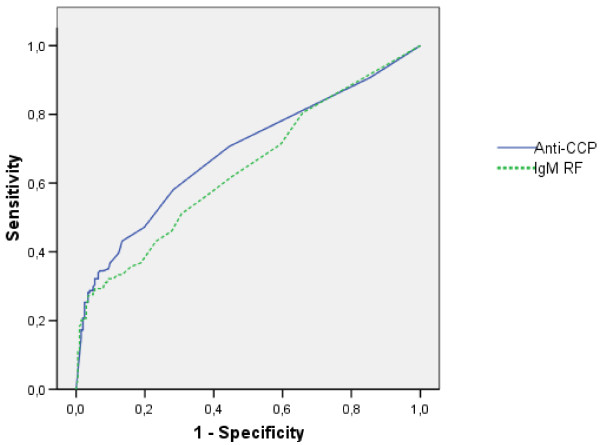
A total of 376 UA patients were included (median arthritis duration 32 days). 59 (15.7%) patients were IgM RF positive, and 62 (16.5%) anti-CCP positive. One hundred, seventy-four (46.3%) had persistent disease after one year. Overlap of anti-CCP and IgM RF positivity was 58%. Sensitivity/specificity for persistent arthritis was 28/95% for IgM RF alone, 30/95% for anti-CCP alone, and 37/92% for positivity of both anti-CCP and IgM RF. The likelihood for persistent disease increased with increasing levels of both anti-CCP and IgM RF.
The likelihood of developing persistent arthritis in UA patients increases with the level of anti-CCP and IgM RF. Testing both anti-CCP and IgM RF has added predictive value in UA patients. This study suggests that antibody level should be taken into account when making risk assessments in patients with UA.
我们旨在评估抗瓜氨酸肽抗体(抗-CCP)和免疫球蛋白 M(IgM)类风湿因子(RF)水平在预测未分化关节炎(UA)发展为持续性关节炎中的重要性,并探讨同时检测抗-CCP 和 IgM RF 对持续性关节炎是否具有额外的预测价值。
在挪威早期关节炎诊所中,评估了患有 UA(排除明确的非类风湿关节炎(RA)诊断)的患者发展为持续性关节炎的情况。研究了抗体水平对持续性关节炎发生可能性的影响,并确定了抗-CCP 和 IgM RF 单独和联合用于持续性关节炎的敏感性和特异性。
共纳入 376 例 UA 患者(关节炎持续时间中位数为 32 天)。59 例(15.7%)患者 IgM RF 阳性,62 例(16.5%)抗-CCP 阳性。174 例(46.3%)患者在一年后患有持续性疾病。抗-CCP 和 IgM RF 阳性的重叠率为 58%。IgM RF 单独用于持续性关节炎的敏感性/特异性为 28/95%,抗-CCP 单独为 30/95%,抗-CCP 和 IgM RF 均阳性为 37/92%。随着抗-CCP 和 IgM RF 水平的升高,持续性疾病的可能性增加。
UA 患者发展为持续性关节炎的可能性随着抗-CCP 和 IgM RF 水平的升高而增加。在 UA 患者中同时检测抗-CCP 和 IgM RF 具有额外的预测价值。本研究表明,在对 UA 患者进行风险评估时,应考虑抗体水平。