The Scripps Research Institute and Scripps Translational Science Institute, 3344 N Torrey Pines Court Ste, 300, La Jolla, CA 92037, USA.
BMC Med Genomics. 2010 May 6;3:16. doi: 10.1186/1755-8794-3-16.
MUC1 protein is highly expressed in lung cancer. The cytoplasmic domain of MUC1 (MUC1-CD) induces tumorigenesis and resistance to DNA-damaging agents. We characterized MUC1-CD-induced transcriptional changes and examined their significance in lung cancer patients.
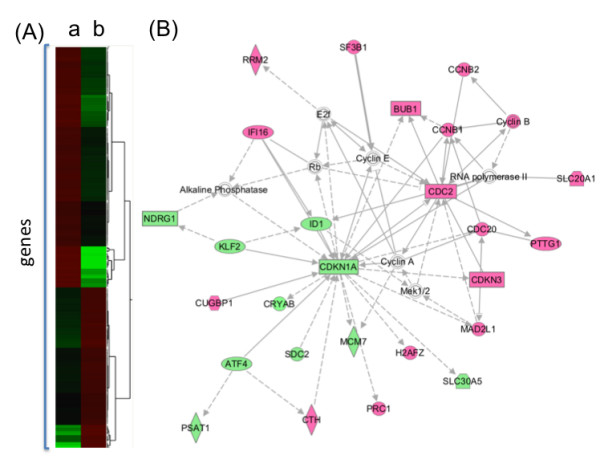
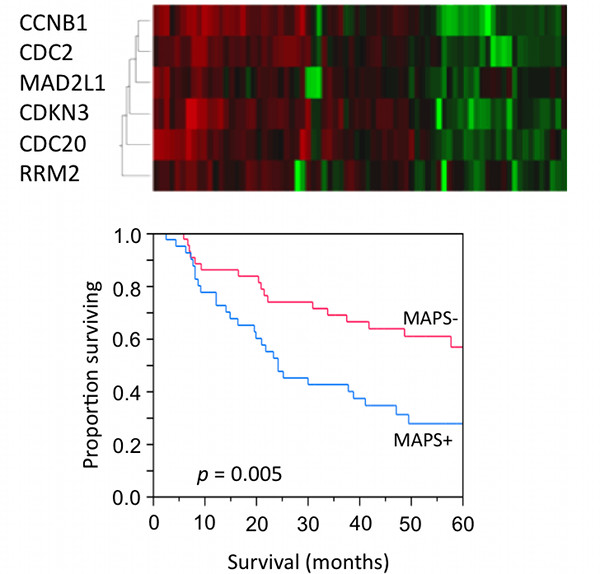
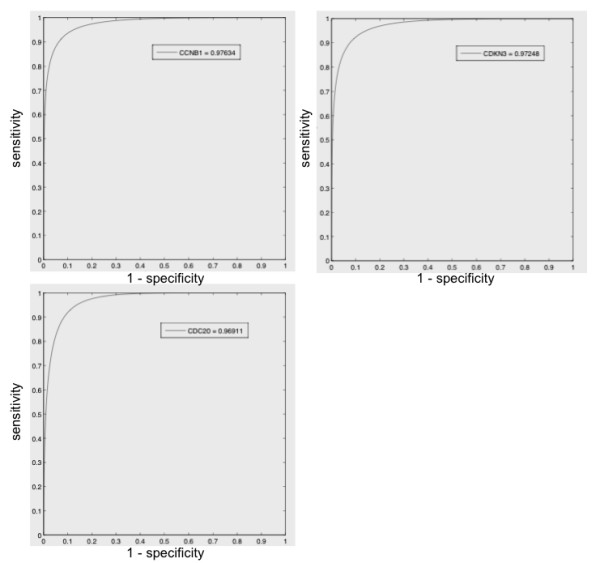
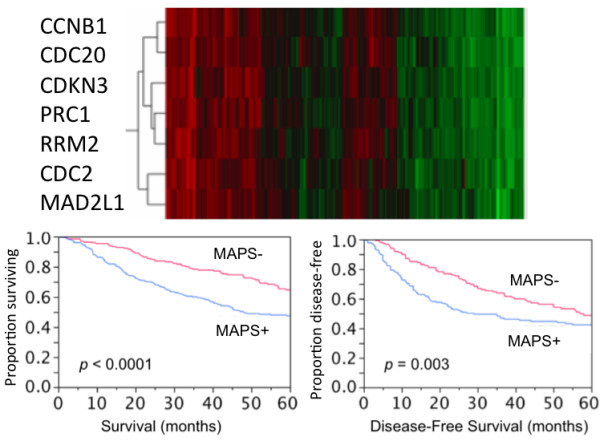
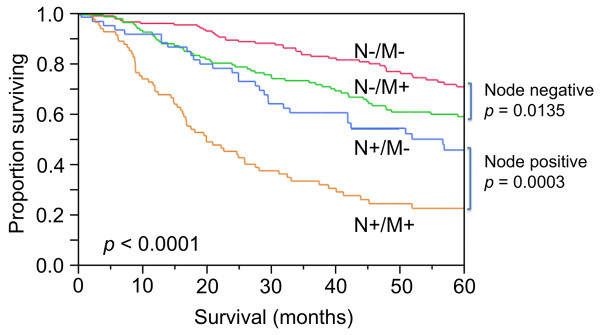
Using DNA microarrays, we identified 254 genes that were differentially expressed in cell lines transformed by MUC1-CD compared to control cell lines. We then examined expression of these genes in 441 lung adenocarcinomas from a publicly available database. We employed statistical analyses independent of clinical outcomes, including hierarchical clustering, Student's t-tests and receiver operating characteristic (ROC) analysis, to select a seven-gene MUC1-associated proliferation signature (MAPS). We demonstrated the prognostic value of MAPS in this database using Kaplan-Meier survival analysis, log-rank tests and Cox models. The MAPS was further validated for prognostic significance in 84 lung adenocarcinoma patients from an independent database.
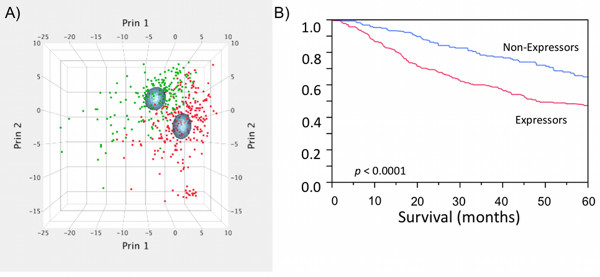
MAPS genes were found to be associated with proliferation and cell cycle regulation and included CCNB1, CDC2, CDC20, CDKN3, MAD2L1, PRC1 and RRM2. MAPS expressors (MAPS+) had inferior survival compared to non-expressors (MAPS-). In the initial data set, 5-year survival was 65% (MAPS-) vs. 45% (MAPS+, p < 0.0001). Similarly, in the validation data set, 5-year survival was 57% (MAPS-) vs. 28% (MAPS+, p = 0.005).
The MAPS signature, comprised of MUC1-CD-dependent genes involved in the control of cell cycle and proliferation, is associated with poor outcomes in patients with adenocarcinoma of the lung. These data provide potential new prognostic biomarkers and treatment targets for lung adenocarcinoma.
MUC1 蛋白在肺癌中高度表达。MUC1 的细胞质结构域(MUC1-CD)可诱导肿瘤发生并对 DNA 损伤剂产生耐药性。我们对 MUC1-CD 诱导的转录变化进行了特征描述,并研究了其在肺癌患者中的意义。
我们使用 DNA 微阵列,鉴定了与对照细胞系相比,MUC1-CD 转化的细胞系中差异表达的 254 个基因。然后,我们在一个公开的数据库中检查了这 441 例肺腺癌中的这些基因的表达情况。我们采用了独立于临床结局的统计分析方法,包括层次聚类、Student's t 检验和接收者操作特征(ROC)分析,以选择与 MUC1 相关的增殖标志(MAPS)的 7 个基因。我们使用 Kaplan-Meier 生存分析、对数秩检验和 Cox 模型在该数据库中证明了 MAPS 的预后价值。我们还在来自另一个独立数据库的 84 例肺腺癌患者中验证了 MAPS 的预后意义。
MAPS 基因与增殖和细胞周期调节有关,包括 CCNB1、CDC2、CDC20、CDKN3、MAD2L1、PRC1 和 RRM2。MAPS 表达者(MAPS+)的生存情况较非表达者(MAPS-)差。在初始数据集中,5 年生存率为 65%(MAPS-)vs. 45%(MAPS+,p<0.0001)。同样,在验证数据集,5 年生存率为 57%(MAPS-)vs. 28%(MAPS+,p=0.005)。
由 MUC1-CD 依赖性基因组成的 MAPS 标志,这些基因参与控制细胞周期和增殖,与肺腺癌患者的不良预后相关。这些数据为肺腺癌提供了潜在的新的预后生物标志物和治疗靶点。