Department of Laboratory Medicine, Kaohsiung Medical University Hospital, Kaohsiung, Taiwan.
J Biomed Sci. 2010 May 12;17(1):37. doi: 10.1186/1423-0127-17-37.
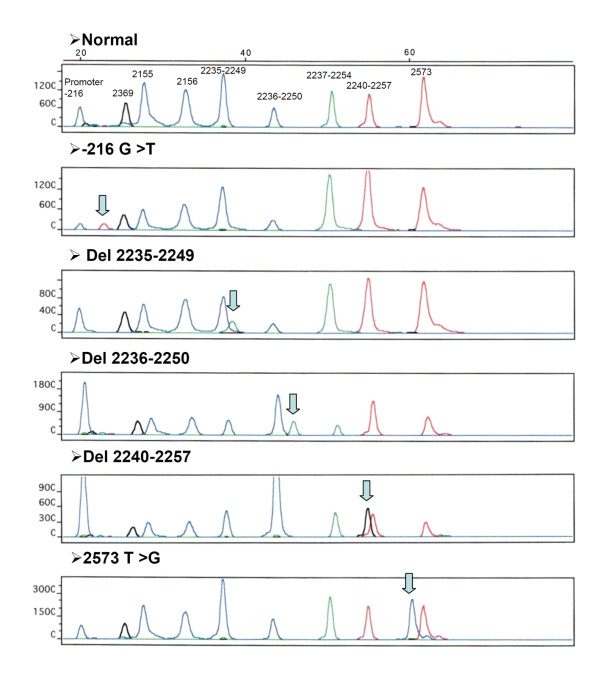
Epidermal growth factor receptor (EGFR) kinase domain mutations hyperactivate the kinase and confer kinase addiction of the non-small-cell lung cancer (NSCLC) tumor cells. Almost all of these mutations are located within exons 18-21. The -216 single nucleotide polymorphism in the promoter region is associated with increased EGFR production. We present a method for detecting these common mutations in 81 cases of NSCLC. The protocol is based on the multiplex amplification of promoter region and exons 18-21 of the EGFR genes in a single tube, followed by primer extension of the PCR products using various sizes of primers to detect base changes at -216 promoter region and codons 719, 746-750, 790, 858 of the EGFR gene. We compared the results with that from direct sequencing for detecting EGFR mutations in 81 cases of NSCLC. The two methods identified the same 26 mutations, but our method is superior to direct sequencing in terms of the amount of work and time required. We presented a simple and fast method to detect mutations of EGFR genes in NSCLC.
表皮生长因子受体(EGFR)激酶结构域突变会使激酶过度激活,并使非小细胞肺癌(NSCLC)肿瘤细胞产生激酶成瘾性。几乎所有这些突变都位于外显子 18-21 内。启动子区域的-216 单核苷酸多态性与 EGFR 产生的增加有关。我们提出了一种在 81 例 NSCLC 中检测这些常见突变的方法。该方案基于在单个管中对 EGFR 基因的启动子区域和外显子 18-21 进行多重扩增,然后使用各种大小的引物对 PCR 产物进行引物延伸,以检测-216 启动子区域和 EGFR 基因的密码子 719、746-750、790、858 处的碱基变化。我们将结果与直接测序检测 81 例 NSCLC 中的 EGFR 突变进行了比较。两种方法都鉴定出了相同的 26 种突变,但我们的方法在工作量和所需时间方面优于直接测序。我们提出了一种简单快速的方法来检测 NSCLC 中的 EGFR 基因突变。