School of Community Health Sciences, University of Nottingham.
BMJ. 2010 May 11;340:c2102. doi: 10.1136/bmj.c2102.
To evaluate whether a service to prevent falls in the community would help reduce the rate of falls in older people who call an emergency ambulance when they fall but are not taken to hospital.
Randomised controlled trial.
Community covered by four primary care trusts, England.
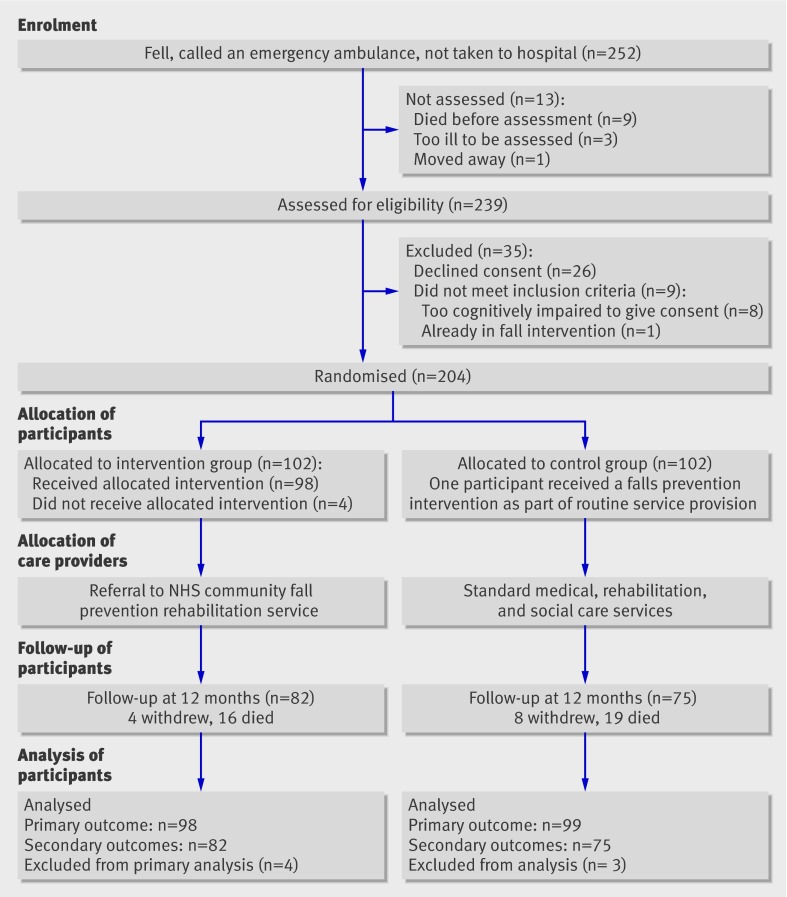
204 adults aged more than 60 living at home or in residential care who had fallen and called an emergency ambulance but were not taken to hospital.
Referral to community fall prevention services or standard medical and social care.
The primary outcome was the rate of falls over 12 months, ascertained from monthly diaries. Secondary outcomes were scores on the Barthel index, Nottingham extended activities of daily living scale, and falls efficacy scale at baseline and by postal questionnaire at 12 months. Analysis was by intention to treat.
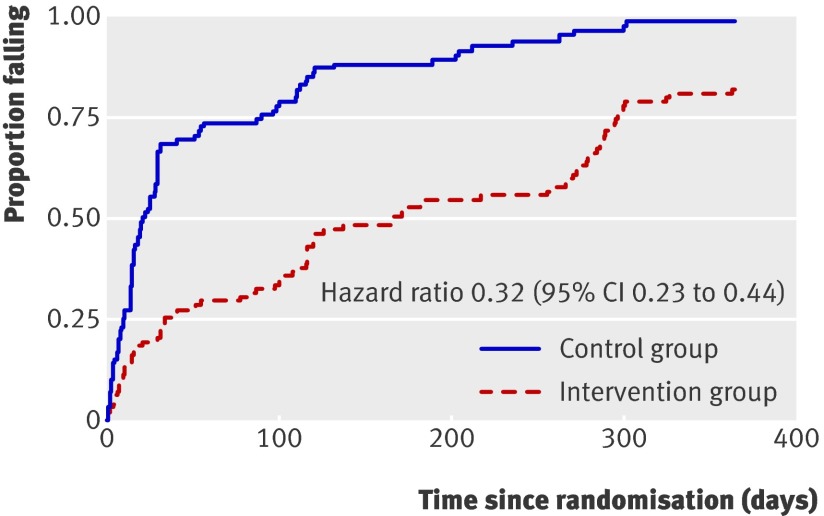
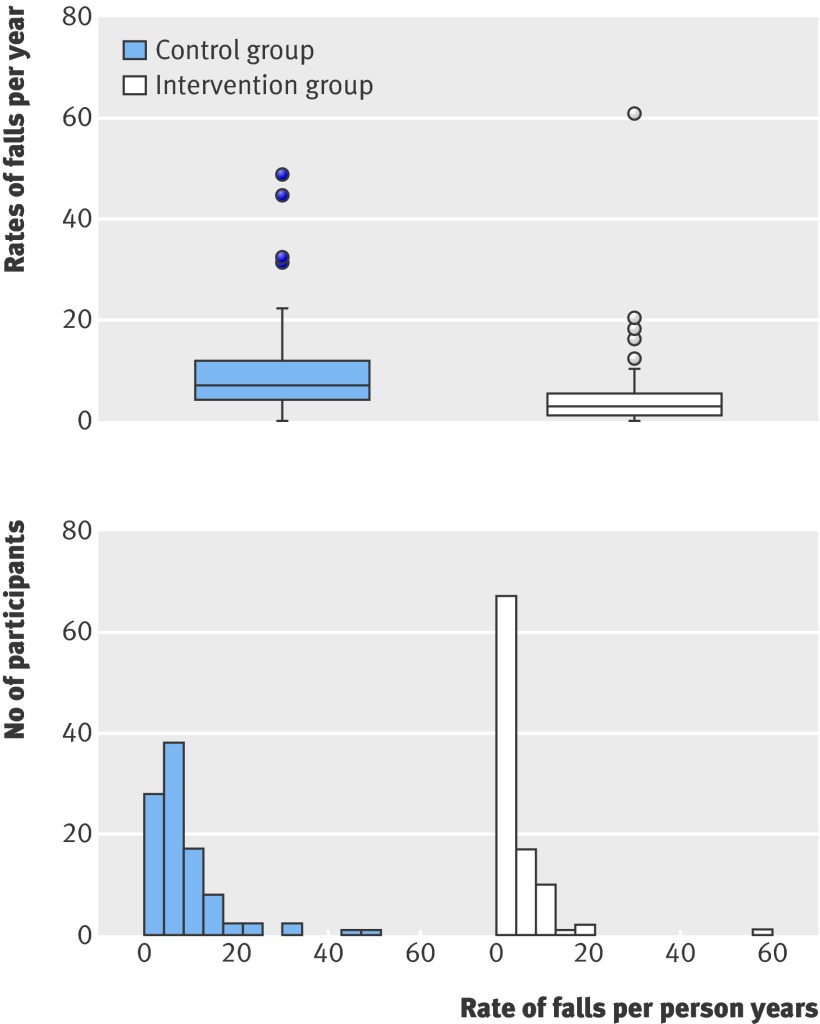
102 people were allocated to each group. 99 (97%) participants in the intervention group received the intervention. Falls diaries were analysed for 88.6 person years in the intervention group and 84.5 person years in the control group. The incidence rates of falls per year were 3.46 in the intervention group and 7.68 in the control group (incidence rate ratio 0.45, 95% confidence interval 0.35 to 0.58, P<0.001). The intervention group achieved higher scores on the Barthel index and Nottingham extended activities of daily living and lower scores on the falls efficacy scale (all P<0.05) at the 12 month follow-up. The number of times an emergency ambulance was called because of a fall was significantly different during follow-up (incidence rate ratio 0.60, 95% confidence interval 0.40 to 0.92, P=0.018).
A service to prevent falls in the community reduced the fall rate and improved clinical outcome in the high risk group of older people who call an emergency ambulance after a fall but are not taken to hospital.
Current Controlled Trials ISRCTN67535605.
评估社区内的防跌倒服务是否有助于降低因跌倒而呼叫紧急救护车但未住院的老年人的跌倒发生率。
随机对照试验。
英格兰四个基层医疗信托机构覆盖的社区。
204 名年龄在 60 岁以上、居住在家庭或养老院的成年人,他们跌倒后呼叫了紧急救护车但未住院。
转诊至社区防跌倒服务或标准医疗和社会护理。
主要结局是 12 个月内的跌倒发生率,通过每月日记确定。次要结局是基线时和 12 个月时通过邮寄问卷评估的巴氏量表评分、诺丁汉扩展日常生活活动量表评分和跌倒效能量表评分。分析采用意向治疗。
每组 102 人。干预组 99 人(97%)接受了干预。对干预组的 88.6 人年和对照组的 84.5 人年进行了跌倒日记分析。每年的跌倒发生率分别为干预组 3.46 次和对照组 7.68 次(发病率比 0.45,95%置信区间 0.35 至 0.58,P<0.001)。干预组在 12 个月随访时巴氏量表评分和诺丁汉扩展日常生活活动量表评分更高,跌倒效能量表评分更低(均 P<0.05)。在随访期间,因跌倒而呼叫紧急救护车的次数明显不同(发病率比 0.60,95%置信区间 0.40 至 0.92,P=0.018)。
社区内的防跌倒服务降低了呼叫紧急救护车后未住院的高危老年人的跌倒率,并改善了临床结局。
当前对照试验 ISRCTN67535605。