Graduate Program in Biophysics, 433 Babcock Drive, University of Wisconsin, Madison, Wisconsin 53706, USA.
J Am Chem Soc. 2010 Jun 16;132(23):7908-18. doi: 10.1021/ja1026387.
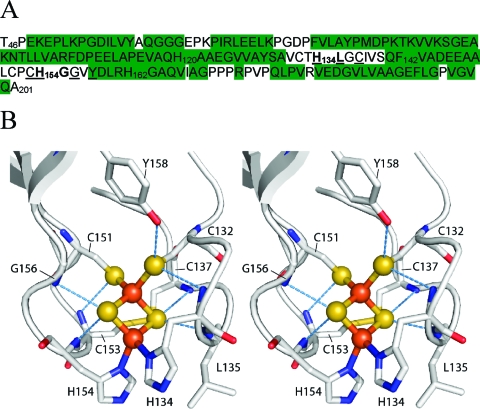
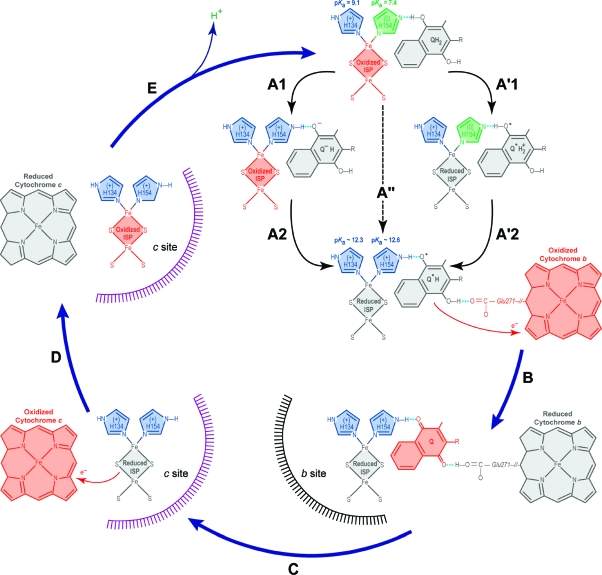
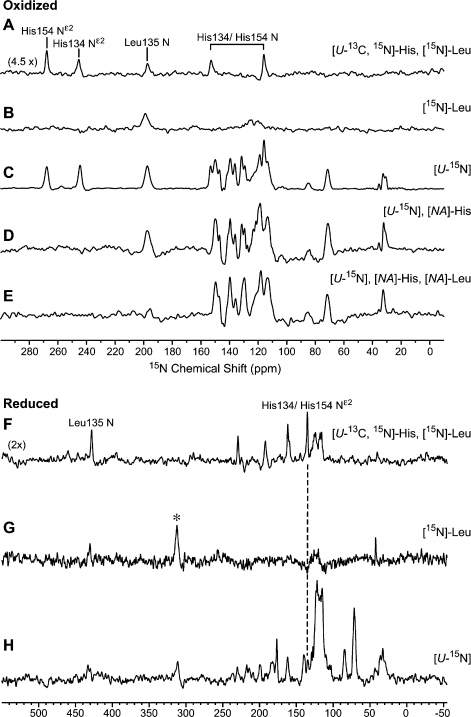
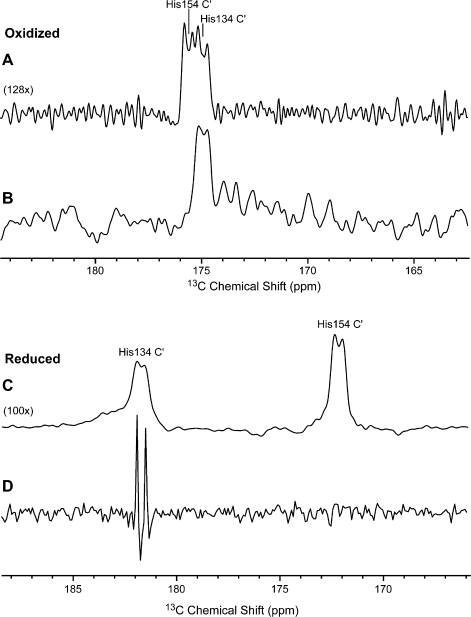
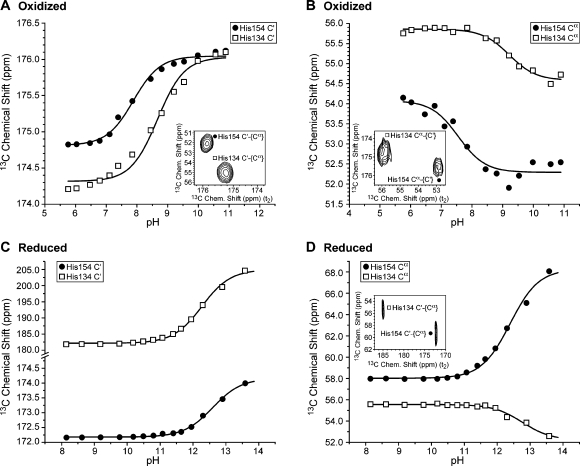
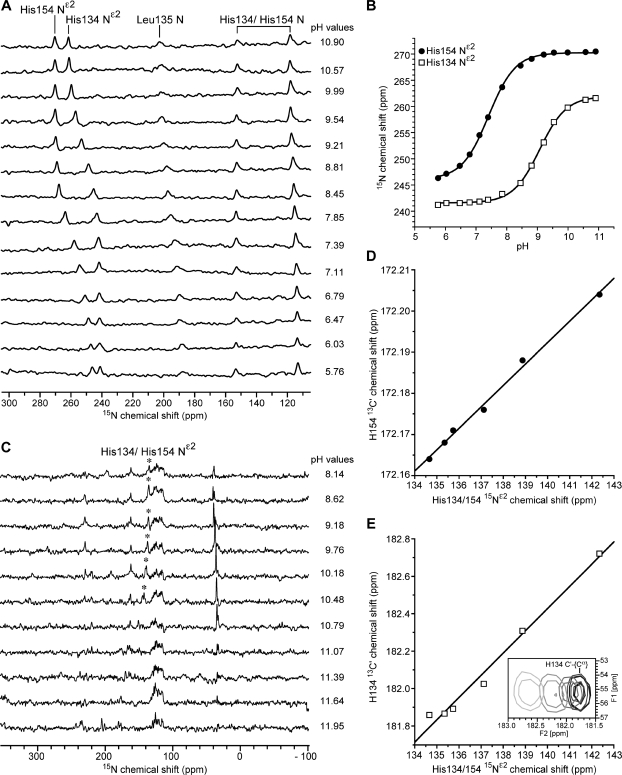
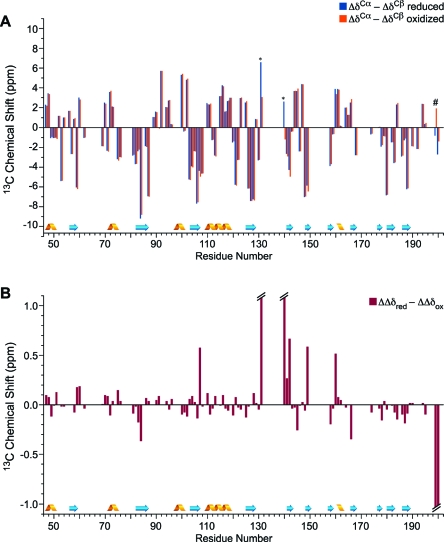
The Rieske protein component of the cytochrome bc complex contains a [2Fe-2S] cluster ligated by two cysteines and two histidines. We report here the pK(a) values of each of the imidazole rings of the two ligating histidines (His134 and His154) in the oxidized and reduced states of the Rieske protein from Thermus thermophilus (TtRp) as determined by NMR spectroscopy. Knowledge of these pK(a) values is of critical interest because of their pertinence to the mechanism of electron and proton transfer in the bifurcated Q-cycle. Although we earlier had observed the pH dependence of a (15)N NMR signal from each of the two ligand histidines in oxidized TtRp (Lin, I. J.; Chen, Y.; Fee, J. A.; Song, J.; Westler, W. M.; Markley, J. L. J. Am. Chem. Soc. 2006, 128, 10672-10673), the strong paramagnetism of the [2Fe-2S] cluster prevented the assignment of these signals by conventional methods. Our approach here was to take advantage of the unique histidine-leucine (His134-Leu135) sequence and to use residue-selective labeling to establish a key sequence-specific assignment, which was then extended. Analysis of the pH dependence of assigned (13)C', (13)C(alpha), and (15)N(epsilon2) signals from the two histidine cluster ligands led to unambiguous assignment of the pK(a) values of oxidized and reduced TtRp. The results showed that the pK(a) of His134 changes from 9.1 in oxidized to approximately 12.3 in reduced TtRp, whereas the pK(a) of His154 changes from 7.4 in oxidized to approximately 12.6 in reduced TtRp. This establishes His154, which is close to the quinone when the Rieske protein is in the cytochrome b site, as the residue experiencing the remarkable redox-dependent pK(a) shift. Secondary structural analysis of oxidized and reduced TtRp based upon our extensive chemical shift assignments rules out a large conformational change between the oxidized and reduced states. Therefore, TtRp likely translocates between the cytochrome b and cytochrome c sites by passive diffusion. Our results are most consistent with a mechanism involving the coupled transfer of an electron and transfer of the proton across the hydrogen bond between the hydroquinone and His154 at the cytochrome b site.
细胞色素 bc 复合物的 Rieske 蛋白组分包含一个由两个半胱氨酸和两个组氨酸连接的 [2Fe-2S] 簇。我们在这里报告了 Thermus thermophilus (TtRp) Rieske 蛋白氧化态和还原态下两个连接组氨酸(His134 和 His154)的每个咪唑环的 pK(a) 值,这是通过 NMR 光谱法确定的。这些 pK(a) 值的知识至关重要,因为它们与分支 Q 循环中电子和质子转移的机制有关。尽管我们之前已经观察到氧化态 TtRp 中两个配体组氨酸中的每个(15)N NMR 信号的 pH 依赖性(Lin, I. J.; Chen, Y.; Fee, J. A.; Song, J.; Westler, W. M.; Markley, J. L. J. Am. Chem. Soc. 2006, 128, 10672-10673),但 [2Fe-2S] 簇的强顺磁性阻止了通过常规方法对这些信号进行分配。我们在这里采用的方法是利用独特的组氨酸-亮氨酸(His134-Leu135)序列并利用残基选择性标记来建立关键的序列特异性分配,然后进行扩展。分析两个组氨酸簇配体的(13)C'、(13)C(alpha) 和(15)N(epsilon2)信号的 pH 依赖性导致氧化和还原 TtRp 的 pK(a) 值的明确分配。结果表明,His134 的 pK(a) 值从氧化态的 9.1 变为还原态的约 12.3,而 His154 的 pK(a) 值从氧化态的 7.4 变为还原态的约 12.6。这表明当 Rieske 蛋白位于细胞色素 b 位点时,靠近醌的 His154 是经历显著氧化还原依赖的 pK(a) 位移的残基。基于我们广泛的化学位移分配规则对氧化和还原 TtRp 的二级结构分析排除了氧化态和还原态之间的大构象变化。因此,TtRp 可能通过被动扩散在细胞色素 b 和细胞色素 c 位点之间迁移。我们的结果与涉及电子耦合转移和质子在氢醌和细胞色素 b 位点的 His154 之间氢键转移的机制最一致。