Fundación Inbiomed, Foundation for Stem Cell Research, Mesenchymal and Hematopoietic Stem Cell Department, Paseo Mikeletegi, San Sebastián, Spain.
J Bone Miner Res. 2010 Oct;25(10):2115-25. doi: 10.1002/jbmr.120.
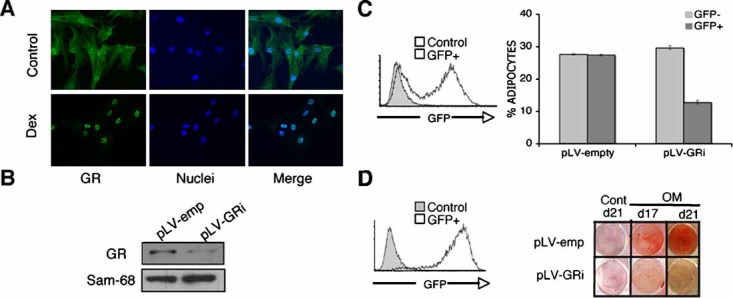
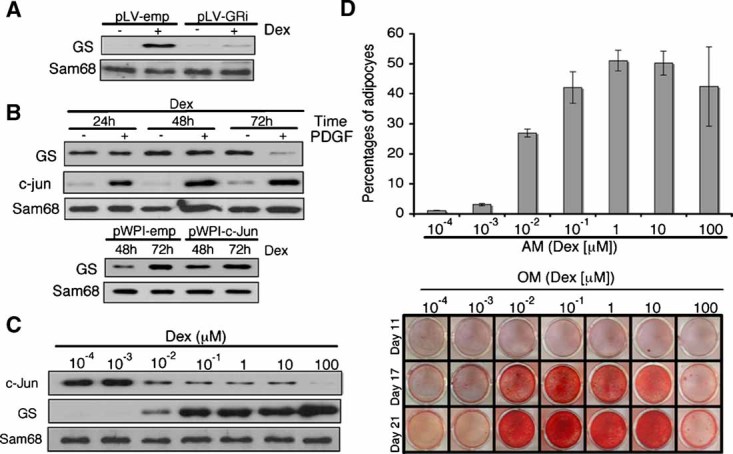
Although marrow adipocytes and osteoblasts derive from a common bone marrow stromal cells (BMSCs), the mechanisms that underlie osteoporosis-associated bone loss and marrow adipogenesis during prolonged steroid treatment are unclear. We show in human BMSCs (hBMSCs) that glucocorticoid receptor (GR) signaling in response to high concentrations of glucocorticoid (GC) supports adipogenesis but inhibits osteogenesis by reducing c-Jun expression and hBMSC proliferation. Conversely, significantly lower concentrations of GC, which permit hBMSC proliferation, are necessary for normal bone mineralization. In contrast, platelet-derived growth factor (PDGF) signaling increases both JNK/c-Jun activity and hBMSC expansion, favoring osteogenic differentiation instead of adipogenesis. Indeed, PDGF antagonizes the proadipogenic qualities of GC/GR signaling. Thus our results reveal a novel c-Jun-centered regulatory network of signaling pathways in differentiating hBMSCs that controls the proliferation-dependent balance between osteogenesis and adipogenesis.
尽管骨髓脂肪细胞和成骨细胞来源于共同的骨髓基质细胞(BMSCs),但在长期类固醇治疗期间导致骨质疏松症相关骨丢失和骨髓脂肪生成的机制尚不清楚。我们在人骨髓基质细胞(hBMSCs)中表明,高浓度糖皮质激素(GC)引起的糖皮质激素受体(GR)信号支持脂肪生成,但通过降低 c-Jun 表达和 hBMSC 增殖来抑制成骨作用。相反,允许 hBMSC 增殖的 GC 浓度显著降低对于正常的骨矿化是必需的。相比之下,血小板衍生生长因子(PDGF)信号增加 JNK/c-Jun 活性和 hBMSC 扩增,有利于成骨分化而不是脂肪生成。事实上,PDGF 拮抗 GC/GR 信号的促脂肪生成特性。因此,我们的结果揭示了一个新的以 c-Jun 为中心的信号通路调控网络,在分化的 hBMSCs 中控制成骨和脂肪生成之间依赖于增殖的平衡。