Peng Yi, Jiang Hai, Zuo Hou-Dong
Medical Imaging Key Laboratory of Sichuan Province, Department of Radiology, Affiliated Hospital of North Sichuan Medical College, Nanchong 637000, Sichuan Province, China.
Department of Radiology, Chengdu Xinhua Hospital, Chengdu 610067, Sichuan Province, China.
World J Stem Cells. 2023 Jun 26;15(6):548-560. doi: 10.4252/wjsc.v15.i6.548.
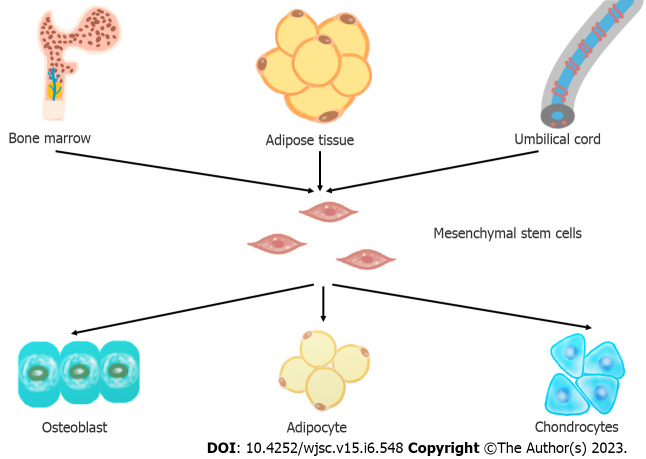
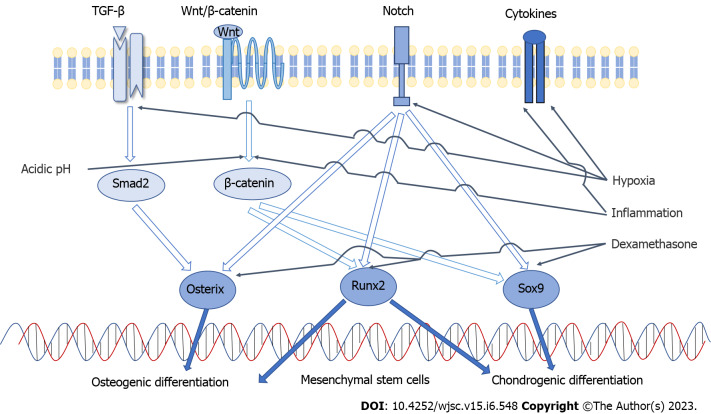
Osteoarthritis (OA) is a common degenerative joint disease that often involves progressive cartilage degeneration and bone destruction of subchondral bone. At present, clinical treatment is mainly for pain relief, and there are no effective methods to delay the progression of the disease. When this disease progresses to the advanced stage, the only treatment option for most patients is total knee replacement surgery, which causes patients great pain and anxiety. As a type of stem cell, mesenchymal stem cells (MSCs) have multidirectional differentiation potential. The osteogenic differentiation and chondrogenic differentiation of MSCs can play vital roles in the treatment of OA, as they can relieve pain in patients and improve joint function. The differentiation direction of MSCs is accurately controlled by a variety of signaling pathways, so there are many factors that can affect the differentiation direction of MSCs by acting on these signaling pathways. When MSCs are applied to OA treatment, the microenvironment of the joints, injected drugs, scaffold materials, source of MSCs and other factors exert specific impacts on the differentiation direction of MSCs. This review aims to summarize the mechanisms by which these factors influence MSC differentiation to produce better curative effects when MSCs are applied clinically in the future.
骨关节炎(OA)是一种常见的退行性关节疾病,常涉及进行性软骨退变和软骨下骨的骨质破坏。目前,临床治疗主要是缓解疼痛,尚无有效方法延缓疾病进展。当该病发展到晚期时,大多数患者唯一的治疗选择是全膝关节置换手术,这给患者带来极大的痛苦和焦虑。间充质干细胞(MSCs)作为一种干细胞,具有多向分化潜能。MSCs的成骨分化和软骨分化在OA治疗中可发挥重要作用,因为它们可以缓解患者疼痛并改善关节功能。MSCs的分化方向由多种信号通路精确控制,因此有许多因素可通过作用于这些信号通路来影响MSCs的分化方向。当将MSCs应用于OA治疗时,关节微环境、注射药物、支架材料、MSCs来源等因素对MSCs的分化方向产生特定影响。本综述旨在总结这些因素影响MSCs分化的机制,以便未来MSCs临床应用时能产生更好的疗效。