Department of Internal Medicine, Seoul National University College of Medicine, Seoul, Korea.
Yonsei Med J. 2010 Jul;51(4):492-8. doi: 10.3349/ymj.2010.51.4.492.
The incidence of differentiated thyroid cancer is increasing in young adults and females in Korea. Some of them experience short-term hypothyroidism in preparation for radioiodine (RAI) therapy, which can have a deleterious effect on the cardiovascular system. However, it is not clear if short-term hypothyroidism induces endothelial dysfunction in patients with low cardiovascular risk. Therefore, the aim of this study was to investigate whether short-term hypothyroidism is associated with endothelial dysfunction in patients with low cardiovascular risk.
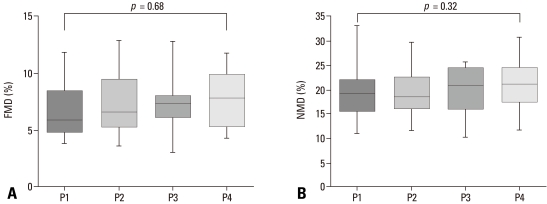
To evaluate the effect of short-term hypothyroidism on endothelial function in this group, we recruited fifteen female patients with low cardiovascular risk. We analyzed clinical, biochemical, and cardiovascular parameters at four time points: the last day on levothyroxine (LT4) at their usual thyroid-stimulating hormone (TSH)-suppressive doses (P1), 7 days (P2) and 4 weeks (P3) after withdrawal of LT4, and 8 weeks (P4) after replacement of the previous dose of LT4. A high resolution ultrasound was used to measure brachial artery diameter at rest, after reactive hyperemia, and after sublingual nitroglycerin.
During short-term hypothyroidism (P3), serum concentrations of total cholesterol and low-density lipoprotein (LDL)-cholesterol were increased (p < 0.001 for each period). In spite of having worsened lipid states, serum high sensitivity C-reactive protein or flow-mediated vasodilatation, which is one of the surrogate markers of the endothelial function, did not change during short-term hypothyroidism.
Short-term hypothyroidism induced worsening of metabolic parameters, but not enough to induce the endothelial dysfunction in patients with low cardiovascular risk.
在韩国,年轻成年人和女性中分化型甲状腺癌的发病率正在增加。他们中的一些人在接受放射性碘(RAI)治疗前会经历短期甲状腺功能减退症,这会对心血管系统造成有害影响。然而,目前尚不清楚短期甲状腺功能减退症是否会导致低心血管风险患者的内皮功能障碍。因此,本研究旨在探讨短期甲状腺功能减退症是否与低心血管风险患者的内皮功能障碍有关。
为了评估短期甲状腺功能减退症对该组患者内皮功能的影响,我们招募了 15 名低心血管风险的女性患者。我们在四个时间点分析了临床、生化和心血管参数:在维持甲状腺刺激激素(TSH)抑制剂量的左甲状腺素(LT4)的最后一天(P1)、停药后 7 天(P2)和 4 周(P3),以及替代之前 LT4 剂量的 8 周(P4)。使用高分辨率超声测量静息、反应性充血和舌下硝酸甘油后的肱动脉直径。
在短期甲状腺功能减退症期间(P3),总胆固醇和低密度脂蛋白(LDL)-胆固醇的血清浓度增加(每个时期均<0.001)。尽管血脂状况恶化,但短期甲状腺功能减退症期间血清高敏 C 反应蛋白或血流介导的血管舒张(内皮功能的替代标志物之一)并没有变化。
短期甲状腺功能减退症导致代谢参数恶化,但不足以导致低心血管风险患者的内皮功能障碍。