Department of Integrative Physiology and Cardiovascular Research Institute, University of North Texas Health Science Center, Fort Worth, Texas 76107, USA.
J Biol Chem. 2010 Jul 23;285(30):23466-76. doi: 10.1074/jbc.M109.093500. Epub 2010 May 25.
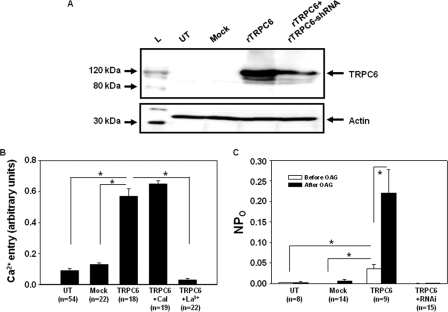
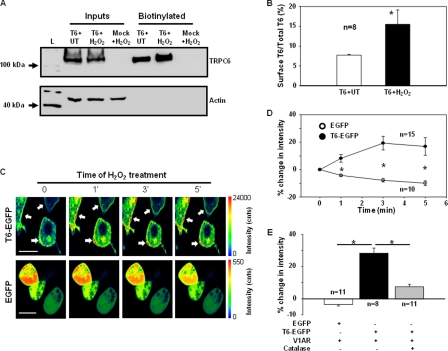
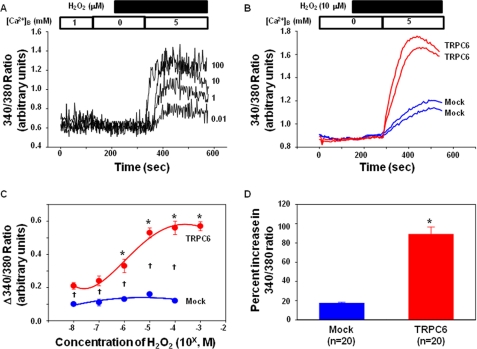
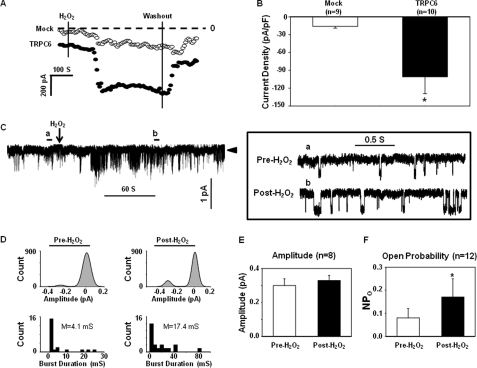
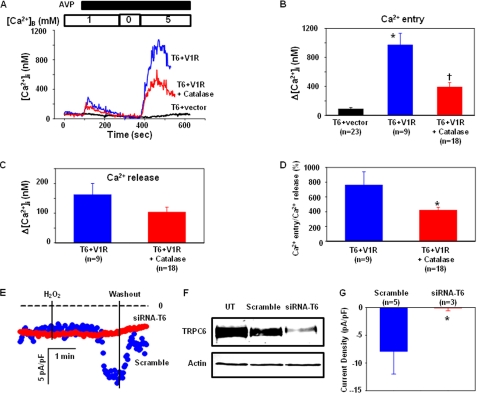
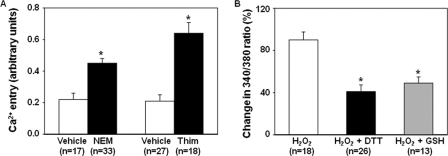
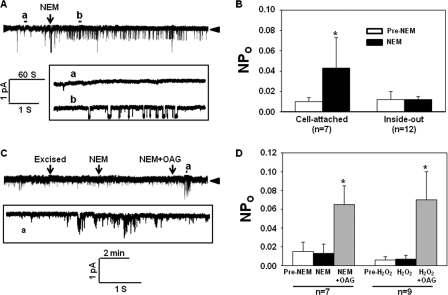
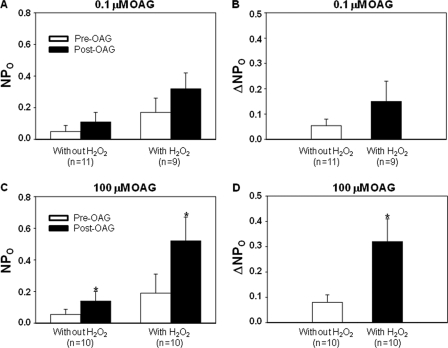
This study examined the effect of H(2)O(2) on the TRPC6 channel and its underlying mechanisms using a TRPC6 heterologous expression system. In TRPC6-expressing HEK293T cells, H(2)O(2) significantly stimulated Ca(2+) entry in a dose-dependent manner. Electrophysiological experiments showed that H(2)O(2) significantly increased TRPC6 channel open probability and whole-cell currents. H(2)O(2) also evoked a robust inward current in A7r5 vascular smooth muscle cells, which was nearly abolished by knockdown of TRPC6 using a small interfering RNA. Catalase substantially attenuated arginine vasopressin (AVP)-induced Ca(2+) entry in cells co-transfected with TRPC6 and AVP V1 receptor. N-Ethylmaleimide and thimerosal were able to simulate the H(2)O(2) response. Dithiothreitol or glutathione-reduced ethyl ester significantly antagonized the response. Furthermore, both N-ethylmaleimide- and H(2)O(2)-induced TRPC6 activations were only observed in the cell-attached patches but not in the inside-out patches. Moreover, 1-oleoyl-2-acetyl-sn-glycerol effect on TRPC6 was significantly greater in the presence of H(2)O(2). Biotinylation assays revealed a significant increase in cell surface TRPC6 in response to H(2)O(2). Similarly, in cells transfected with TRPC6-EGFP, confocal microscopy showed a significant increase in fluorescence intensity in the region of the cell membrane and adjacent to the membrane. AVP also increased the fluorescence intensity on the surface of the cells co-transfected with TRPC6-EGFP and V1 receptor, and this response was inhibited by catalase. These data indicate that H(2)O(2) activates TRPC6 channels via modification of thiol groups of intracellular proteins. This cysteine oxidation-dependent pathway not only stimulates the TRPC6 channel by itself but also sensitizes the channels to diacylglycerol and promotes TRPC6 trafficking to the cell surface.
这项研究使用 TRPC6 异源表达系统,考察了 H2O2 对 TRPC6 通道的影响及其潜在机制。在表达 TRPC6 的 HEK293T 细胞中,H2O2 呈浓度依赖性显著刺激 Ca2+内流。电生理实验表明,H2O2 显著增加 TRPC6 通道开放概率和全细胞电流。H2O2 还可在 A7r5 血管平滑肌细胞中引起强烈的内向电流,该电流可被用小干扰 RNA 敲低 TRPC6 而几乎消除。过氧化氢酶可显著减弱共转染 TRPC6 和血管加压素 V1 受体的细胞中血管加压素诱导的 Ca2+内流。N-乙基马来酰亚胺和硫柳汞能够模拟 H2O2 的反应。二硫苏糖醇或谷胱甘肽还原乙基酯显著拮抗该反应。此外,N-乙基马来酰亚胺和 H2O2 诱导的 TRPC6 激活仅在细胞贴附斑中观察到,而不在胞内斑中观察到。此外,在存在 H2O2 的情况下,1-油酰基-2-乙酰基-sn-甘油对 TRPC6 的作用明显更大。生物素化实验表明,H2O2 反应导致细胞表面 TRPC6 显著增加。同样,在转染 TRPC6-EGFP 的细胞中,共聚焦显微镜显示细胞膜区域和膜附近的荧光强度显著增加。血管加压素也增加了共转染 TRPC6-EGFP 和 V1 受体的细胞表面的荧光强度,该反应被过氧化氢酶抑制。这些数据表明,H2O2 通过细胞内蛋白质巯基基团的修饰来激活 TRPC6 通道。这种半胱氨酸氧化依赖性途径不仅可自身刺激 TRPC6 通道,还可使通道对二酰基甘油敏感,并促进 TRPC6 向细胞表面转运。