Laboratory of Cellular and Molecular Biology, Center for Cancer Research, National Cancer Institute, National Institutes of Health, Bethesda, Maryland 20892-4256, USA.
Cancer Res. 2010 Jun 15;70(12):4789-94. doi: 10.1158/0008-5472.CAN-10-0610. Epub 2010 May 25.
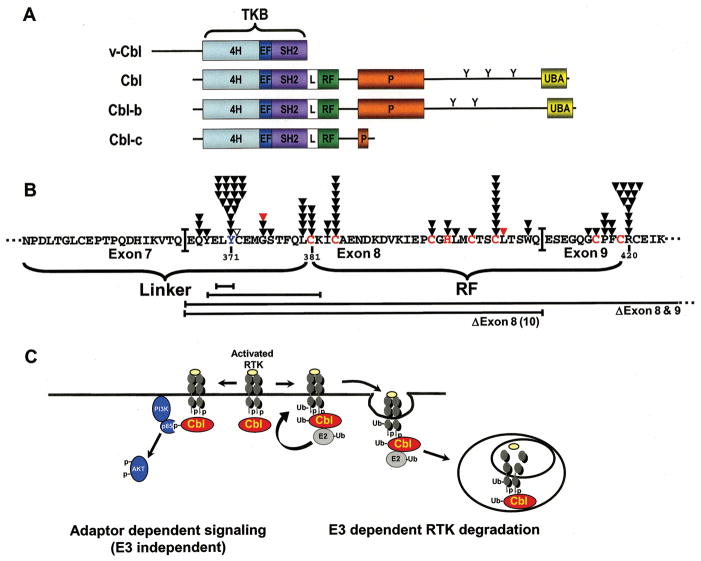
Cbl was originally discovered in 1989 as the cellular homolog of the v-Cbl oncogene, the transforming gene of the Cas NS-1 murine retrovirus that causes myeloid leukemia and lymphomas in mice. Cbl is a member of a family of RING finger ubiquitin ligases that negatively regulate signaling by tyrosine kinases and that function as adaptor proteins to regulate signaling positively. Until the past 2 years, there was little evidence that Cbl proteins were involved in human malignancies. Recent publications have shown homozygous mutations in Cbl in human myeloid neoplasms. Although in vitro and animal transformation models suggested that mutant forms of Cbl acted as an oncogene, the cellular role suggested that the protein could serve as a tumor suppressor gene. The recent data begin to reconcile this paradox as the loss of ubiquitin ligase function (the tumor suppressor function) is coupled to the maintenance of the positive signaling function (the oncogene function). These data also provide insight into potential therapeutic approaches to myeloid disorders harboring Cbl mutations.
Cbl 最初于 1989 年被发现,是 Cas NS-1 鼠逆转录病毒 v-Cbl 癌基因的细胞同源物,该病毒可导致小鼠的髓性白血病和淋巴瘤。Cbl 是 RING 指泛素连接酶家族的成员,该酶家族通过负向调节酪氨酸激酶信号通路,以及作为衔接蛋白正向调节信号通路而发挥作用。直到过去 2 年,几乎没有证据表明 Cbl 蛋白与人类恶性肿瘤有关。最近的出版物表明,人类髓性肿瘤中存在 Cbl 基因的纯合突变。尽管体外和动物转化模型表明 Cbl 的突变形式可作为致癌基因,但该蛋白的细胞作用表明其可能作为肿瘤抑制基因。最近的数据开始调和这一悖论,因为泛素连接酶功能(肿瘤抑制功能)的丧失与正向信号通路功能(致癌基因功能)的维持相关。这些数据还为携带 Cbl 突变的髓系疾病提供了潜在的治疗方法。