Huh Y J, Weiss A A
Department of Microbiology and Immunology, Virginia Commonwealth University, Richmond 23298.
Infect Immun. 1991 Jul;59(7):2389-95. doi: 10.1128/iai.59.7.2389-2395.1991.
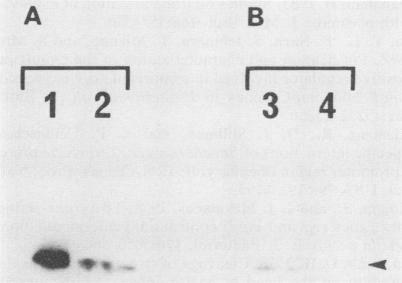
Bordetella pertussis coordinately regulates expression of its virulence factors in response to changing environmental conditions. These factors include pertussis toxin, adenylate cyclase toxin, and the filamentous hemagglutinin (FHA). The vir (or bvg) locus has been shown genetically to be required for this coordinate regulation. We have attempted to study the biochemical basis for coordinate regulation. DNA promoter deletion studies from other laboratories have shown that two tandem 20-bp repeats -157 to -117 bp upstream from the pertussis toxin promoter are essential for transcription. A similar 20-bp tandem repeat was found at the same site in the upstream region of the adenylate cyclase toxin promoter but is not present in the FHA or vir promoter region. Gel retardation revealed protein from virulent strains (able to express the virulence genes) but not from avirulent strains (unable to express the virulence genes) bound to the promoter region of the pertussis toxin gene, and this binding could be abolished by competition with an excess of oligonucleotides corresponding to either tandem repeat. The protein was determined to be 23 kDa by Southwestern (DNA-protein) analysis and could bind to either 20-bp oligonucleotide from the pertussis toxin promoter and either 20-bp oligonucleotide from the adenylate cyclase toxin promoter. BvgA, a 23-kDa protein encoded in the vir locus, has been reported to bind to a 14-bp inverted repeat in the FHA promoter which is not present in the pertussis toxin or adenylate cyclase promoter. We could not demonstrate binding of BvgA to the pertussis toxin promoter region. These data suggest that we have identified a second 23-kDa protein, distinct from BvgA but regulated by the vir operon, that binds to DNA sequences required for transcription of some, but not all, vir-regulated genes.
百日咳博德特氏菌会根据环境条件的变化来协调调节其毒力因子的表达。这些因子包括百日咳毒素、腺苷酸环化酶毒素和丝状血凝素(FHA)。从遗传学角度来看,vir(或bvg)位点是这种协调调节所必需的。我们试图研究协调调节的生化基础。其他实验室进行的DNA启动子缺失研究表明,百日咳毒素启动子上游-157至-117 bp处的两个串联20 bp重复序列对于转录至关重要。在腺苷酸环化酶毒素启动子的上游区域的相同位点也发现了类似的20 bp串联重复序列,但在FHA或vir启动子区域中不存在。凝胶阻滞实验表明,来自有毒力菌株(能够表达毒力基因)的蛋白质而非无毒力菌株(无法表达毒力基因)的蛋白质与百日咳毒素基因的启动子区域结合,并且这种结合可以通过与对应于任一串联重复序列的过量寡核苷酸竞争而被消除。通过蛋白质印迹(DNA-蛋白质)分析确定该蛋白质为23 kDa,并且它可以与来自百日咳毒素启动子的任一20 bp寡核苷酸以及来自腺苷酸环化酶毒素启动子的任一20 bp寡核苷酸结合。据报道,在vir位点编码的23 kDa蛋白质BvgA与FHA启动子中的一个14 bp反向重复序列结合,而该序列在百日咳毒素或腺苷酸环化酶启动子中不存在。我们无法证明BvgA与百日咳毒素启动子区域的结合。这些数据表明,我们已经鉴定出一种与BvgA不同但受vir操纵子调节的23 kDa蛋白质,它与部分(但不是全部)受vir调节基因转录所需的DNA序列结合。