Biology, Orebro Life Science Center, School of Science and Technology, Orebro University, SE-701 82 Orebro, Sweden.
BMC Immunol. 2010 May 27;11:26. doi: 10.1186/1471-2172-11-26.
Activator protein (AP)-1 and nuclear factor (NF)-kappaB largely control T-cell activation, following binding of foreign antigens to the T-cell receptor leading to cytokine secretion. Elevated levels of pro-inflammatory cytokines and chemokines such as TNF, IL-6 and CXCL8 are associated with several human diseases including cystic fibrosis, pulmonary fibrosis and AIDS. The aim of this study was to investigate the role of the transcription factors, AP-1 and NF-kappaB, in IL-6 and CXCL8 regulation in Jurkat T-cells.
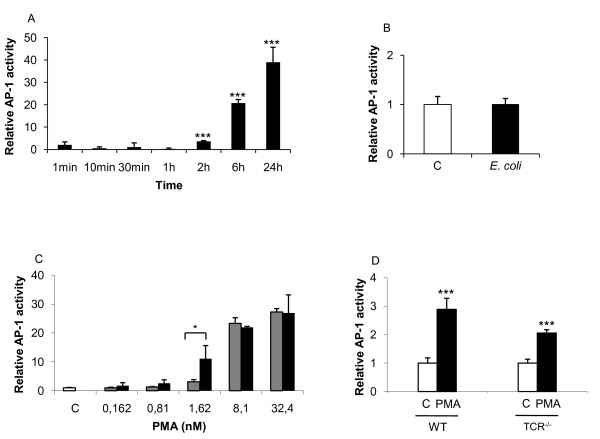
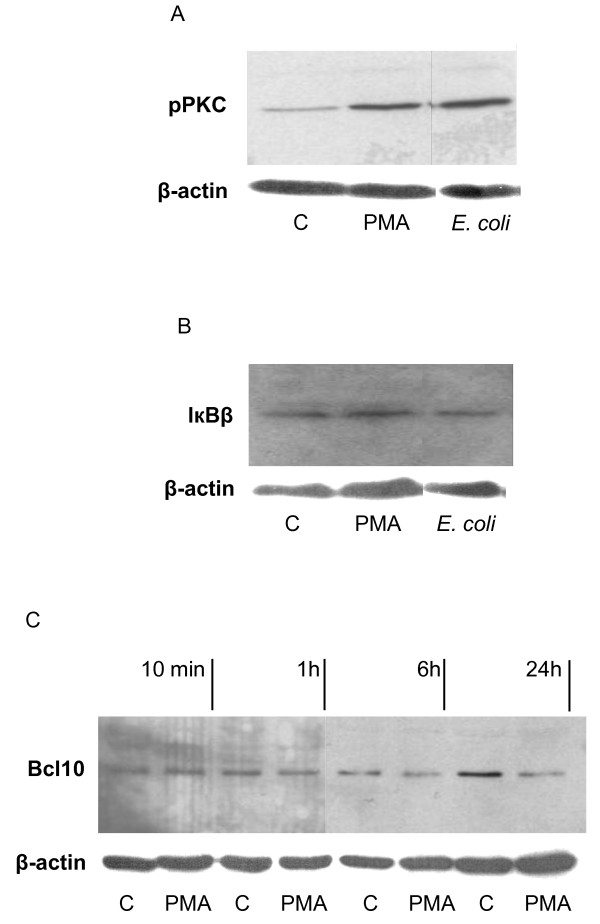
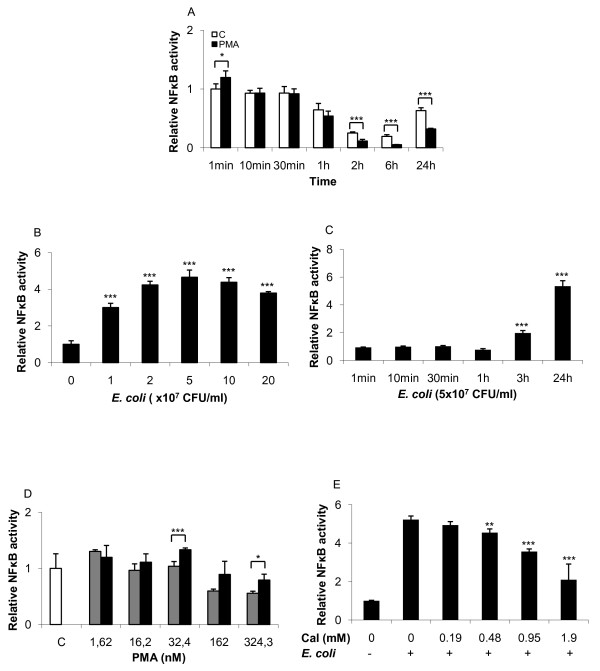
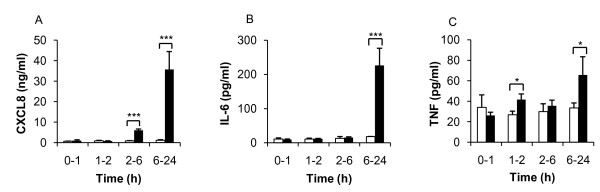
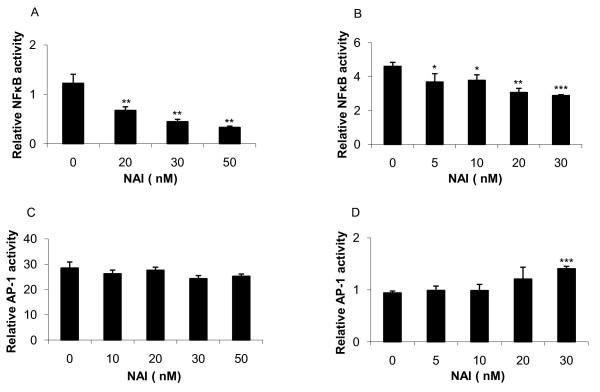
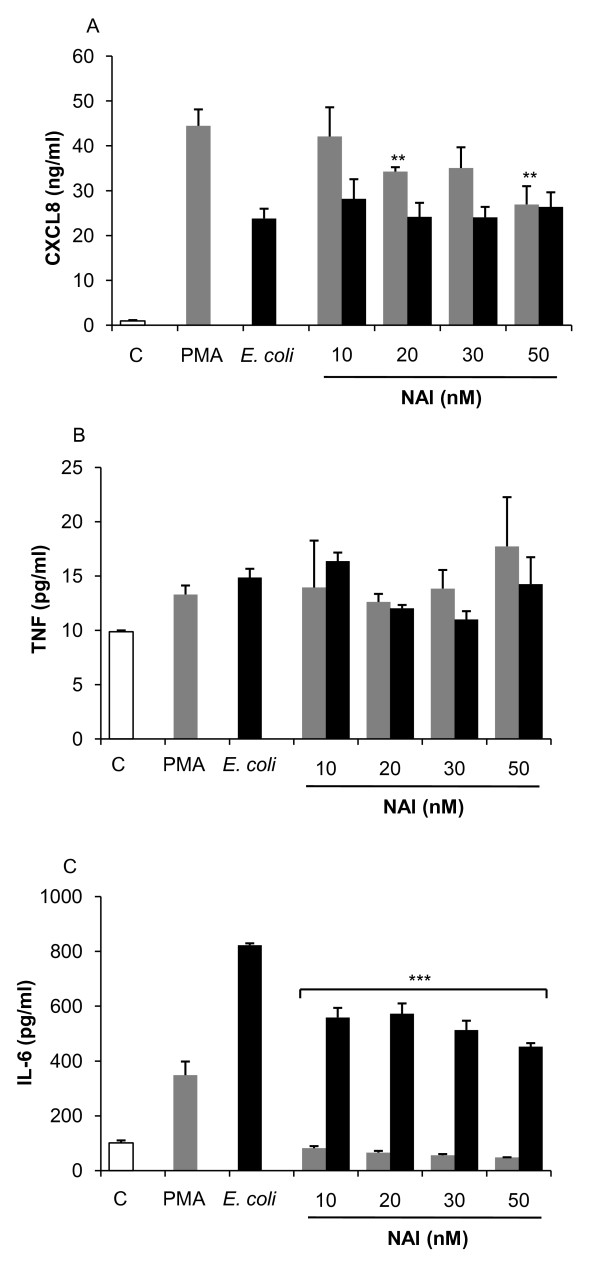
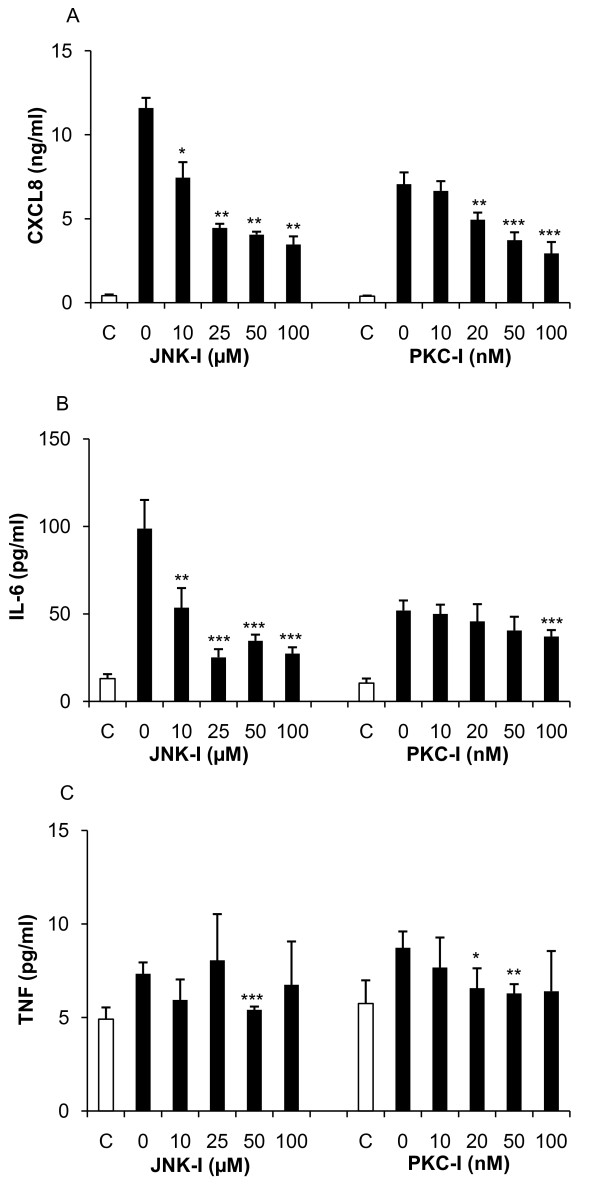
Phorbol myristate acetate (PMA) exposure resulted in an up-regulation of AP-1 and down-regulation of NF-kappaB activity, however, exposure to heat killed (HK) Escherichia. coli MG1655 resulted in a dose-dependent increase in NF-kappaB activity without affecting AP-1. The cytokine profile revealed an up-regulation of the chemokine CXCL8 and the pro-inflammatory cytokines TNF, IL-2 and IL-6 following treatment with both PMA and HK E. coli, while the levels of the anti-inflammatory cytokine IL-10 were not affected by PMA but were significantly down-regulated by HK E. coli. AP-1 activation was significantly increased 2 h after PMA exposure and continued to increase thereafter. In contrast, NF-kappaB responded to PMA exposure by a rapid up-regulation followed by a subsequent down-regulation. Increased intracellular Ca2+ concentrations countered the down-regulation of NF-kappaB by PMA, while similar treatment with calcium ionophore resulted in a reduced NF-kappaB activity following induction with HK E. coli. In order to further study NF-kappaB activation, we considered two up-stream signalling proteins, PKC and Bcl10. Phosphorylated-PKC levels increased in response to PMA and HK E. coli, while Bcl10 levels significantly decreased following PMA treatment. Using an NF-kappaB activation inhibitor, we observed complete inhibition of IL-6 expression while CXCL8 levels only decreased by 40% at the highest concentration. Treatment of Jurkat T-cells with PMA in the presence of JNK-inhibitor suppressed both CXCL8 and IL-6 while PKC-inhibitor primarily decreased CXCL8 expression.
The present study shows that NF-kappaB regulated IL-6 but not CXCL8. This complex regulation of CXCL8 suggests that there is a need to further evaluate the signalling pathways in order to develop new treatment for diseases with elevated CXCL8 levels, such as AIDS and autoimmune diseases.
激活蛋白 (AP)-1 和核因子 (NF)-κB 主要控制 T 细胞的激活,当外源性抗原与 T 细胞受体结合导致细胞因子分泌后。促炎细胞因子和趋化因子如 TNF、IL-6 和 CXCL8 的水平升高与包括囊性纤维化、肺纤维化和艾滋病在内的几种人类疾病相关。本研究的目的是研究转录因子 AP-1 和 NF-κB 在 Jurkat T 细胞中调节 IL-6 和 CXCL8 中的作用。
佛波醇肉豆蔻酸乙酯 (PMA) 暴露导致 AP-1 的上调和 NF-κB 活性的下调,但热杀死 (HK) 大肠杆菌 MG1655 的暴露导致 NF-κB 活性的剂量依赖性增加,而不影响 AP-1。细胞因子谱显示,用 PMA 和 HK 大肠杆菌处理后,趋化因子 CXCL8 和促炎细胞因子 TNF、IL-2 和 IL-6 的水平上调,而抗炎细胞因子 IL-10 的水平不受 PMA 影响,但明显受 HK 大肠杆菌下调。AP-1 激活在 PMA 暴露后 2 小时显着增加,并持续增加。相比之下,NF-κB 对 PMA 暴露的反应是快速上调,随后下调。增加细胞内 Ca2+浓度抵消了 PMA 对 NF-κB 的下调,而用钙离子载体进行类似处理后,用 HK 大肠杆菌诱导 NF-κB 活性降低。为了进一步研究 NF-κB 的激活,我们考虑了两种上游信号蛋白,PKC 和 Bcl10。磷酸化 PKC 水平响应于 PMA 和 HK 大肠杆菌而增加,而 Bcl10 水平在用 PMA 处理后显着降低。使用 NF-κB 激活抑制剂,我们观察到 IL-6 表达完全抑制,而 CXCL8 水平仅在最高浓度时降低 40%。在 JNK 抑制剂存在下用 PMA 处理 Jurkat T 细胞可同时抑制 CXCL8 和 IL-6,而 PKC 抑制剂主要降低 CXCL8 的表达。
本研究表明 NF-κB 调节 IL-6 而不是 CXCL8。CXCL8 的这种复杂调节表明需要进一步评估信号通路,以开发治疗 CXCL8 水平升高的疾病(如艾滋病和自身免疫性疾病)的新疗法。