BMC Public Health. 2010 May 28;10:287. doi: 10.1186/1471-2458-10-287.
Aboriginal Australians have a life expectancy more than ten years less than that of non-Aboriginal Australians, reflecting their disproportionate burden of both communicable and non-communicable disease throughout the lifespan. Little is known about the health and health trajectories of Aboriginal children and, although the majority of Aboriginal people live in urban areas, data are particularly sparse in relation to children living in urban areas.
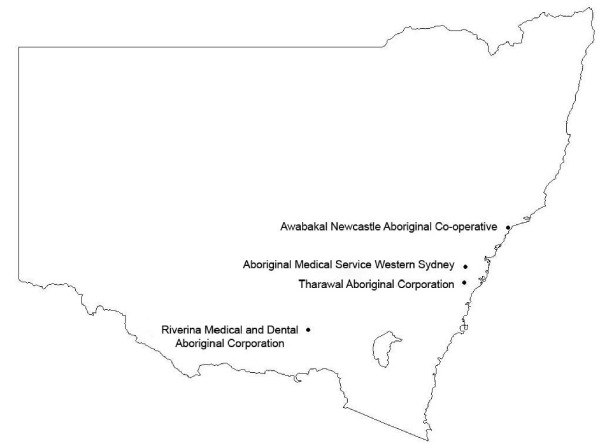
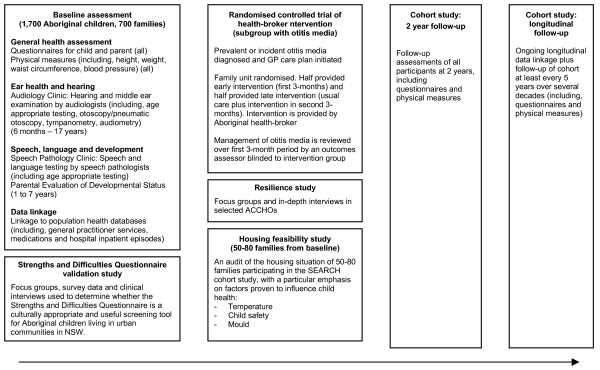
METHODS/DESIGN: The Study of Environment on Aboriginal Resilience and Child Health (SEARCH) is a cohort study of Aboriginal children aged 0-17 years, from urban and large regional centers in New South Wales, Australia. SEARCH focuses on Aboriginal community identified health priorities of: injury; otitis media; vaccine-preventable conditions; mental health problems; developmental delay; obesity; and risk factors for chronic disease. Parents/caregivers and their children are invited to participate in SEARCH at the time of presentation to one of the four participating Aboriginal Community Controlled Health Organisations at Mount Druitt, Campbelltown, Wagga Wagga and Newcastle. Questionnaire data are obtained from parents/caregivers and children, along with signed permission for follow-up through repeat data collection and data linkage. All children have their height, weight, waist circumference and blood pressure measured and complete audiometry, otoscopy/pneumatic otoscopy and tympanometry. Children aged 1-7 years have speech and language assessed and their parents/caregivers complete the Parental Evaluation of Developmental Status. The Study aims to recruit 1700 children by the end of 2010 and to secure resources for long term follow up. From November 2008 to March 2010, 1010 children had joined the study. From those 446 children with complete data entry, participating children ranged in age from 2 weeks to 17 years old, with 144 aged 0-3, 147 aged 4-7, 75 aged 8-10 and 79 aged 11-17. 55% were male and 45% female.
SEARCH is built on strong community partnerships, under Aboriginal leadership, and addresses community priorities relating to a number of under-researched areas. SEARCH will provide a unique long-term resource to investigate the causes and trajectories of health and illness in urban Aboriginal children and to identify potential targets for interventions to improve health.
澳大利亚原住民的预期寿命比非原住民少十年以上,这反映了他们在整个生命周期中都面临着传染性和非传染性疾病的不成比例的负担。关于原住民儿童的健康和健康轨迹知之甚少,尽管大多数原住民居住在城市地区,但与居住在城市地区的儿童有关的数据特别稀少。
方法/设计:《环境对原住民适应能力和儿童健康影响的研究》(SEARCH)是一项针对澳大利亚新南威尔士州城市和大型地区中心 0-17 岁原住民儿童的队列研究。SEARCH 侧重于原住民社区确定的健康重点领域:伤害;中耳炎;可通过疫苗预防的疾病;心理健康问题;发育迟缓;肥胖;以及慢性病的危险因素。当父母/照顾者及其子女在 Mount Druitt、Campbelltown、Wagga Wagga 和 Newcastle 的四个参与的原住民社区控制的健康组织之一就诊时,他们被邀请参与 SEARCH。通过重复数据收集和数据链接,从父母/照顾者和儿童那里获得问卷调查数据,并获得随访的签名同意。所有儿童的身高、体重、腰围和血压都进行了测量,并完成了听力测试、耳镜/气压耳镜和鼓室压测量。1-7 岁的儿童进行言语和语言评估,其父母/照顾者完成发育状况家长评估。该研究的目标是在 2010 年底前招募 1700 名儿童,并为长期随访提供资源。从 2008 年 11 月到 2010 年 3 月,已有 1010 名儿童加入了该研究。在已完成完整数据输入的 446 名儿童中,参与研究的儿童年龄从 2 周到 17 岁不等,其中 144 名 0-3 岁,147 名 4-7 岁,75 名 8-10 岁,79 名 11-17 岁。55%是男性,45%是女性。
SEARCH 建立在强大的社区伙伴关系之上,由原住民领导,并解决了与许多研究不足领域相关的社区优先事项。SEARCH 将为调查城市原住民儿童健康和疾病的原因和轨迹提供独特的长期资源,并确定改善健康的潜在干预目标。