Department of Microbiology and Immunology, National Cheng Kung University Medical College, Tainan, Taiwan.
BMC Cancer. 2010 May 31;10:245. doi: 10.1186/1471-2407-10-245.
Angiogenesis plays an important role in the development and progression of tumors. Kallistatin exerts anti-angiogenic and anti-inflammatory activities that may be effective in inhibiting tumor metastasis. We investigated the antitumor effect of lentivirus-mediated kallistatin gene transfer in a syngeneic murine tumor model.
Lentiviral vector encoding kallistatin (LV-Kallistatin) was constructed. The expression of kallistatin was verified by enzyme-linked immunosorbent assay (ELISA), and the bioactivity of kallistatin was determined by using cell proliferation, migration, and invasion assays. In addition, antitumor effects of LV-Kallistatin were evaluated by the intravenous injection of virus into tumor-bearing mice.
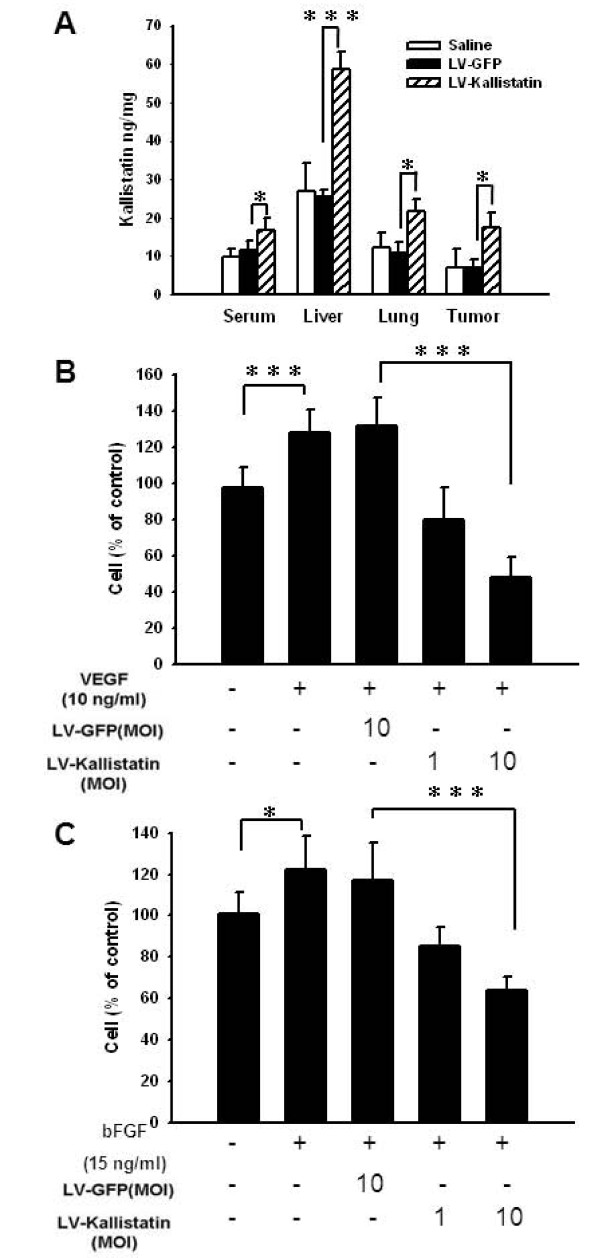
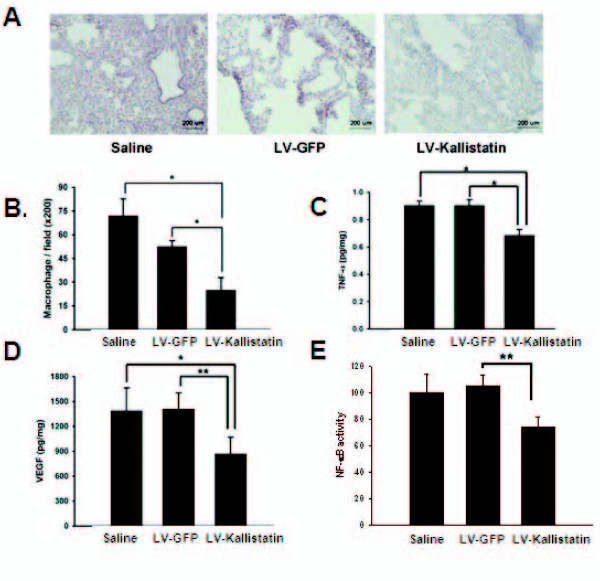
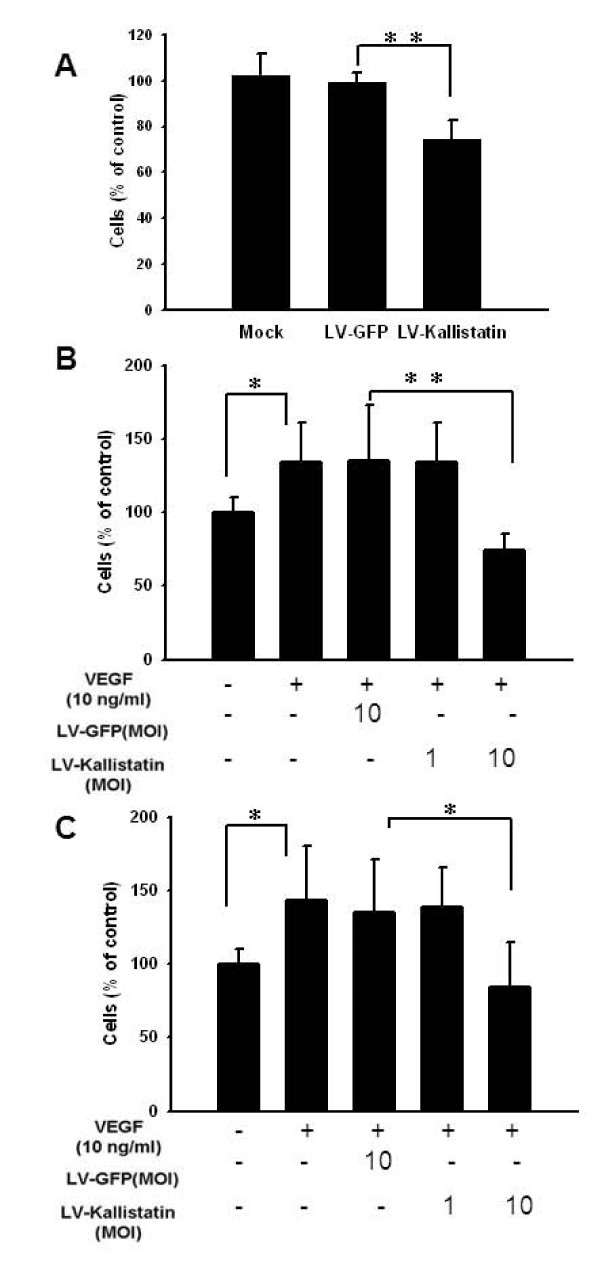
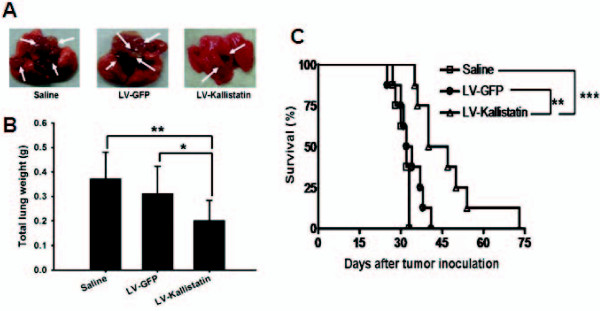
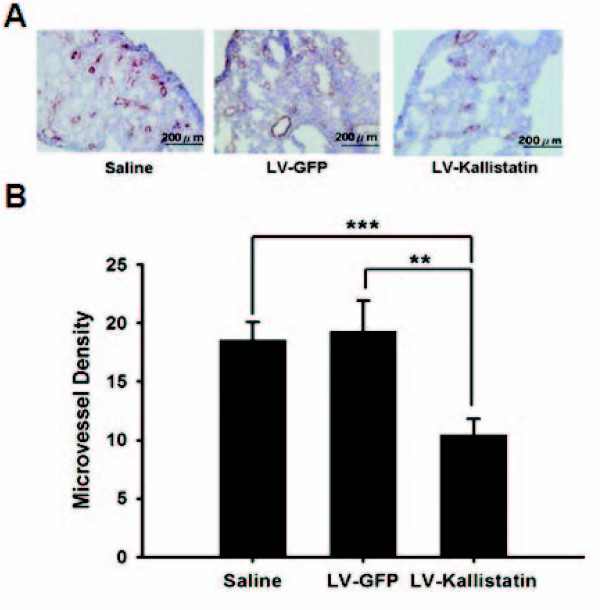
The conditioned medium from LV-Kallistatin-treated cells inhibited the migration and proliferation of endothelial cells. Meanwhile, it also reduced the migration and invasion of tumor cells. In the experimental lung metastatic model, tumor-bearing mice receiving LV-Kallistatin had lower tumor nodules and longer survival than those receiving control virus or saline. Moreover, the microvessel densities, the levels of vascular endothelial growth factor (VEGF), tumor necrosis factor (TNF)-alpha, and nuclear factor kappaB (NF-kappaB) transcriptional activity were reduced in the LV-Kallistatin-treated mice.
Results of this study showed that systemic administration of lentiviral vectors encoding kallistatin inhibited the growth of metastatic tumor and prolonged the survival of tumor-bearing mice. These results suggest that gene therapy using lentiviruses carrying the kallistatin gene, which exerts anti-angiogenic and anti-inflammatory activities, represents a promising strategy for the treatment of lung cancer.
血管生成在肿瘤的发生和发展中起着重要作用。激肽释放酶原相关肽(Kallistatin)具有抗血管生成和抗炎作用,可能有效抑制肿瘤转移。我们研究了慢病毒介导的 Kallistatin 基因转移在同种异体小鼠肿瘤模型中的抗肿瘤作用。
构建了编码 Kallistatin 的慢病毒载体(LV-Kallistatin)。通过酶联免疫吸附试验(ELISA)验证 Kallistatin 的表达,并通过细胞增殖、迁移和侵袭试验测定 Kallistatin 的生物活性。此外,通过向荷瘤小鼠静脉注射病毒来评估 LV-Kallistatin 的抗肿瘤作用。
LV-Kallistatin 处理过的细胞条件培养基抑制了内皮细胞的迁移和增殖。同时,它还减少了肿瘤细胞的迁移和侵袭。在实验性肺转移模型中,接受 LV-Kallistatin 的荷瘤小鼠的肿瘤结节较少,存活时间较长,而接受对照病毒或生理盐水的小鼠则较少。此外,LV-Kallistatin 治疗小鼠的微血管密度、血管内皮生长因子(VEGF)水平、肿瘤坏死因子(TNF)-α和核因子 kappaB(NF-kappaB)转录活性降低。
本研究结果表明,系统给予携带 Kallistatin 基因的慢病毒载体抑制了转移性肿瘤的生长并延长了荷瘤小鼠的存活时间。这些结果表明,携带 Kallistatin 基因的慢病毒基因治疗具有抗血管生成和抗炎作用,为治疗肺癌提供了一种有前途的策略。