National Laboratory of Biomacromolecules, Institute of Biophysics, Chinese Academy of Sciences, Beijing 100101, China; Graduate University of the Chinese Academy of Sciences, Beijing 100049, China.
Department of Biological Sciences, University of Warwick, Coventry CV4 7AL, United Kingdom.
J Biol Chem. 2010 Aug 27;285(35):26788-26797. doi: 10.1074/jbc.M110.107839. Epub 2010 Jun 1.
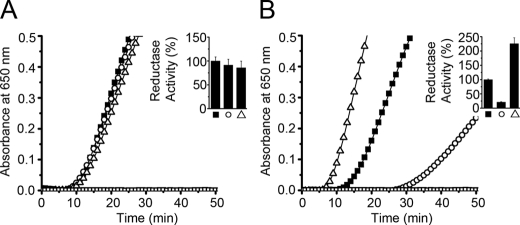
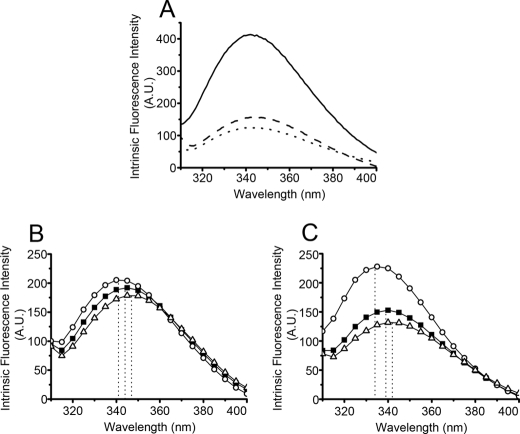
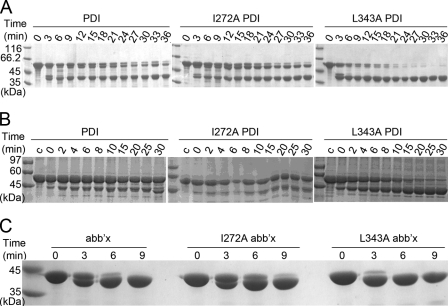
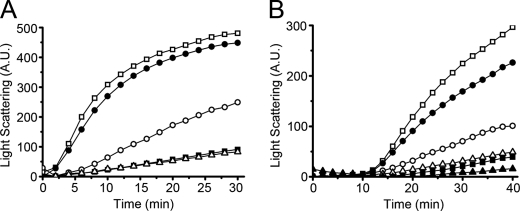
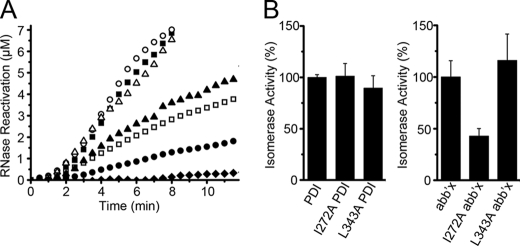
Protein disulfide isomerase (PDI), which consists of multiple domains arranged as abb'xa'c, is a key enzyme responsible for oxidative folding in the endoplasmic reticulum. In this work we focus on the conformational plasticity of this enzyme. Proteolysis of native human PDI (hPDI) by several proteases consistently targets sites in the C-terminal half of the molecule (x-linker and a' domain) leaving large fragments in which the N terminus is intact. Fluorescence studies on the W111F/W390F mutant of full-length PDI show that its fluorescence is dominated by Trp-347 in the x-linker which acts as an intrinsic reporter and indicates that this linker can move between "capped" and "uncapped" conformations in which it either occupies or exposes the major ligand binding site on the b' domain of hPDI. Studies with a range of constructs and mutants using intrinsic fluorescence, collision quenching, and extrinsic probe fluorescence (1-anilino-8-naphthalene sulfonate) show that the presence of the a' domain in full-length hPDI moderates the ability of the x-linker to generate the capped conformation (compared with shorter fragments) but does not abolish it. Hence, unlike yeast PDI, the major conformational plasticity of full-length hPDI concerns the mobility of the a' domain "arm" relative to the bb' "trunk" mediated by the x-linker. The chaperone and enzymatic activities of these constructs and mutants are consistent with the interpretation that the reversible interaction of the x-linker with the ligand binding site mediates access of protein substrates to this site.
蛋白质二硫键异构酶(PDI)由多个结构域排列组成 abb'xa'c,是内质网中负责氧化折叠的关键酶。在这项工作中,我们专注于该酶的构象可塑性。几种蛋白酶对天然人 PDI(hPDI)的蛋白水解作用一致靶向分子 C 端半部分的位点(x 链接器和 a' 结构域),留下大片段,其中 N 端完整。全长 PDI 的 W111F/W390F 突变体的荧光研究表明,其荧光由 x 链接器中的色氨酸-347主导,该色氨酸-347作为内在报告基团,表明该链接器可以在“封闭”和“开放”构象之间移动,在这两种构象中,它要么占据要么暴露 hPDI 的 b' 结构域上的主要配体结合位点。使用内在荧光、碰撞猝灭和外在探针荧光(1-苯胺基-8-萘磺酸盐)对一系列构建体和突变体的研究表明,全长 hPDI 中 a' 结构域的存在调节了 x 链接器产生封闭构象的能力(与较短片段相比),但并未完全消除该构象。因此,与酵母 PDI 不同,全长 hPDI 的主要构象可塑性涉及 x 链接器介导的 a' 结构域“臂”相对于 bb'“主干”的相对移动。这些构建体和突变体的伴侣和酶活性与以下解释一致,即 x 链接器与配体结合位点的可逆相互作用介导了蛋白质底物对该位点的进入。