Hermens Frouke, Ernst Udo
Laboratory of Psychophysics, Brain Mind Institutem, Ecole Polytechnique Fédérale de Lausanne (EPFL), Switzerland.
Adv Cogn Psychol. 2008 Jul 15;3(1-2):93-105. doi: 10.2478/v10053-008-0017-0.
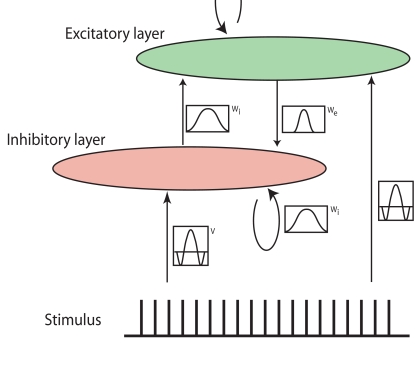
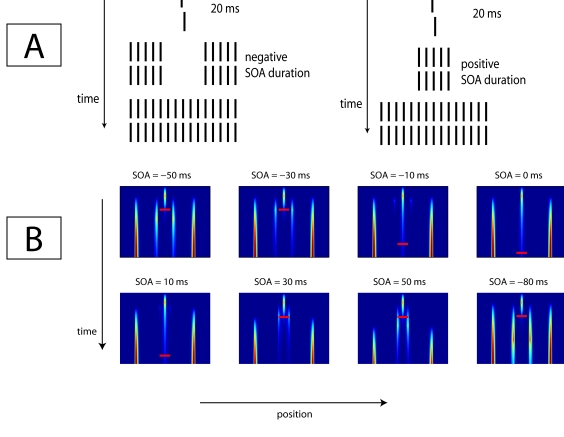
In modeling visual backward masking, the focus has been on temporal effects. More specifically, an explanation has been sought as to why strongest masking can occur when the mask is delayed with respect to the target. Although interesting effects of the spatial layout of the mask have been found, only a few attempts have been made to model these phenomena. Here, we elaborate a structurally simple model which employs lateral excitation and inhibition together with different neural time scales to explain many spatial and temporal aspects of backward masking. We argue that for better understanding of visual masking, it is vitally important to consider the interplay of spatial and temporal factors together in one single model.
在对视觉后向掩蔽进行建模时,重点一直放在时间效应上。更具体地说,人们一直在寻求一种解释,即为什么当掩蔽刺激相对于目标刺激延迟时会出现最强的掩蔽效果。尽管已经发现了掩蔽刺激空间布局的有趣效应,但只有少数尝试对这些现象进行建模。在这里,我们阐述了一个结构简单的模型,该模型利用侧向兴奋和抑制以及不同的神经时间尺度来解释后向掩蔽的许多空间和时间方面。我们认为,为了更好地理解视觉掩蔽,在一个单一模型中同时考虑空间和时间因素的相互作用至关重要。