van Donkelaar Aaron, Martin Randall V, Brauer Michael, Kahn Ralph, Levy Robert, Verduzco Carolyn, Villeneuve Paul J
Department of Physics and Atmospheric Science, Dalhousie University, Halifax, Nova Scotia, Canada.
Environ Health Perspect. 2010 Jun;118(6):847-55. doi: 10.1289/ehp.0901623.
Epidemiologic and health impact studies of fine particulate matter with diameter < 2.5 microm (PM2.5) are limited by the lack of monitoring data, especially in developing countries. Satellite observations offer valuable global information about PM2.5 concentrations.
In this study, we developed a technique for estimating surface PM2.5 concentrations from satellite observations.
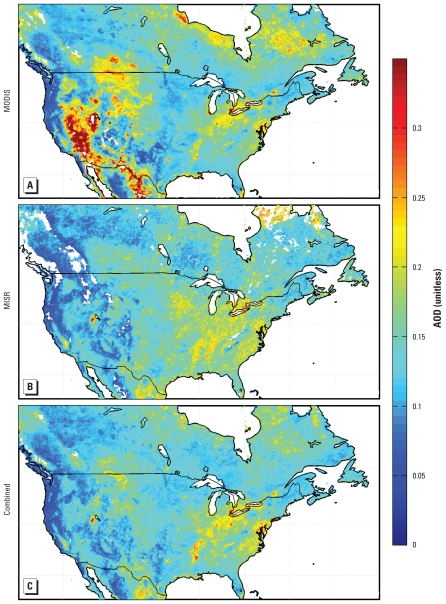
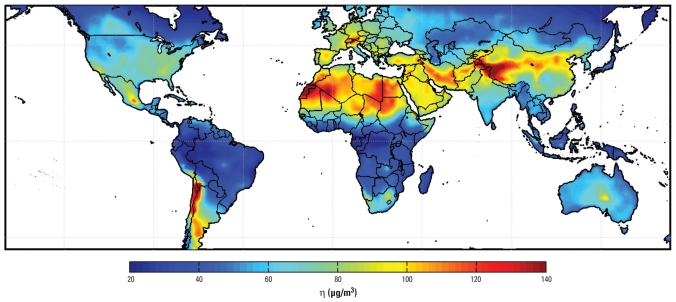
We mapped global ground-level PM2.5 concentrations using total column aerosol optical depth (AOD) from the MODIS (Moderate Resolution Imaging Spectroradiometer) and MISR (Multiangle Imaging Spectroradiometer) satellite instruments and coincident aerosol vertical profiles from the GEOS-Chem global chemical transport model.
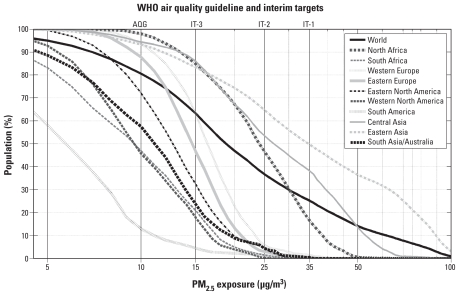
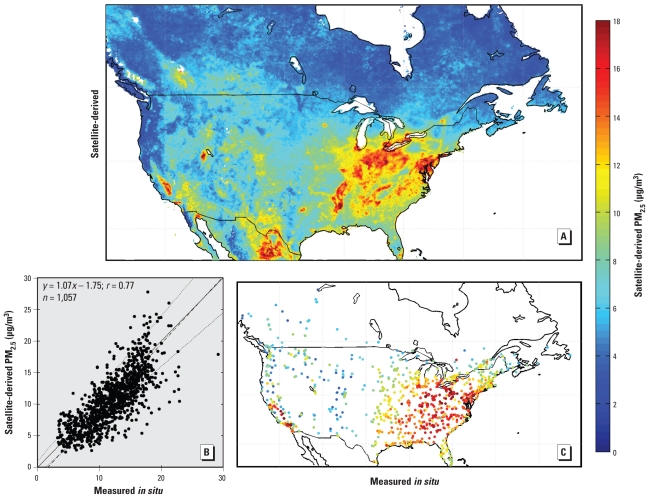
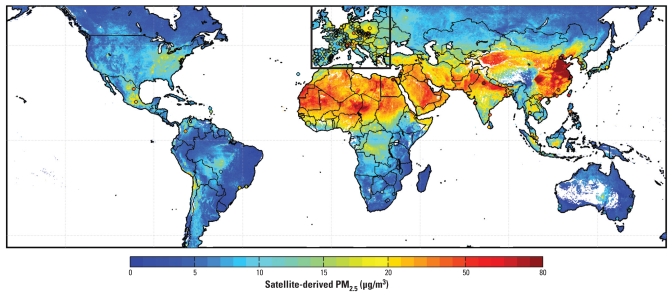
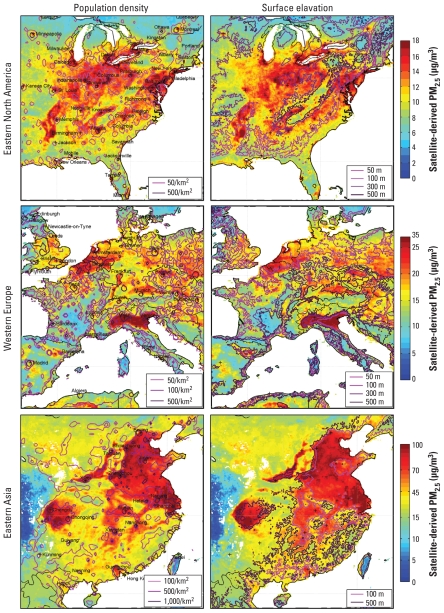
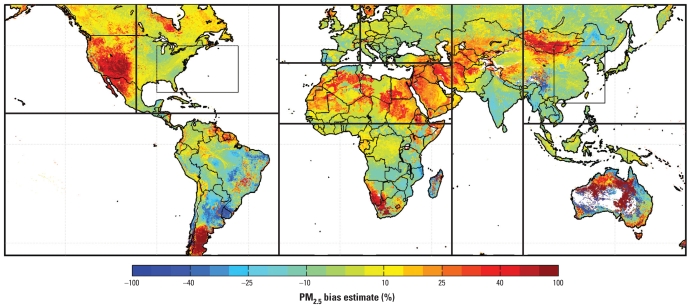
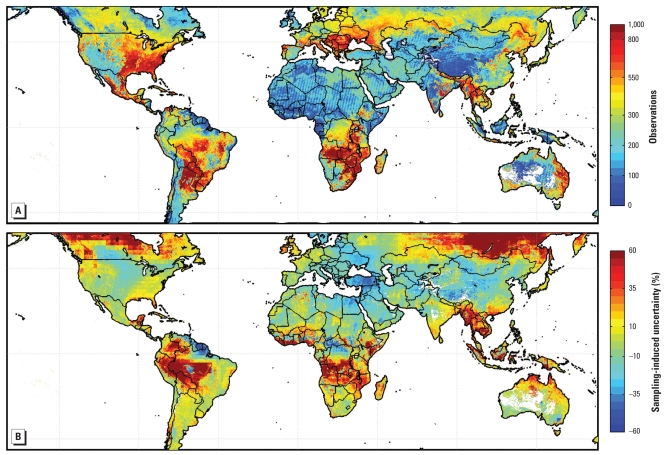
We determined that global estimates of long-term average (1 January 2001 to 31 December 2006) PM2.5 concentrations at approximately 10 km x 10 km resolution indicate a global population-weighted geometric mean PM2.5 concentration of 20 microg/m3. The World Health Organization Air Quality PM2.5 Interim Target-1 (35 microg/m3 annual average) is exceeded over central and eastern Asia for 38% and for 50% of the population, respectively. Annual mean PM2.5 concentrations exceed 80 microg/m3 over eastern China. Our evaluation of the satellite-derived estimate with ground-based in situ measurements indicates significant spatial agreement with North American measurements (r = 0.77; slope = 1.07; n = 1057) and with noncoincident measurements elsewhere (r = 0.83; slope = 0.86; n = 244). The 1 SD of uncertainty in the satellite-derived PM2.5 is 25%, which is inferred from the AOD retrieval and from aerosol vertical profile errors and sampling. The global population-weighted mean uncertainty is 6.7 microg/m3.
Satellite-derived total-column AOD, when combined with a chemical transport model, provides estimates of global long-term average PM2.5 concentrations.
直径小于2.5微米的细颗粒物(PM2.5)的流行病学和健康影响研究因缺乏监测数据而受到限制,尤其是在发展中国家。卫星观测提供了有关PM2.5浓度的宝贵全球信息。
在本研究中,我们开发了一种从卫星观测估计地面PM2.5浓度的技术。
我们利用中分辨率成像光谱仪(MODIS)和多角度成像光谱仪(MISR)卫星仪器的总柱气溶胶光学厚度(AOD)以及GEOS-Chem全球化学传输模型的同步气溶胶垂直剖面,绘制了全球地面PM2.5浓度图。
我们确定,以约10千米×10千米分辨率对2001年1月1日至2006年12月31日长期平均PM2.5浓度进行的全球估计表明,全球人口加权几何平均PM2.5浓度为20微克/立方米。在亚洲中部和东部,分别有38%的地区和50%的人口超过了世界卫生组织空气质量PM2.5临时目标-1(年平均35微克/立方米)。中国东部的年平均PM2.5浓度超过80微克/立方米。我们将卫星衍生估计值与地面原位测量值进行评估,结果表明与北美测量值存在显著空间一致性(r = 0.77;斜率 = 1.07;n = 1057),与其他地区的非同步测量值也存在显著空间一致性(r = 0.83;斜率 = 0.86;n = 244)。卫星衍生的PM2.5不确定性的1个标准差为25%,这是根据AOD反演以及气溶胶垂直剖面误差和采样推断得出的。全球人口加权平均不确定性为6.7微克/立方米。
卫星衍生的总柱AOD与化学传输模型相结合,可提供全球长期平均PM2.5浓度的估计值。