Laboratoire de Psychologie et Neuropsychologie Cognitives (FRE-3292), CNRS - Université Paris Descartes, Boulogne-Billancourt, France.
PLoS One. 2010 May 26;5(5):e10833. doi: 10.1371/journal.pone.0010833.
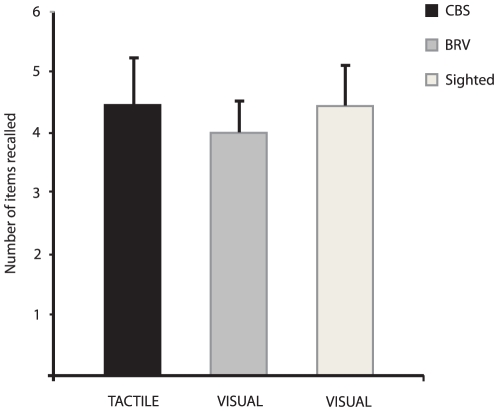
Blind individuals have been shown on multiple occasions to compensate for their loss of sight by developing exceptional abilities in their remaining senses. While most research has been focused on perceptual abilities per se in the auditory and tactile modalities, recent work has also investigated higher-order processes involving memory and language functions. Here we examined tactile working memory for Braille in two groups of visually challenged individuals (completely blind subjects, CBS; blind with residual vision, BRV). In a first experimental procedure both groups were given a Braille tactile memory span task with and without articulatory suppression, while the BRV and a sighted group performed a visual version of the task. It was shown that the Braille tactile working memory (BrWM) of CBS individuals under articulatory suppression is as efficient as that of sighted individuals' visual working memory in the same condition. Moreover, the results suggest that BrWM may be more robust in the CBS than in the BRV subjects, thus pointing to the potential role of visual experience in shaping tactile working memory. A second experiment designed to assess the nature (spatial vs. verbal) of this working memory was then carried out with two new CBS and BRV groups having to perform the Braille task concurrently with a mental arithmetic task or a mental displacement of blocks task. We show that the disruption of memory was greatest when concurrently carrying out the mental displacement of blocks, indicating that the Braille tactile subsystem of working memory is likely spatial in nature in CBS. The results also point to the multimodal nature of working memory and show how experience can shape the development of its subcomponents.
盲人多次被证明通过发展其剩余感官的非凡能力来弥补视力的丧失。虽然大多数研究都集中在听觉和触觉模态本身的感知能力上,但最近的工作也研究了涉及记忆和语言功能的高阶过程。在这里,我们在两组视力受损者(完全失明者,CBS;有残余视力的盲人,BRV)中检查了盲文触觉工作记忆。在第一个实验程序中,两组人都在有和没有发音抑制的情况下进行了盲文触觉记忆广度任务,而 BRV 和视力正常组则执行了任务的视觉版本。结果表明,在发音抑制下,CBS 个体的盲文触觉工作记忆(BrWM)与相同条件下视力正常个体的视觉工作记忆一样高效。此外,结果表明 BrWM 在 CBS 中可能比在 BRV 中更稳健,从而表明视觉经验在塑造触觉工作记忆方面的潜在作用。然后进行了第二个实验,旨在评估这种工作记忆的性质(空间与言语),使用两个新的 CBS 和 BRV 组进行,他们必须同时执行盲文任务、心算任务或积木心理移位任务。我们表明,当同时进行积木心理移位时,记忆的干扰最大,这表明 CBS 中盲文触觉工作记忆子系统可能具有空间性质。结果还指出了工作记忆的多模态性质,并展示了经验如何塑造其子组件的发展。