Genomic Interactions Group, Research School of Biology, College of Medicine, Biology and Environment, The Australian National University, Canberra, Australian Capital Territory, Australia.
PLoS One. 2010 May 25;5(5):e10820. doi: 10.1371/journal.pone.0010820.
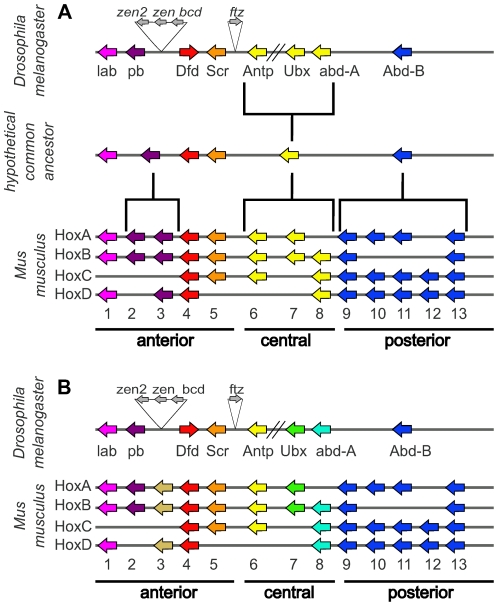
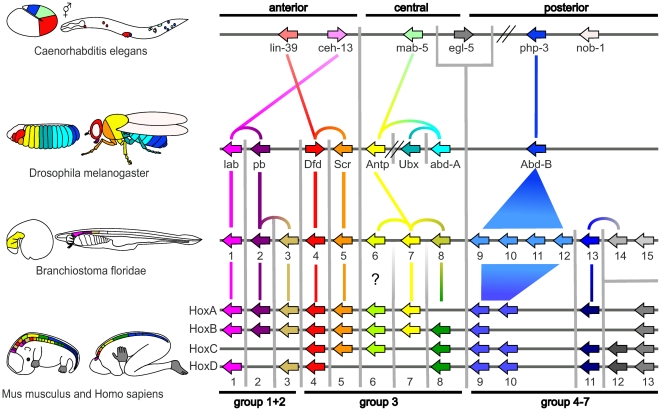
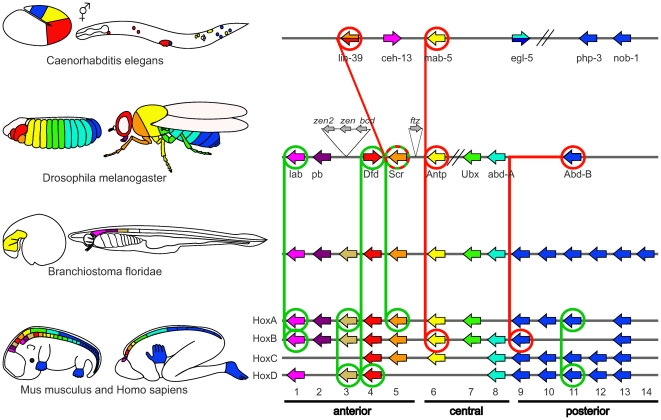
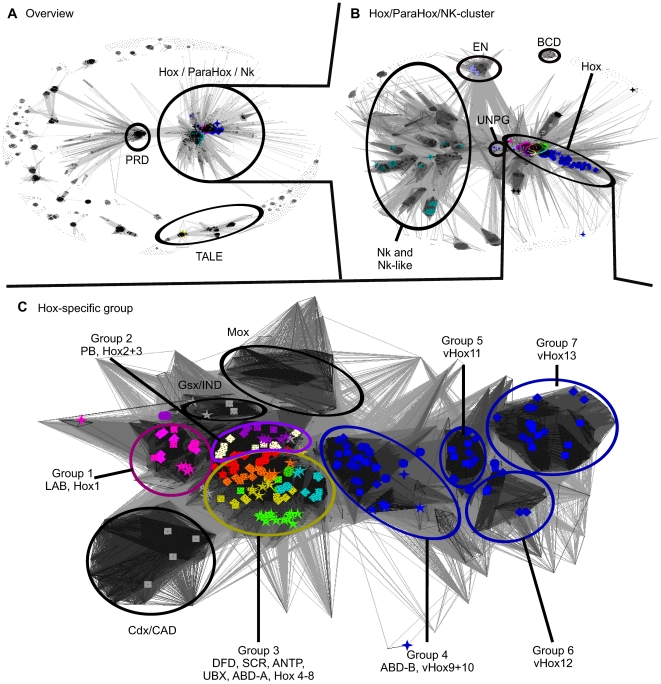
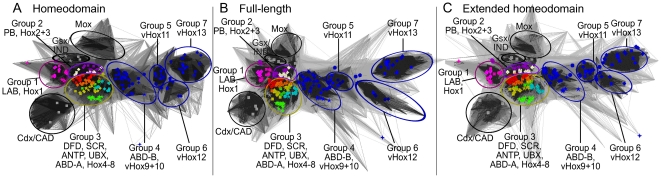
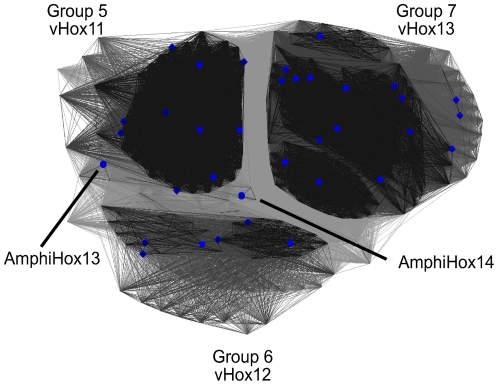
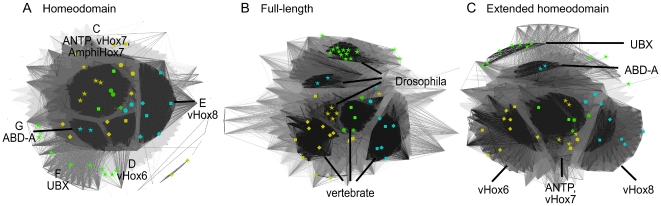
The family of Hox-proteins has been a major focus of research for over 30 years. Hox-proteins are crucial to the correct development of bilateral organisms, however, some uncertainty remains as to which Hox-proteins are functionally equivalent across different species. Initial classification of Hox-proteins was based on phylogenetic analysis of the 60 amino acid homeodomain. This approach was successful in classifying Hox-proteins with differing homeodomains, but the relationships of Hox-proteins with nearly identical homeodomains, yet distinct biological functions, could not be resolved. Correspondingly, these 'problematic' proteins were classified into one large unresolved group. Other classifications used the relative location of the Hox-protein coding genes on the chromosome (synteny) to further resolve this group. Although widely used, this synteny-based classification is inconsistent with experimental evidence from functional equivalence studies. These inconsistencies led us to re-examine and derive a new classification for the Hox-protein family using all Hox-protein sequences available in the GenBank non-redundant protein database (NCBI-nr). We compare the use of the homeodomain, the homeodomain with conserved flanking regions (the YPWM and linker region), and full length Hox-protein sequences as a basis for classification of Hox-proteins. In contrast to previous attempts, our approach is able to resolve the relationships for the 'problematic' as well as ABD-B-like Hox-proteins. We highlight differences to previous classifications and clarify the relationships of Hox-proteins across the five major model organisms, Caenorhabditis elegans, Drosophila melanogaster, Branchiostoma floridae, Mus musculus and Danio rerio. Comparative and functional analysis of Hox-proteins, two fields crucial to understanding the development of bilateral organisms, have been hampered by difficulties in predicting functionally equivalent Hox-proteins across species. Our classification scheme offers a higher-resolution classification that is in accordance with phylogenetic as well as experimental data and, thereby, provides a novel basis for experiments, such as comparative and functional analyses of Hox-proteins.
Hox 蛋白家族一直是研究的重点对象,已经超过 30 年了。Hox 蛋白对于双侧生物的正确发育至关重要,然而,在不同物种中哪些 Hox 蛋白具有功能等效性仍然存在一些不确定性。最初的 Hox 蛋白分类是基于 60 个氨基酸同源域的系统发育分析。这种方法成功地对具有不同同源域的 Hox 蛋白进行了分类,但对于具有几乎相同同源域但具有不同生物学功能的 Hox 蛋白的关系则无法解决。相应地,这些“有问题”的蛋白质被归类为一个未解决的大组。其他分类方法使用 Hox 蛋白编码基因在染色体上的相对位置(同线性)来进一步解决这个问题。尽管这种同线性分类法被广泛使用,但它与功能等效性研究的实验证据不一致。这些不一致促使我们重新检查并使用 GenBank 非冗余蛋白质数据库(NCBI-nr)中可用的所有 Hox 蛋白序列为 Hox 蛋白家族生成一个新的分类。我们比较了使用同源域、包含保守侧翼区域的同源域(YPWM 和连接子区域)以及全长 Hox 蛋白序列作为 Hox 蛋白分类的基础。与之前的尝试不同,我们的方法能够解决“有问题”的以及 ABD-B 样 Hox 蛋白的关系。我们强调了与之前分类的区别,并阐明了跨越五种主要模式生物(秀丽隐杆线虫、黑腹果蝇、文昌鱼、小家鼠和斑马鱼)的 Hox 蛋白之间的关系。Hox 蛋白的比较和功能分析对于理解双侧生物的发育至关重要,但由于难以预测物种间具有功能等效性的 Hox 蛋白,这两个领域一直受到阻碍。我们的分类方案提供了一种更高分辨率的分类,它与系统发育和实验数据一致,从而为 Hox 蛋白的比较和功能分析等实验提供了新的基础。