Cain Brittany, Gebelein Brian
Division of Developmental Biology, Cincinnati Children's Hospital Medical Center, Cincinnati, OH, United States.
Department of Pediatrics, University of Cincinnati College of Medicine, Cincinnati, OH, United States.
Front Cell Dev Biol. 2021 Nov 16;9:787339. doi: 10.3389/fcell.2021.787339. eCollection 2021.
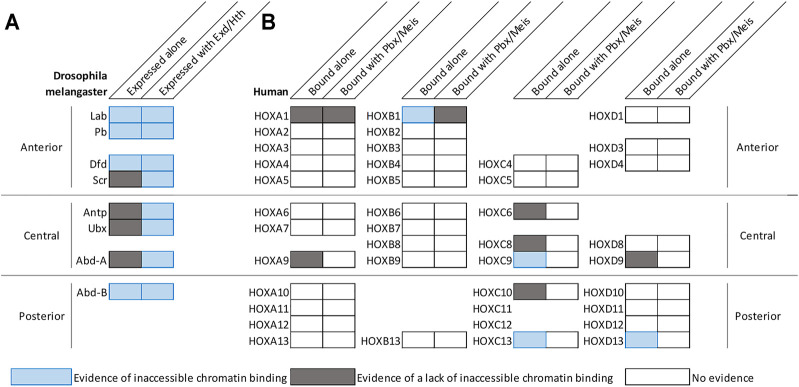
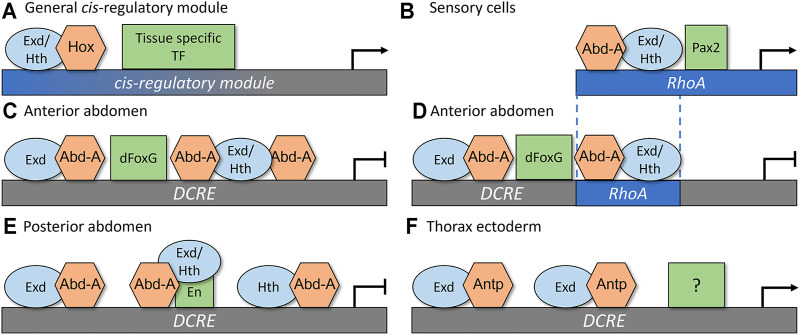
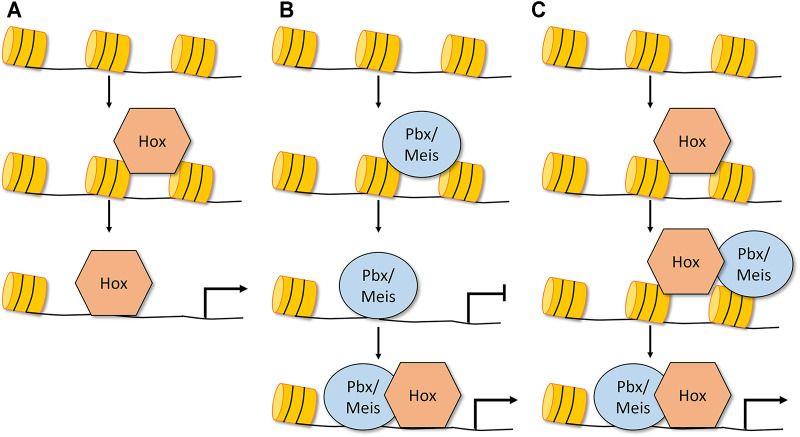
Metazoans differentially express multiple Hox transcription factors to specify diverse cell fates along the developing anterior-posterior axis. Two challenges arise when trying to understand how the Hox transcription factors regulate the required target genes for morphogenesis: First, how does each Hox factor differ from one another to accurately activate and repress target genes required for the formation of distinct segment and regional identities? Second, how can a Hox factor that is broadly expressed in many tissues within a segment impact the development of specific organs by regulating target genes in a cell type-specific manner? In this review, we highlight how recent genomic, interactome, and -regulatory studies are providing new insights into answering these two questions. Collectively, these studies suggest that Hox factors may differentially modify the chromatin of gene targets as well as utilize numerous interactions with additional co-activators, co-repressors, and sequence-specific transcription factors to achieve accurate segment and cell type-specific transcriptional outcomes.
后生动物差异性地表达多种Hox转录因子,以沿发育中的前后轴确定不同的细胞命运。在试图理解Hox转录因子如何调控形态发生所需的靶基因时,出现了两个挑战:第一,每个Hox因子彼此之间有何不同,从而准确激活和抑制形成不同节段和区域特征所需的靶基因?第二,在一个节段内许多组织中广泛表达的Hox因子如何通过以细胞类型特异性方式调控靶基因来影响特定器官的发育?在这篇综述中,我们强调了最近的基因组学、相互作用组学和调控研究如何为回答这两个问题提供新的见解。总体而言,这些研究表明,Hox因子可能会差异性地修饰基因靶标的染色质,并利用与其他共激活因子、共抑制因子和序列特异性转录因子的大量相互作用,以实现准确的节段和细胞类型特异性转录结果。