Society of Fellows, Harvard University, Cambridge, Massachusetts, United States of America.
PLoS Biol. 2010 May 25;8(5):e1000377. doi: 10.1371/journal.pbio.1000377.
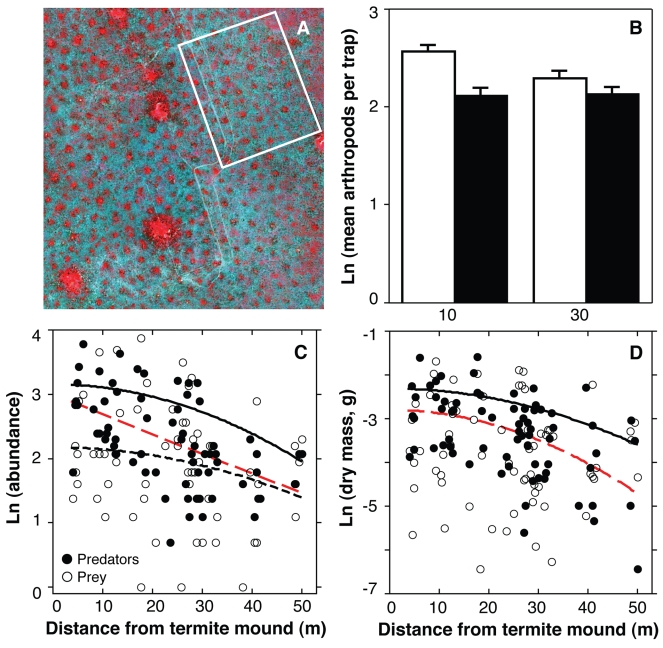
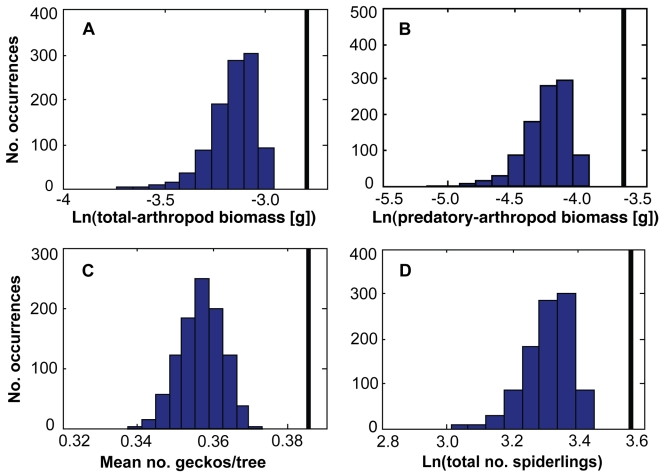
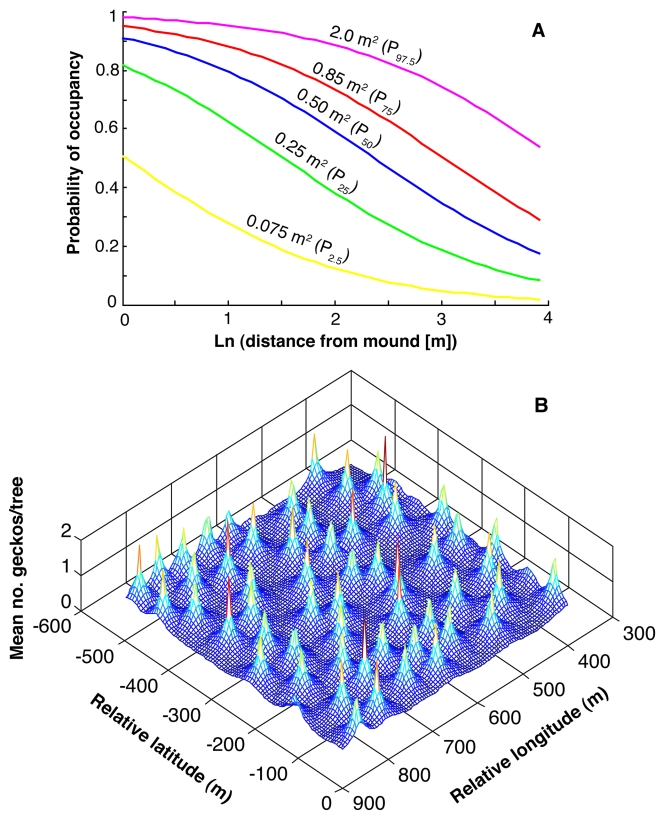
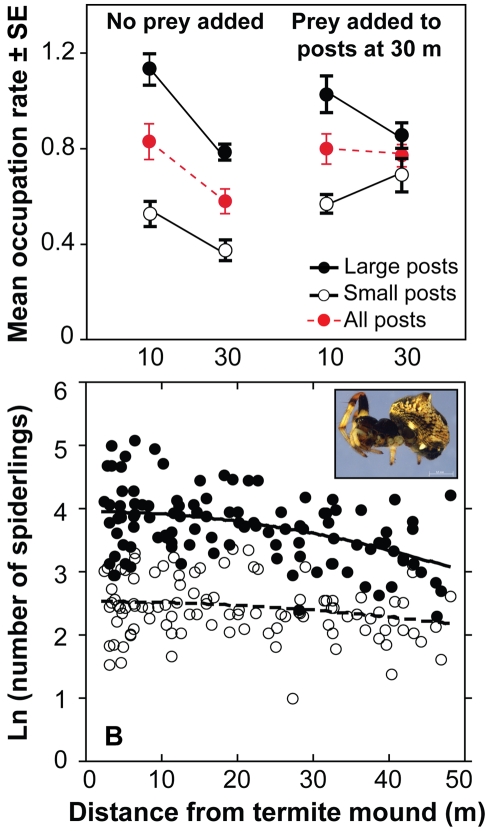
The finding that regular spatial patterns can emerge in nature from local interactions between organisms has prompted a search for the ecological importance of these patterns. Theoretical models have predicted that patterning may have positive emergent effects on fundamental ecosystem functions, such as productivity. We provide empirical support for this prediction. In dryland ecosystems, termite mounds are often hotspots of plant growth (primary productivity). Using detailed observations and manipulative experiments in an African savanna, we show that these mounds are also local hotspots of animal abundance (secondary and tertiary productivity): insect abundance and biomass decreased with distance from the nearest termite mound, as did the abundance, biomass, and reproductive output of insect-eating predators. Null-model analyses indicated that at the landscape scale, the evenly spaced distribution of termite mounds produced dramatically greater abundance, biomass, and reproductive output of consumers across trophic levels than would be obtained in landscapes with randomly distributed mounds. These emergent properties of spatial pattern arose because the average distance from an arbitrarily chosen point to the nearest feature in a landscape is minimized in landscapes where the features are hyper-dispersed (i.e., uniformly spaced). This suggests that the linkage between patterning and ecosystem functioning will be common to systems spanning the range of human management intensities. The centrality of spatial pattern to system-wide biomass accumulation underscores the need to conserve pattern-generating organisms and mechanisms, and to incorporate landscape patterning in efforts to restore degraded habitats and maximize the delivery of ecosystem services.
从生物体之间的局部相互作用中自然出现的规则空间模式的发现,促使人们去寻找这些模式对生态系统的重要性。理论模型预测,模式的形成可能对基本的生态系统功能(如生产力)产生积极的影响。我们提供了对这一预测的实证支持。在旱地生态系统中,白蚁丘通常是植物生长的热点(初级生产力)。我们利用非洲热带稀树草原的详细观测和操纵实验,表明这些土丘也是动物丰度的局部热点(次级和三级生产力):昆虫的丰度和生物量随着与最近的白蚁丘的距离的增加而减少,食虫捕食者的丰度、生物量和生殖输出也减少了。零模型分析表明,在景观尺度上,白蚁丘的均匀分布产生了显著更高的消费者丰度、生物量和生殖输出,跨越了营养级,而不是在具有随机分布的土丘的景观中获得的。这种空间模式的涌现属性是由于在特征超分散(即均匀分布)的景观中,从任意选择的点到最近特征的平均距离最小化。这表明,模式形成与生态系统功能之间的联系将在人类管理强度范围广泛的系统中普遍存在。空间模式对系统范围内生物量积累的核心地位强调了保护产生模式的生物和机制的必要性,并将景观模式纳入恢复退化栖息地和最大化生态系统服务的努力中。