Department of Pharmaceutical Technology, Jadavpur University, India.
Indian J Pharmacol. 2009 Aug;41(4):176-81. doi: 10.4103/0253-7613.56075.
In drug discovery research, the compounds should not only to be potent and selective but also must possess acceptable pharmacokinetic properties such as absorption, distribution, metabolism, and excretion (ADME) to increase success rate in clinical studies.
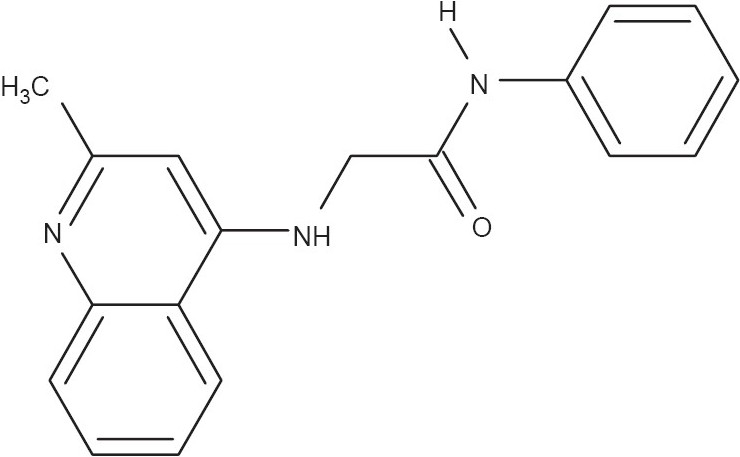
Exploration of drug-like properties of 2-(2-methylquinolin-4-ylamino)-N-phenyl acetamide, a potent antileishmanial compound by performing some in vitro ADME experiments along with validation of such studies.
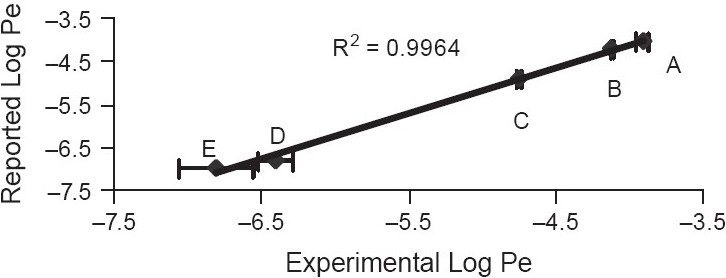
Experimental protocols were established and validated for stability (in PBS pH7.4, simulated gastric and intestinal fluid), solubility, permeability, distribution coefficient (Log D), plasma protein binding and metabolism by rat liver microsomes by using spectrophotometer or HPLC. Methods were considered valid if the results of the standard compounds matched with reported results or within acceptable range or with proper ranking (high-medium-low).
The compound was found to be stable (>95% remaining) in all stability studies and aqueous solubility was 299.7 +/- 6.42 muM. The parallel artificial membrane permeability assay (PAMPA) indicated its medium permeability (Log Pe = -5.53 +/- 0.01). The distribution coefficients (Log D) in octanol/PBS and cyclohexane/PBS systems were found to be 0.54 and -1.33, respectively. The plasma protein binding study by the equilibrium dialysis method was observed to be 78.82 +/- 0.13% while metabolism by Phase-I enzymes for 1 hour at 37 degrees C revealed that 36.07 +/- 4.15% of the compound remained after metabolism.
The methods were found to be very useful for day-to-day ADME studies. All the studies with the antileishmanial compound ascertained that the compound bears optimum pharmacokinetic properties to be used orally as a potential drug for the treatment of leishmaniasis.
在药物发现研究中,化合物不仅应该具有强效和选择性,还必须具有可接受的药代动力学特性,如吸收、分布、代谢和排泄(ADME),以提高临床研究的成功率。
通过进行一些体外 ADME 实验并验证这些研究,探索 2-(2-甲基喹啉-4-基氨基)-N-苯基乙酰胺作为一种有效的抗利什曼原虫化合物的类药性。
使用分光光度计或 HPLC 为稳定性(在 PBS pH7.4、模拟胃液和肠液中)、溶解度、渗透性、分配系数(Log D)、血浆蛋白结合和大鼠肝微粒体代谢建立和验证实验方案。如果标准化合物的结果与报道的结果或可接受的范围内或适当的排名(高-中-低)相匹配,则认为方法是有效的。
该化合物在所有稳定性研究中均被发现稳定(>95%残留),水溶解度为 299.7±6.42μM。平行人工膜渗透性测定(PAMPA)表明其中等渗透性(Log Pe=-5.53±0.01)。在辛醇/PBS 和环己烷/PBS 系统中的分配系数(Log D)分别为 0.54 和-1.33。平衡透析法的血浆蛋白结合研究观察到 78.82±0.13%,而在 37°C 下 1 小时进行的 Phase-I 酶代谢研究表明,代谢后化合物仍有 36.07±4.15%。
这些方法对于日常的 ADME 研究非常有用。所有针对抗利什曼原虫化合物的研究都表明,该化合物具有最佳的药代动力学特性,可作为治疗利什曼病的口服潜在药物。