Department of Industrial and Physical Pharmacy, School of Pharmacy, Purdue University, West Lafayette, Indiana, USA.
Mol Pharm. 2010 Aug 2;7(4):1057-68. doi: 10.1021/mp900178j.
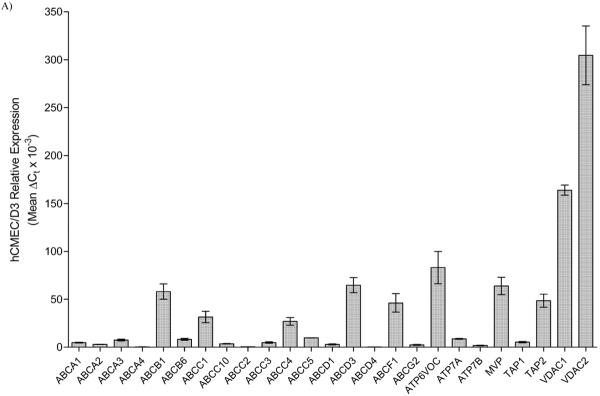
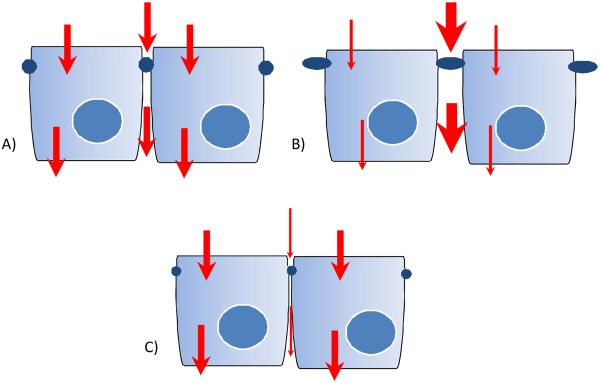
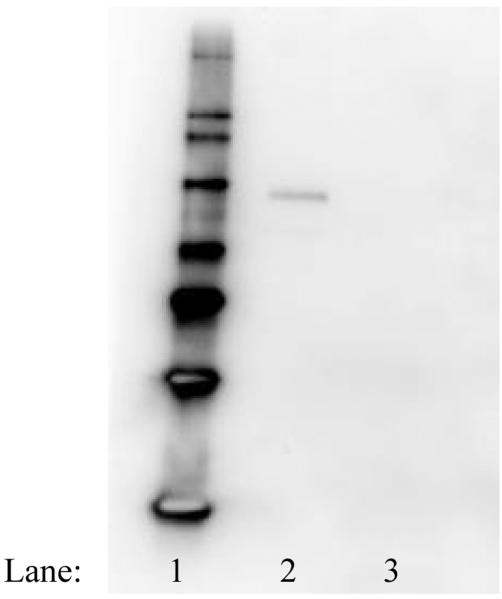
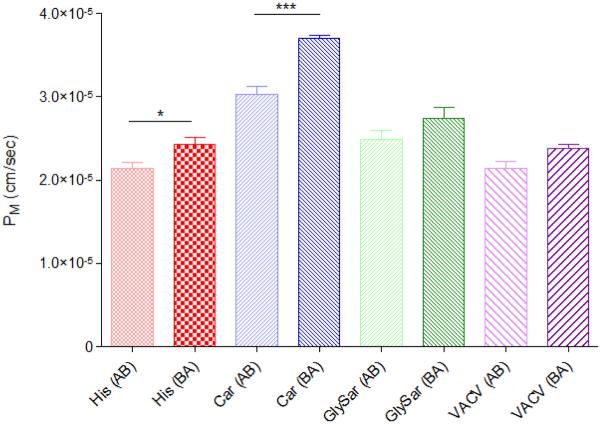
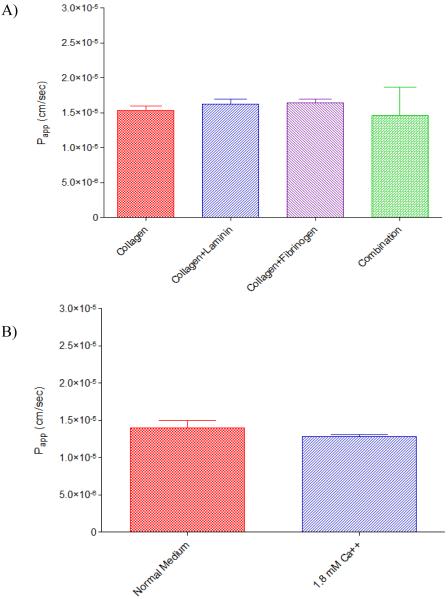
Initial studies indicate that the newly developed hCMEC/D3 cell line may prove to be a useful model for studying the physiology of the human blood-brain barrier (BBB) endothelium. The purpose of this study was to assess the mRNA expression of several ABC and SLC transporters, with an emphasis on the proton-coupled oligopeptide transporter superfamily (POT) transporters in this immortalized BBB cell model. The transport kinetics of POT-substrates was also evaluated. The hCMEC/D3 cell line was maintained in a modified EGM-2 medium in collagenated culture flasks and passaged every 3-4 days at approximately 85%-95% confluence. Messenger RNA (mRNA) expression of a variety of ABC and SLC transporters was evaluated using qRT-PCR arrays, while additional qRT-PCR primers were designed to assess the expression of POT members. The transport kinetics of mannitol and urea were utilized to quantitatively estimate the intercellular pore radius, while POT substrate transport was also determined to assess the suitability of the cell model from a drug screening perspective. Optimization of the cell line was attempted by culturing with on laminin and fibronectin enhanced collagen and in the presence of excess Ca(2+). hCMEC/D3 cells express both hPHT1 and hPHT2, while little to no expression of either hPepT1 or hPepT2 was observed. The relative expression of other ABC and SLC transporters is discussed. While POT substrate transport does suggest suitability for BBB drug permeation screening, the relative intercellular pore radius was estimated at 19 A, significantly larger than that approximated in vivo. Culturing with extracellular matrix proteins did not alter mannitol permeability. These studies characterized this relevant human hCMEC/D3 BBB cell line with respect to both the relative mRNA expression of various ABC and SLC transporters and its potential utility as an in vitro screening tool for brain permeation. Additional studies are required to adequately determine the potential to establish an in vivo correlation.
初步研究表明,新开发的 hCMEC/D3 细胞系可能被证明是研究人血脑屏障 (BBB) 内皮细胞生理学的有用模型。本研究旨在评估几种 ABC 和 SLC 转运体的 mRNA 表达,重点是该永生化 BBB 细胞模型中的质子偶联寡肽转运体超家族 (POT) 转运体。还评估了 POT 底物的转运动力学。hCMEC/D3 细胞系在改良的 EGM-2 培养基中于胶原化培养瓶中维持,并在大约 85%-95%汇合度时每 3-4 天传代一次。使用 qRT-PCR 阵列评估各种 ABC 和 SLC 转运体的信使 RNA (mRNA) 表达,同时设计了额外的 qRT-PCR 引物来评估 POT 成员的表达。甘露醇和尿素的转运动力学用于定量估计细胞间孔半径,而 POT 底物的转运也用于从药物筛选的角度评估细胞模型的适用性。通过在存在过量 Ca(2+) 的情况下在层粘连蛋白和纤连蛋白增强的胶原上培养来尝试优化细胞系。hCMEC/D3 细胞表达 hPHT1 和 hPHT2,而几乎没有观察到 hPepT1 或 hPepT2 的表达。讨论了其他 ABC 和 SLC 转运体的相对表达。虽然 POT 底物的转运确实表明适合 BBB 药物渗透筛选,但相对细胞间孔半径估计为 19 A,明显大于体内近似值。用细胞外基质蛋白培养不会改变甘露醇的通透性。这些研究根据各种 ABC 和 SLC 转运体的相对 mRNA 表达及其作为体外筛选工具用于脑渗透的潜力,对相关的人 hCMEC/D3 BBB 细胞系进行了表征。需要进一步的研究来充分确定建立体内相关性的潜力。