Department of Anesthesiology, Intensive Care Medicine and Pain Management, Hanse-Klinikum Stralsund, Grosse Parower Strasse 47-53, Stralsund 18435, Germany.
Crit Care. 2010;14(3):R103. doi: 10.1186/cc9047. Epub 2010 Jun 3.
It has been proposed that individual genetic variation contributes to the course of severe infections and sepsis. Recent studies of single nucleotide polymorphisms (SNPs) within the endotoxin receptor and its signaling system showed an association with the risk of disease development. This study aims to examine the response associated with genetic variations of TLR4, the receptor for bacterial LPS, and a central intracellular signal transducer (TIRAP/Mal) on cytokine release and for susceptibility and course of severe hospital acquired infections in distinct patient populations.
Three intensive care units in tertiary care university hospitals in Greece and Germany participated. 375 and 415 postoperative patients and 159 patients with ventilator associated pneumonia (VAP) were included. TLR4 and TIRAP/Mal polymorphisms in 375 general surgical patients were associated with risk of infection, clinical course and outcome. In two prospective studies, 415 patients following cardiac surgery and 159 patients with newly diagnosed VAP predominantly caused by Gram-negative bacteria were studied for cytokine levels in-vivo and after ex-vivo monocyte stimulation and clinical course.
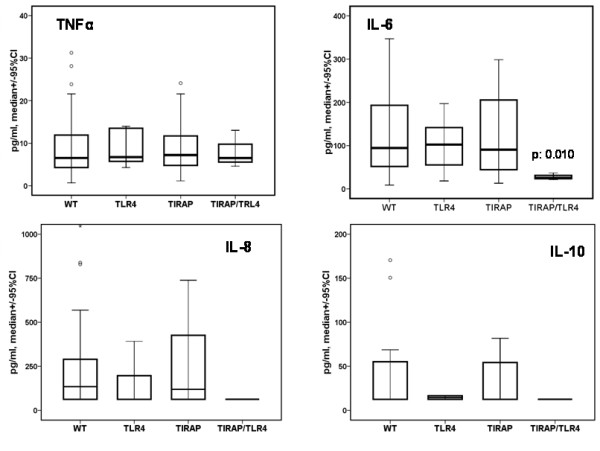
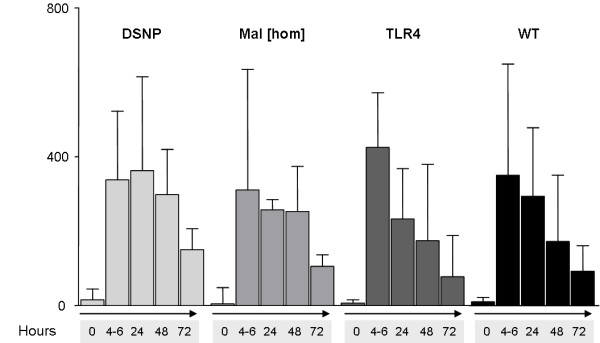
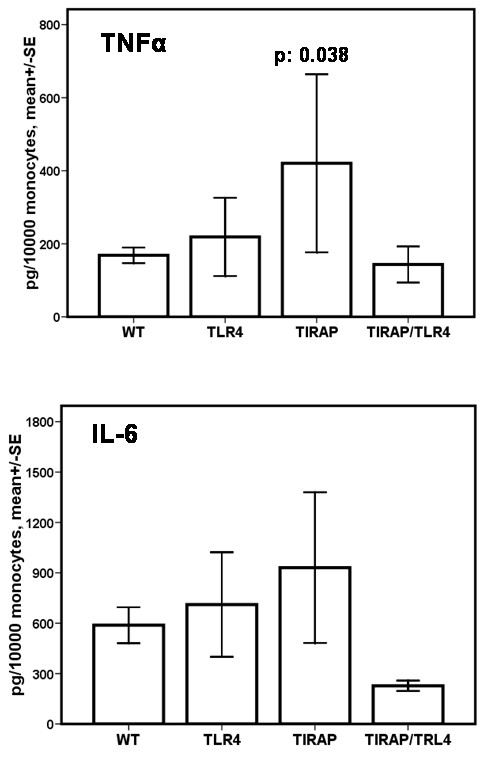
Patients simultaneously carrying polymorphisms in TIRAP/Mal and TLR4 and patients homozygous for the TIRAP/Mal SNP had a significantly higher risk of severe infections after surgery (odds ratio (OR) 5.5; confidence interval (CI): 1.34 - 22.64; P = 0.02 and OR: 7.3; CI: 1.89 - 28.50; P < 0.01 respectively). Additionally we found significantly lower circulating cytokine levels in double-mutant individuals with ventilator associated pneumonia and reduced cytokine production in an ex-vivo monocyte stimulation assay, but this difference was not apparent in TIRAP/Mal-homozygous patients. In cardiac surgery patients without infection, the cytokine release profiles were not changed when comparing different genotypes.
Carriers of mutations in sequential components of the TLR signaling system may have an increased risk for severe infections. Patients with this genotype showed a decrease in cytokine release when infected which was not apparent in patients with sterile inflammation following cardiac surgery.
有人提出,个体遗传变异会影响严重感染和败血症的病程。最近对内毒素受体及其信号系统中的单核苷酸多态性(SNP)的研究表明,其与疾病发展的风险有关。本研究旨在研究与细菌 LPS 受体 TLR4 及其信号转导系统中的遗传变异相关的反应,该反应与不同患者人群中严重医院获得性感染的易感性和病程有关。
希腊和德国的 3 家三级护理大学医院的 3 个重症监护病房参与了该研究。共纳入 375 例术后患者、415 例心脏手术后患者和 159 例呼吸机相关性肺炎(VAP)患者。对 375 例普通外科患者的 TLR4 和 TIRAP/Mal 多态性与感染风险、临床病程和结局进行了关联分析。在两项前瞻性研究中,对 415 例心脏手术后患者和 159 例主要由革兰氏阴性菌引起的新诊断的 VAP 患者进行了体内和体外单核细胞刺激后细胞因子水平以及临床病程的研究。
同时携带 TIRAP/Mal 和 TLR4 多态性的患者和 TIRAP/Mal SNP 纯合子的患者在手术后发生严重感染的风险显著增加(比值比(OR)为 5.5;95%置信区间(CI)为 1.34-22.64;P = 0.02 和 OR 为 7.3;95%CI 为 1.89-28.50;P < 0.01)。此外,我们发现 VAP 合并双重突变的个体循环细胞因子水平显著降低,体外单核细胞刺激试验中细胞因子产生减少,但 TIRAP/Mal 纯合子患者未见此差异。在无感染的心脏手术患者中,比较不同基因型时细胞因子释放谱没有变化。
TLR 信号系统连续组分的突变携带者可能有发生严重感染的风险增加。感染时,该基因型患者的细胞因子释放减少,但心脏手术后无菌性炎症患者未见此现象。