Department of Sports Medicine and Sports Nutrition, University of Bochum, Bochum, Germany.
BMC Musculoskelet Disord. 2010 Jun 3;11:110. doi: 10.1186/1471-2474-11-110.
Multiple epiphyseal dysplasia (MED) is one of the more common generalised skeletal dysplasias. Due to its clinical heterogeneity diagnosis may be difficult. Mutations of at least six separate genes can cause MED. Joint deformities, joint pain and gait disorders are common symptoms.
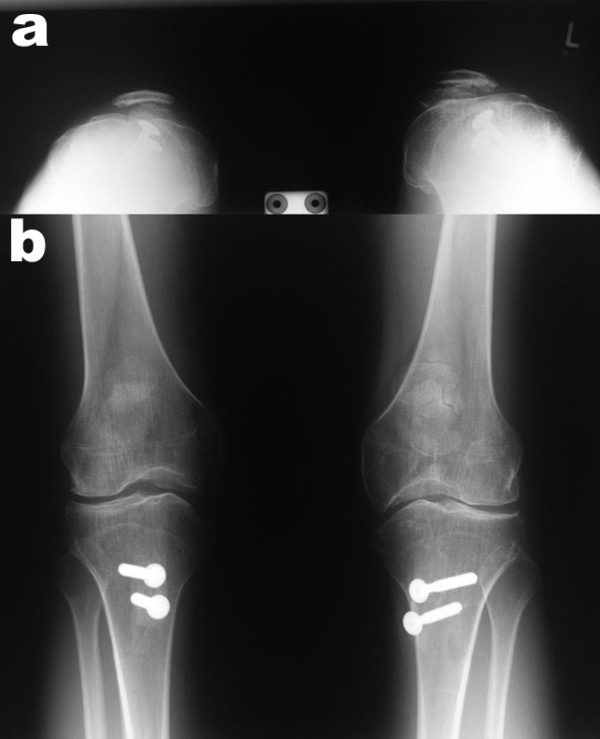
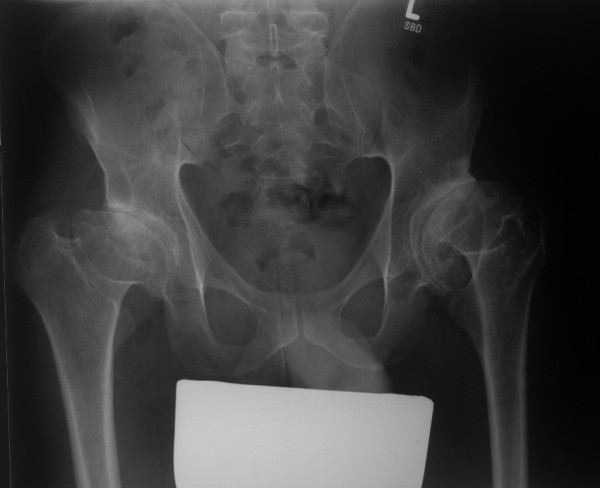
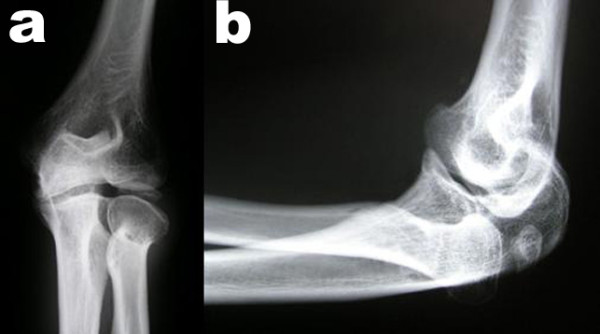
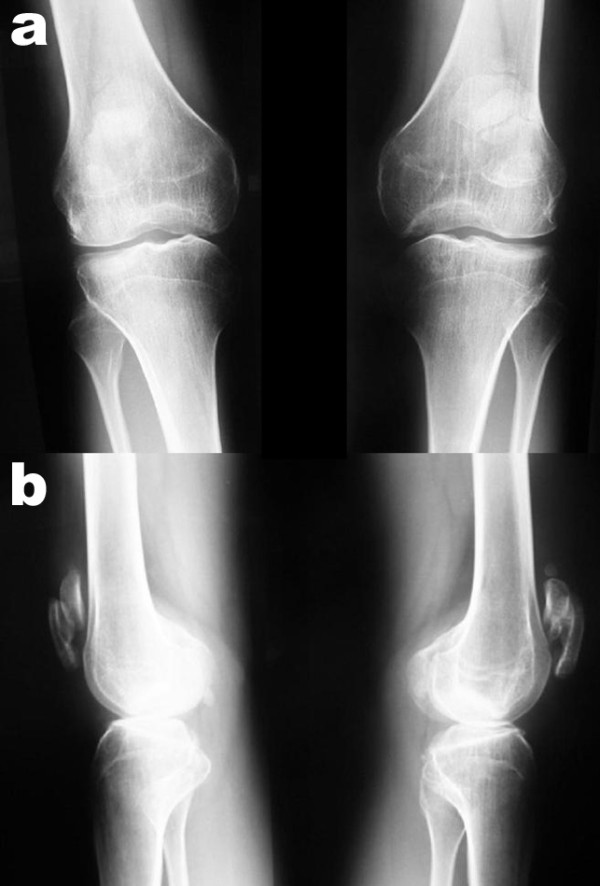
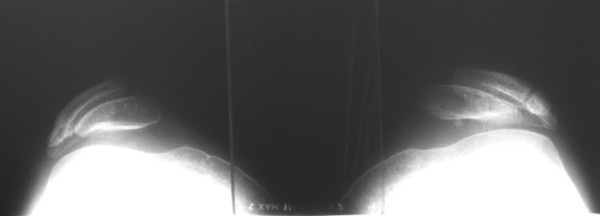
We report on a 27-year-old male patient suffering from clinical symptoms of autosomal recessive MED with habitual dislocation of a multilayered patella on both sides, on the surgical treatment and on short-term clinical outcome. Clinical findings were: bilateral hip and knee pain, instability of femorotibial and patellofemoral joints with habitual patella dislocation on both sides, contractures of hip, elbow and second metacarpophalangeal joints. Main radiographic findings were: bilateral dislocated multilayered patella, dysplastic medial tibial plateaus, deformity of both femoral heads and osteoarthritis of the hip joints, and deformity of both radial heads. In the molecular genetic analysis, the DTDST mutation g.1984T > A (p.C653S) was found at the homozygote state. Carrier status was confirmed in the DNA of the patient's parents. The mutation could be considered to be the reason for the patient's disease. Surgical treatment of habitual patella dislocation with medialisation of the tibial tuberosity led to an excellent clinical outcome.
The knowledge of different phenotypes of skeletal dysplasias helps to select genes for genetic analysis. Compared to other DTDST mutations, this is a rather mild phenotype. Molecular diagnosis is important for genetic counselling and for an accurate prognosis. Even in case of a multilayered patella in MED, habitual patella dislocation could be managed successfully by medialisation of the tibial tuberosity.
多发性骨骺发育不良(MED)是一种较为常见的全身性骨骼发育不良症。由于其临床表现具有异质性,诊断可能较为困难。至少有六个独立的基因突变可导致 MED。关节畸形、关节疼痛和步态障碍是常见的症状。
我们报告了一例 27 岁男性患者,患有常染色体隐性遗传 MED,表现为双侧多层髌骨习惯性脱位,伴有双侧髋膝关节疼痛、不稳定,髌骨习惯性脱位,髋、肘和第二掌指关节挛缩。主要影像学表现为双侧多层髌骨脱位、内侧胫骨平台发育不良、双侧股骨头畸形和髋关节骨关节炎、双侧桡骨头畸形。在分子遗传学分析中,发现患者纯合子状态存在 DTDST 基因突变 g.1984T > A(p.C653S)。患者父母的 DNA 中证实存在携带者状态。该突变可被认为是导致患者疾病的原因。通过胫骨结节内移术治疗习惯性髌骨脱位,取得了极佳的临床效果。
了解不同表型的骨骼发育不良有助于选择基因进行遗传分析。与其他 DTDST 突变相比,这是一种相对较轻的表型。分子诊断对于遗传咨询和准确的预后具有重要意义。即使在 MED 存在多层髌骨的情况下,通过胫骨结节内移术也可以成功治疗习惯性髌骨脱位。