Département de chiropratique, Université du Québec à Trois-Rivières, Trois-Rivières G9A 5H7, Canada.
BMC Musculoskelet Disord. 2010 Jun 4;11:112. doi: 10.1186/1471-2474-11-112.
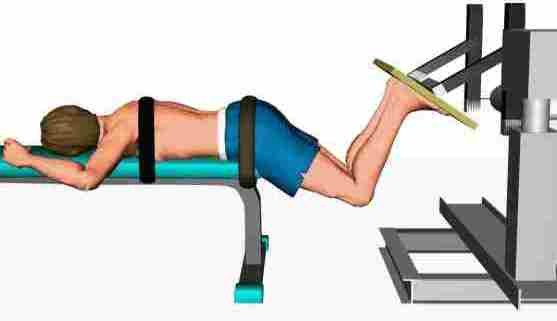
The flexion-relaxation phenomenon (FRP) is defined by reduced lumbar erector spinae (ES) muscle myoelectric activity during full trunk flexion. The objectives of this study were to quantify the effect of hip and back extensor muscle fatigue on FRP parameters and lumbopelvic kinematics.
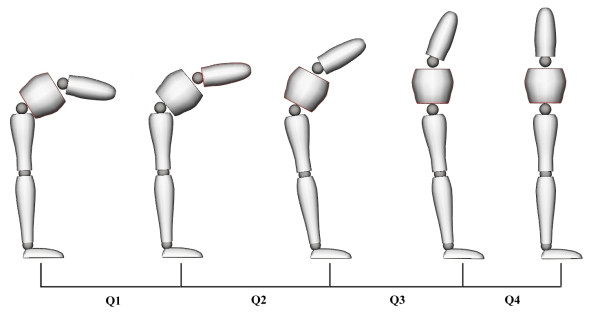
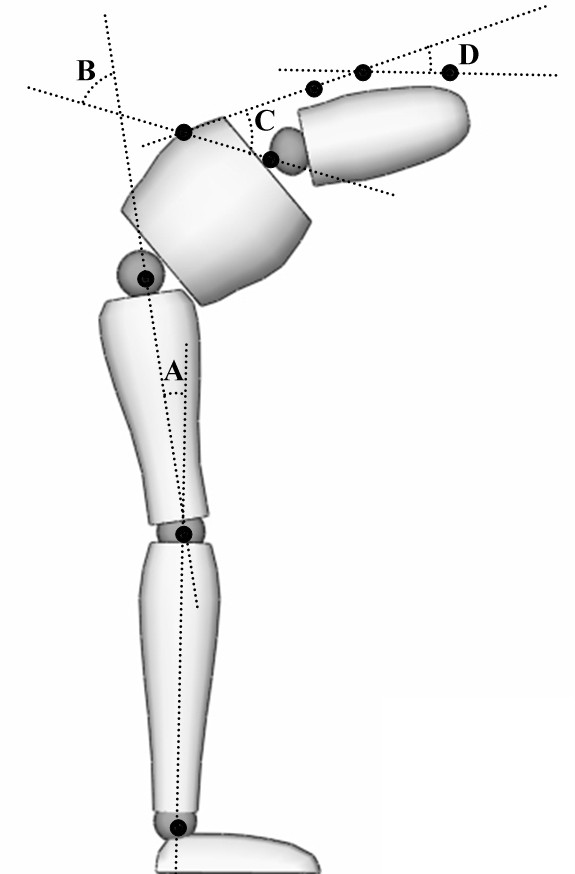
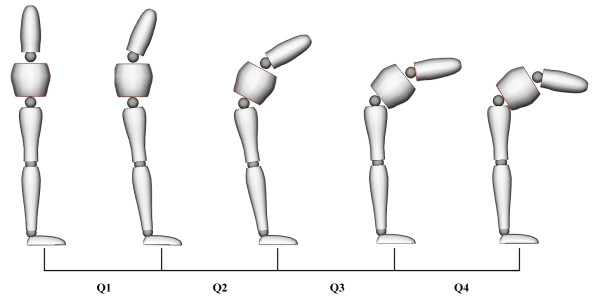
Twenty-seven healthy adults performed flexion-extension tasks under 4 different experimental conditions: no fatigue/no load, no fatigue/load, fatigue/no load, and fatigue/load. Total flexion angle corresponding to the onset and cessation of myoelectric silence, hip flexion angle, lumbar flexion angle and maximal trunk flexion angle were compared across different experimental conditions by 2 x 2 (Load x Fatigue) repeated-measures ANOVA.
The angle corresponding to the ES onset of myoelectric silence was reduced after the fatigue task, and loading the spine decreased the lumbar contribution to motion compared to the hip during both flexion and extension. A relative increment of lumbar spine motion compared to pelvic motion was also observed in fatigue conditions.
Previous results suggested that ES muscles, in a state of fatigue, are unable to provide sufficient segmental stabilization. The present findings indicate that, changes in lumbar-stabilizing mechanisms in the presence of muscle fatigue seem to be caused by modulation of lumbopelvic kinematics.
屈肌放松现象(FRP)定义为在完全躯干屈曲期间减少腰椎竖脊肌(ES)的肌电活动。本研究的目的是量化髋部和背部伸肌疲劳对 FRP 参数和腰骶部运动学的影响。
27 名健康成年人在 4 种不同的实验条件下进行屈伸任务:无疲劳/无负荷、无疲劳/负荷、疲劳/无负荷和疲劳/负荷。通过 2x2(负荷 x 疲劳)重复测量方差分析比较不同实验条件下总屈曲角度与肌电静止起始和终止时的 hip flexion angle、lumbar flexion angle 和 maximal trunk flexion angle。
疲劳任务后 ES 肌电静止的起始角度减小,与伸展相比,脊柱负重会降低髋部在屈伸过程中对运动的贡献。在疲劳状态下也观察到腰椎相对于骨盆运动的相对增量。
先前的研究结果表明,疲劳状态下的 ES 肌肉无法提供足够的节段稳定性。本研究结果表明,在肌肉疲劳存在的情况下,腰椎稳定机制的变化似乎是由腰骶部运动学的调节引起的。