Poverty, Health, and Nutrtition Division, International Food Policy Research Institute, 2033 K Street, Washington, DC 20006, USA.
BMC Public Health. 2010 Jun 7;10:316. doi: 10.1186/1471-2458-10-316.
The evidence evaluating the benefits of programmatic nutrition interventions to HIV-infected individuals in developing countries, where there is a large overlap between HIV prevalence and malnutrition, is limited. This study evaluates the impact of food assistance (FA) on change in weight and disease progression as measured by WHO staging.
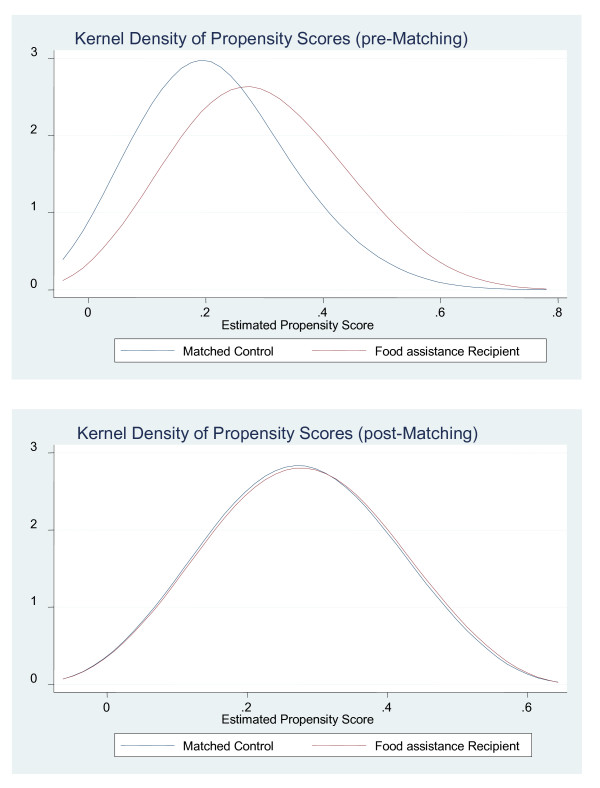
We utilize program data from The AIDS Support Organization (TASO) in Uganda to compare outcomes among FA recipients to a control group, using propensity score matching (PSM) methods among 14,481 HIV-infected TASO clients.
FA resulted in a significant mean weight gain of 0.36 kg over one year period. This impact was conditional on anti-retroviral therapy (ART) receipt and disease stage at baseline. FA resulted in mean weight gain of 0.36 kg among individuals not receiving ART compared to their matched controls. HIV-infected individuals receiving FA with baseline WHO stage II and III had a significant weight gain (0.26 kg and 0.2 kg respectively) compared to their matched controls. Individuals with the most advanced disease at baseline (WHO stage IV) had the highest weight gain of 1.9 kg. The impact on disease progression was minimal. Individuals receiving FA were 2 percentage points less likely to progress by one or more WHO stage compared to their matched controls. There were no significant impacts on either outcome among individuals receiving ART.
Given the widespread overlap of HIV and malnutrition in sub-Saharan Africa, FA programs have the potential to improve weight and delay disease progression, especially among HIV-infected individuals not yet on ART. Additional well designed prospective studies evaluating the impact of FA are urgently needed.
在发展中国家,艾滋病毒感染人群与营养不良人群高度重叠,在这些国家中,评估规划性营养干预措施对艾滋病毒感染者的益处的证据有限。本研究评估了食物援助(FA)对体重变化和疾病进展的影响,以世界卫生组织(WHO)分期来衡量。
我们利用乌干达艾滋病支持组织(TASO)的项目数据,通过倾向评分匹配(PSM)方法,比较了接受 FA 的患者与对照组在 14481 名 TASO 艾滋病毒感染者中的结局。
FA 在一年的时间里导致体重平均增加了 0.36 公斤。这种影响取决于抗逆转录病毒治疗(ART)的接受情况和基线时的疾病阶段。在未接受 ART 的个体中,FA 导致体重平均增加 0.36 公斤,而其匹配对照则没有。基线时患有 WHO 分期 II 和 III 的接受 FA 的艾滋病毒感染者与他们的匹配对照组相比,体重分别增加了 0.26 公斤和 0.2 公斤。基线时疾病最严重的(WHO 分期 IV)个体体重增加最多,为 1.9 公斤。对疾病进展的影响很小。与匹配对照组相比,接受 FA 的个体进展到一个或多个 WHO 阶段的可能性低 2 个百分点。接受 ART 的个体在这两个结果上均无显著影响。
鉴于撒哈拉以南非洲地区艾滋病毒和营养不良的广泛重叠,FA 项目有可能改善体重和延缓疾病进展,特别是在尚未接受 ART 的艾滋病毒感染者中。迫切需要进行更多设计良好的前瞻性研究,以评估 FA 的影响。