Harun-Or-Rashid Md, Asai Masato, Sun Xiao-Yang, Hayashi Yoshitaka, Sakamoto Junichi, Murata Yoshiharu
Research Institute of Environmental Medicine, Nagoya University Graduate School of Medicine, Nagoya, Japan.
Thyroid Res. 2010 Jun 9;3(1):3. doi: 10.1186/1756-6614-3-3.
Iodide that is essential for thyroid hormone synthesis is actively transported into the thyroid follicular cells via sodium/iodide symporter (NIS) protein in vertebrates. It is well known that NIS expression in thyroid is regulated by the thyroid statuses mainly through thyroid stimulating hormone (TSH). Although NIS mRNA expressions in extrathyroidal tissues have been qualitatively reported, their regulation by thyroid statuses has not been well clarified.
Male ICR mice aged four weeks were assigned into three groups (control, hypothyroid, and hyperthyroid). Hypothyroid group of mice were treated with 0.02% methimazole in drinking water and hyperthyroid group of mice received intraperitoneal injection (4 mug L-T4 twice a week) for four weeks. NIS mRNA expression levels in the tissues were evaluated using Northern blot hybridization and quantitative real-time RTPCR (qPCR). Additionally, end-point RTPCR for the thyroid follicular cell-characteristic genes (TSH receptor, TSHR; thyroid transcription factor-1, TTF1; and paired box gene 8, Pax8) was carried out.
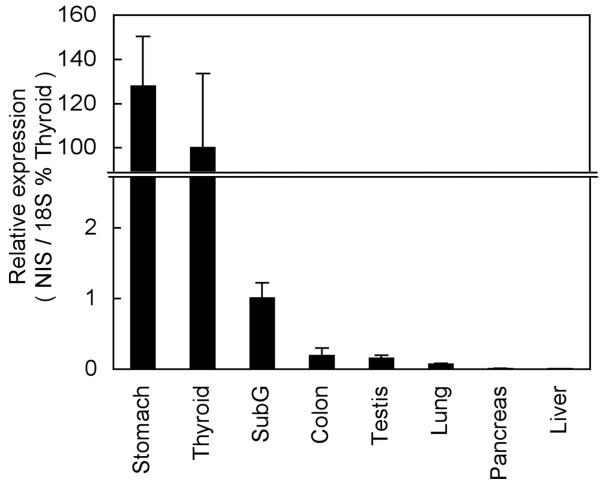
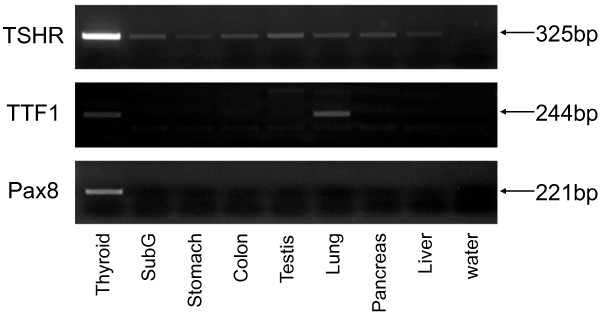
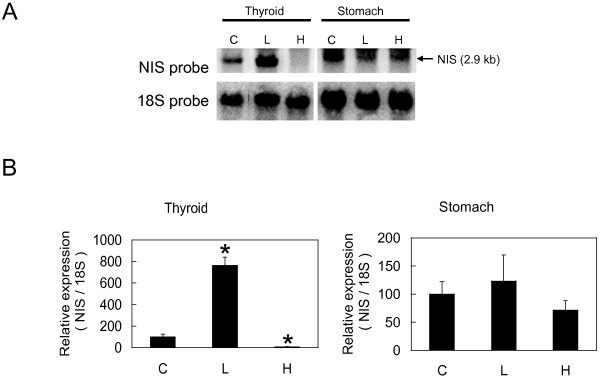
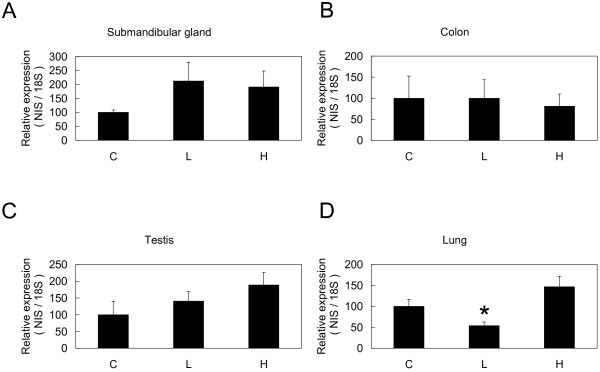
By Northern blot analysis, NIS mRNA was detected in thyroid and stomach. In addition to these organs, qPCR revealed the expression also in the submandibular gland, colon, testis, and lung. Expression of NIS mRNA in thyroid was significantly increased in hypothyroid and decreased in hyperthyroid group. Trends of NIS mRNA expression in extrathyroidal tissues were not in line with that in the thyroid gland in different thyroid statuses. Only in lung, NIS mRNA was regulated by thyroid statuses but in opposite way compared to the manner in the thyroid gland. There were no extrathyroidal tissues that expressed all three characteristic genes of thyroid follicular cells.
NIS mRNA expression in the thyroid gland was up-regulated in hypothyroid mice and was down-regulated in hyperthyroid mice, suggesting that NIS mRNA in the thyroid gland is regulated by thyroid statuses. In contrast, NIS mRNA expression in extrathyroidal tissues was not altered by thyroid statuses although it was widely expressed. Lack of responsiveness of NIS mRNA expressions in extrathyroidal tissues reemphasizes additional functions of NIS protein in extrathyroidal tissues other than iodide trapping.
碘是甲状腺激素合成所必需的,在脊椎动物中,它通过钠/碘同向转运体(NIS)蛋白被主动转运进入甲状腺滤泡细胞。众所周知,甲状腺中NIS的表达主要受甲状腺状态通过促甲状腺激素(TSH)调控。尽管已有关于甲状腺外组织中NIS mRNA表达的定性报道,但其受甲状腺状态的调控尚未完全阐明。
将4周龄雄性ICR小鼠分为三组(对照组、甲状腺功能减退组和甲状腺功能亢进组)。甲状腺功能减退组小鼠饮用含0.02%甲巯咪唑的水,甲状腺功能亢进组小鼠每周两次腹腔注射(4μg L-T4),持续四周。使用Northern印迹杂交和定量实时RT-PCR(qPCR)评估组织中NIS mRNA的表达水平。此外,对甲状腺滤泡细胞特征性基因(促甲状腺激素受体,TSHR;甲状腺转录因子-1,TTF1;配对盒基因8,Pax8)进行终点RT-PCR。
通过Northern印迹分析,在甲状腺和胃中检测到NIS mRNA。除这些器官外,qPCR还显示在颌下腺、结肠、睾丸和肺中也有表达。甲状腺功能减退组甲状腺中NIS mRNA表达显著增加,甲状腺功能亢进组则减少。在不同甲状腺状态下,甲状腺外组织中NIS mRNA表达趋势与甲状腺中的不一致。仅在肺中,NIS mRNA受甲状腺状态调控,但与甲状腺中的方式相反。没有甲状腺外组织表达所有三种甲状腺滤泡细胞特征性基因。
甲状腺功能减退小鼠甲状腺中NIS mRNA表达上调,甲状腺功能亢进小鼠中则下调,表明甲状腺中NIS mRNA受甲状腺状态调控。相比之下,甲状腺外组织中NIS mRNA表达虽广泛存在,但不受甲状腺状态改变影响。甲状腺外组织中NIS mRNA表达缺乏反应性再次强调了NIS蛋白在甲状腺外组织中除碘摄取外的其他功能。