Departments of Pathology, Internal Medicine, Human Genetics, School of Medicine, University of Michigan, Ann Arbor, Michigan, USA.
PLoS One. 2010 Jun 3;5(6):e10936. doi: 10.1371/journal.pone.0010936.
The problem of prostate cancer progression to androgen independence has been extensively studied. Several studies systematically analyzed gene expression profiles in the context of biological networks and pathways, uncovering novel aspects of prostate cancer. Despite significant research efforts, the mechanisms underlying tumor progression are poorly understood. We applied a novel approach to reconstruct system-wide molecular events following stimulation of LNCaP prostate cancer cells with synthetic androgen and to identify potential mechanisms of androgen-independent progression of prostate cancer.
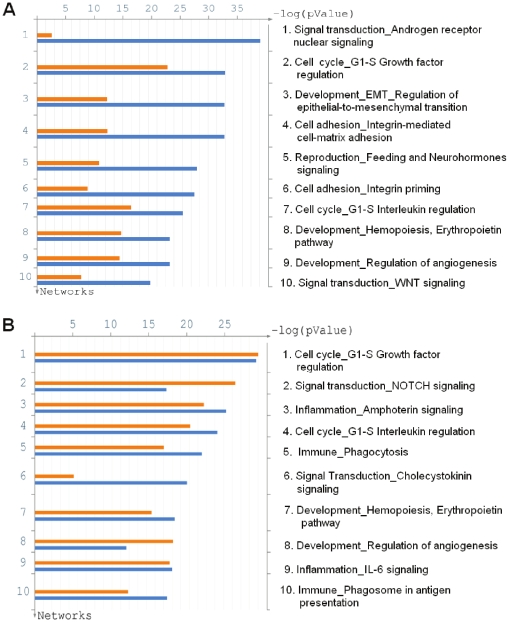
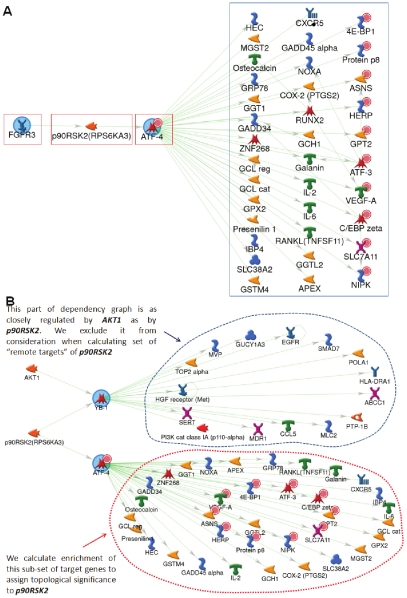
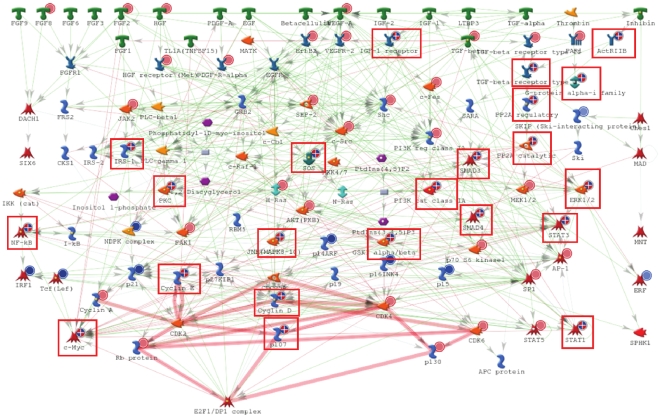
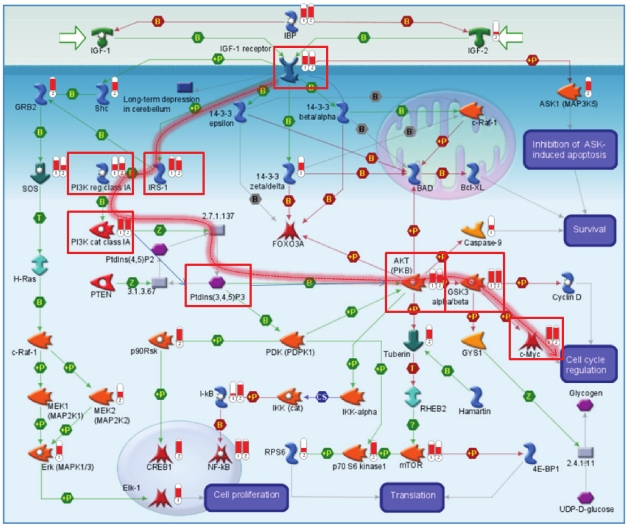
METHODOLOGY/PRINCIPAL FINDINGS: We have performed concurrent measurements of gene expression and protein levels following the treatment using microarrays and iTRAQ proteomics. Sets of up-regulated genes and proteins were analyzed using our novel concept of "topological significance". This method combines high-throughput molecular data with the global network of protein interactions to identify nodes which occupy significant network positions with respect to differentially expressed genes or proteins. Our analysis identified the network of growth factor regulation of cell cycle as the main response module for androgen treatment in LNCap cells. We show that the majority of signaling nodes in this network occupy significant positions with respect to the observed gene expression and proteomic profiles elicited by androgen stimulus. Our results further indicate that growth factor signaling probably represents a "second phase" response, not directly dependent on the initial androgen stimulus.
CONCLUSIONS/SIGNIFICANCE: We conclude that in prostate cancer cells the proliferative signals are likely to be transmitted from multiple growth factor receptors by a multitude of signaling pathways converging on several key regulators of cell proliferation such as c-Myc, Cyclin D and CREB1. Moreover, these pathways are not isolated but constitute an interconnected network module containing many alternative routes from inputs to outputs. If the whole network is involved, a precisely formulated combination therapy may be required to fight the tumor growth effectively.
前列腺癌向雄激素非依赖性进展的问题已得到广泛研究。几项研究系统地分析了生物网络和途径背景下的基因表达谱,揭示了前列腺癌的新方面。尽管进行了大量研究,但肿瘤进展的机制仍知之甚少。我们采用了一种新方法,在合成雄激素刺激 LNCaP 前列腺癌细胞后,重建系统范围的分子事件,并确定前列腺癌雄激素非依赖性进展的潜在机制。
方法/主要发现:我们使用微阵列和 iTRAQ 蛋白质组学技术,在治疗后同时测量基因表达和蛋白质水平。使用我们的“拓扑意义”新概念分析上调基因和蛋白质集。该方法将高通量分子数据与蛋白质相互作用的全局网络相结合,以识别相对于差异表达基因或蛋白质占据显著网络位置的节点。我们的分析确定了细胞周期生长因子调节网络是 LNCap 细胞中雄激素治疗的主要反应模块。我们表明,该网络中的大多数信号节点相对于雄激素刺激引起的观察到的基因表达和蛋白质组学谱占据显著位置。我们的结果进一步表明,生长因子信号可能代表“第二阶段”反应,不直接依赖于初始雄激素刺激。
结论/意义:我们得出的结论是,在前列腺癌细胞中,增殖信号可能通过多种信号通路从多个生长因子受体传递,这些信号通路汇聚到几个关键的细胞增殖调节剂上,如 c-Myc、Cyclin D 和 CREB1。此外,这些途径不是孤立的,而是构成一个相互连接的网络模块,其中包含从输入到输出的许多替代途径。如果整个网络都参与其中,可能需要精确制定的联合治疗方案才能有效地对抗肿瘤生长。