Intensive Care and Department of Paediatric Surgery, Erasmus MC - Sophia Children's Hospital, Rotterdam, The Netherlands.
PLoS One. 2010 Jun 3;5(6):e10938. doi: 10.1371/journal.pone.0010938.
To evaluate the effect of extracorporeal membrane oxygenation (ECMO) support on pharmacokinetics of oseltamivir and oseltamivir carboxylate (OC) in children.
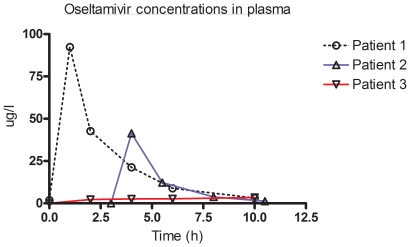
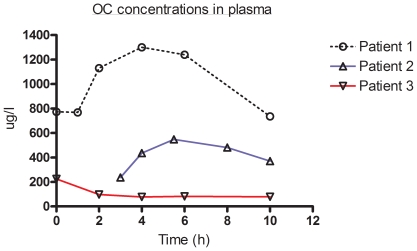
Steady state 0-12 hour pharmacokinetic sampling was performed in new influenza A (H1N1) infected children treated with oseltamivir while on ECMO support. Cmax, Cmin and AUC(0-12 h) were calculated. The age-specific oseltamivir dosage was doubled to counter expected decreased plasma drug concentrations due to increased volume of distribution on ECMO support.
Three patients were enrolled aged 15, 6 and 14 years in this pharmacokinetic case series. For two children the OC plasma concentrations were higher than those found in children and adults not on ECMO. These increased plasma concentrations related to the increased oseltamivir dosage and decreased kidney function. In one patient suboptimal plasma concentrations coincided with a decreased gastric motility.
Oseltamivir pharmacokinetics do not appear to be significantly influenced by ECMO support. Caution is required in case of nasogastric administration and decreased gastric motility. Due to the limited number of (paediatric) patients available further multicenter studies are warranted.
评估体外膜氧合(ECMO)支持对儿童奥司他韦和奥司他韦羧酸(OC)药代动力学的影响。
对接受 ECMO 支持的新甲型流感(H1N1)感染儿童进行奥司他韦稳态 0-12 小时药代动力学采样。计算 Cmax、Cmin 和 AUC(0-12 h)。为了抵消 ECMO 支持导致的分布容积增加而预期降低的血浆药物浓度,将特定年龄的奥司他韦剂量增加一倍。
这项药代动力学病例系列研究纳入了 3 名年龄分别为 15、6 和 14 岁的患者。对于两名儿童,OC 血浆浓度高于未接受 ECMO 的儿童和成人。这些增加的血浆浓度与增加的奥司他韦剂量和肾功能下降有关。在一名患者中,血浆浓度不理想与胃动力降低有关。
ECMO 支持似乎不会对奥司他韦的药代动力学产生显著影响。在存在鼻胃管给药和胃动力降低的情况下应谨慎。由于可供选择的(儿科)患者数量有限,需要进一步的多中心研究。