FIMM, Institute for Molecular Medicine Finland, University of Helsinki, Finland.
PLoS Genet. 2010 Jun 3;6(6):e1000976. doi: 10.1371/journal.pgen.1000976.
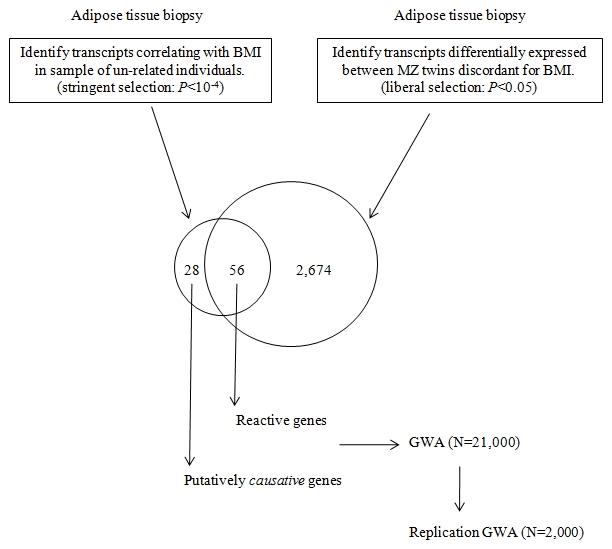
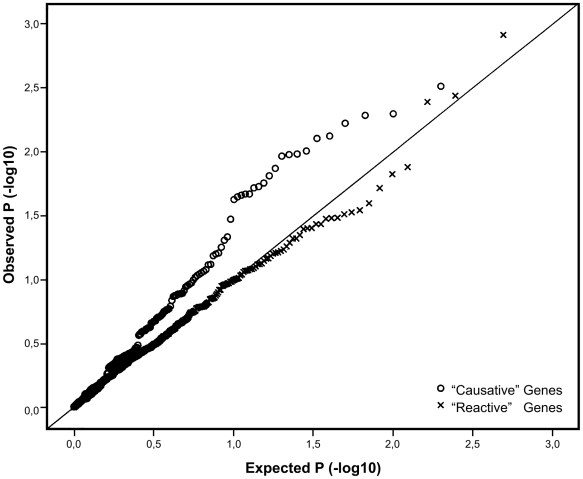
To get beyond the "low-hanging fruits" so far identified by genome-wide association (GWA) studies, new methods must be developed in order to discover the numerous remaining genes that estimates of heritability indicate should be contributing to complex human phenotypes, such as obesity. Here we describe a novel integrative method for complex disease gene identification utilizing both genome-wide transcript profiling of adipose tissue samples and consequent analysis of genome-wide association data generated in large SNP scans. We infer causality of genes with obesity by employing a unique set of monozygotic twin pairs discordant for BMI (n = 13 pairs, age 24-28 years, 15.4 kg mean weight difference) and contrast the transcript profiles with those from a larger sample of non-related adult individuals (N = 77). Using this approach, we were able to identify 27 genes with possibly causal roles in determining the degree of human adiposity. Testing for association of SNP variants in these 27 genes in the population samples of the large ENGAGE consortium (N = 21,000) revealed a significant deviation of P-values from the expected (P = 4x10(-4)). A total of 13 genes contained SNPs nominally associated with BMI. The top finding was blood coagulation factor F13A1 identified as a novel obesity gene also replicated in a second GWA set of approximately 2,000 individuals. This study presents a new approach to utilizing gene expression studies for informing choice of candidate genes for complex human phenotypes, such as obesity.
为了超越全基因组关联 (GWA) 研究迄今为止确定的“低挂果实”,必须开发新的方法,以发现大量其余的基因,这些基因的遗传力估计应该有助于肥胖等复杂的人类表型。在这里,我们描述了一种利用脂肪组织样本的全基因组转录谱和随后对大型 SNP 扫描中生成的全基因组关联数据进行分析的新的复杂疾病基因识别综合方法。我们通过使用一套独特的 BMI 不一致的同卵双胞胎对(n = 13 对,年龄 24-28 岁,平均体重差异 15.4kg)来推断与肥胖相关的基因的因果关系,并将转录谱与更大的非相关成年个体样本(n = 77)的转录谱进行对比。使用这种方法,我们能够确定 27 个基因可能在决定人类肥胖程度方面具有因果作用。在 ENGAGE 大型联盟的人群样本中(n = 21,000)对这些 27 个基因中的 SNP 变体进行关联测试,发现 P 值与预期值有显著偏差(P = 4x10(-4))。共有 13 个基因包含与 BMI 名义相关的 SNP。最显著的发现是血液凝固因子 F13A1,它被确定为一个新的肥胖基因,在大约 2000 人的第二个 GWA 集中也得到了复制。本研究提出了一种利用基因表达研究为肥胖等复杂人类表型选择候选基因的新方法。