Department of Mechanical Engineering, Massachusetts Institute of Technology, Cambridge, Massachusetts, USA.
PLoS Comput Biol. 2010 Jun 3;6(6):e1000795. doi: 10.1371/journal.pcbi.1000795.
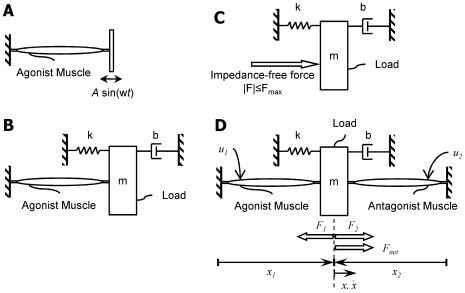
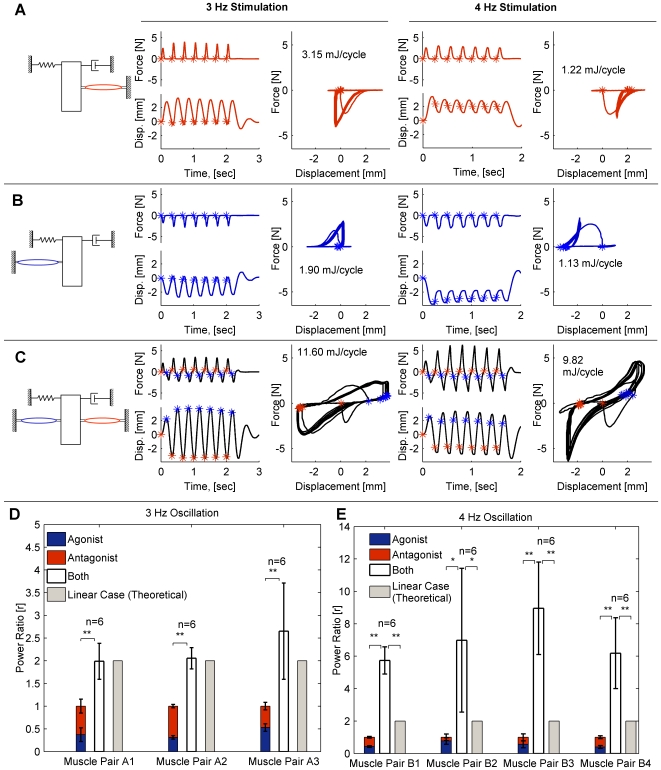
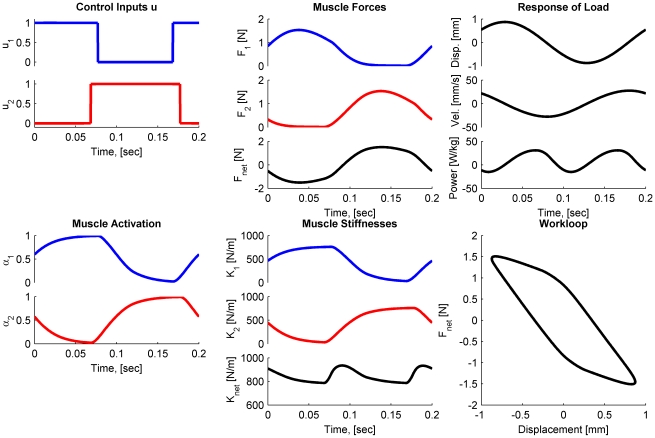
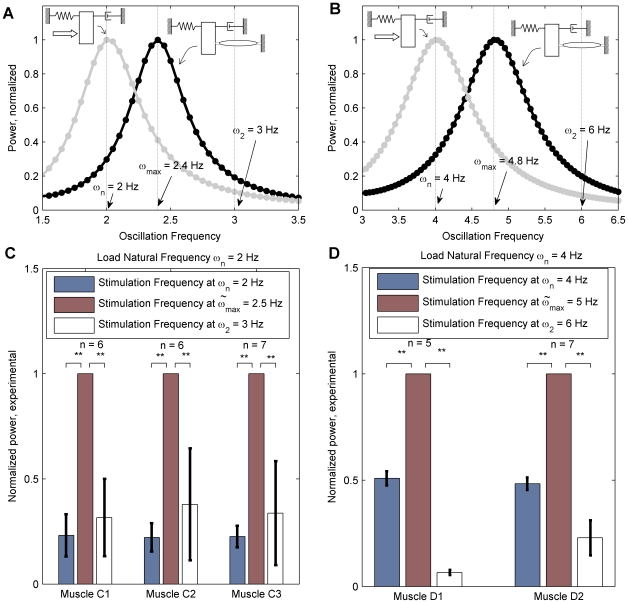
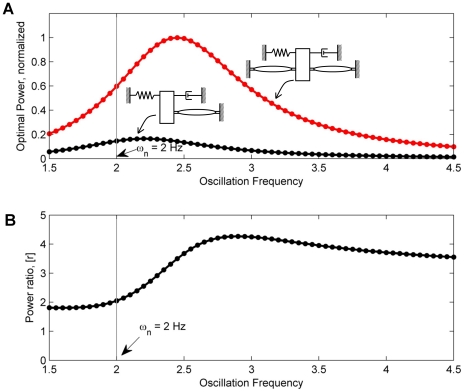
Integrative approaches to studying the coupled dynamics of skeletal muscles with their loads while under neural control have focused largely on questions pertaining to the postural and dynamical stability of animals and humans. Prior studies have focused on how the central nervous system actively modulates muscle mechanical impedance to generate and stabilize motion and posture. However, the question of whether muscle impedance properties can be neurally modulated to create favorable mechanical energetics, particularly in the context of periodic tasks, remains open. Through muscle stiffness tuning, we hypothesize that a pair of antagonist muscles acting against a common load may produce significantly more power synergistically than individually when impedance matching conditions are met between muscle and load. Since neurally modulated muscle stiffness contributes to the coupled muscle-load stiffness, we further anticipate that power-optimal oscillation frequencies will occur at frequencies greater than the natural frequency of the load. These hypotheses were evaluated computationally by applying optimal control methods to a bilinear muscle model, and also evaluated through in vitro measurements on frog Plantaris longus muscles acting individually and in pairs upon a mass-spring-damper load. We find a 7-fold increase in mechanical power when antagonist muscles act synergistically compared to individually at a frequency higher than the load natural frequency. These observed behaviors are interpreted in the context of resonance tuning and the engineering notion of impedance matching. These findings suggest that the central nervous system can adopt strategies to harness inherent muscle impedance in relation to external loads to attain favorable mechanical energetics.
综合研究神经控制下骨骼肌肉与其负载的耦合动力学的方法主要集中在与动物和人类姿势和动力稳定性相关的问题上。先前的研究集中于中枢神经系统如何主动调节肌肉力学阻抗以产生和稳定运动和姿势。然而,肌肉阻抗特性是否可以通过神经调节来创造有利的机械能量,特别是在周期性任务的背景下,这个问题仍然没有答案。通过肌肉僵硬调谐,我们假设一对拮抗肌在共同负载下共同作用,当肌肉和负载之间满足阻抗匹配条件时,可能会比单独作用产生更多的协同功率。由于神经调节的肌肉僵硬有助于耦合的肌肉-负载僵硬,我们进一步预计,功率最优的振荡频率将出现在高于负载自然频率的频率。这些假设通过将最优控制方法应用于双线性肌肉模型进行了计算评估,并且还通过在离体测量中对单独和成对作用于质量-弹簧-阻尼负载的青蛙跖肌进行了评估。我们发现,当拮抗肌以高于负载自然频率的频率协同作用时,与单独作用相比,机械功率增加了 7 倍。这些观察到的行为在共振调谐和阻抗匹配的工程概念的背景下进行了解释。这些发现表明,中枢神经系统可以采用与外部负载相关的固有肌肉阻抗的策略来获得有利的机械能量。