School of Biological Sciences, Institute of Evolutionary Biology, University of Edinburgh, Ashworth Labs, Edinburgh EH9 3JT, UK.
Proc Biol Sci. 2010 Nov 7;277(1698):3291-7. doi: 10.1098/rspb.2010.0772. Epub 2010 Jun 9.
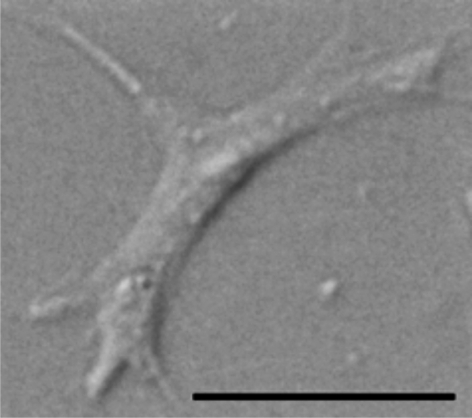
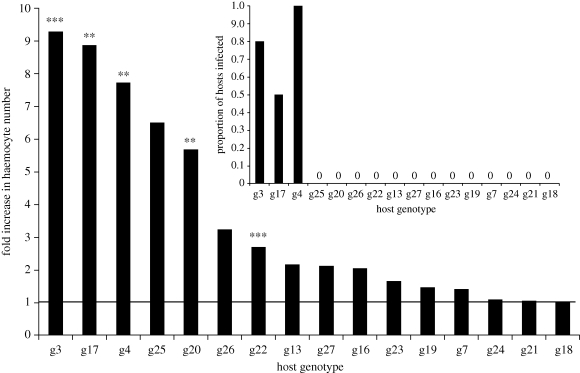
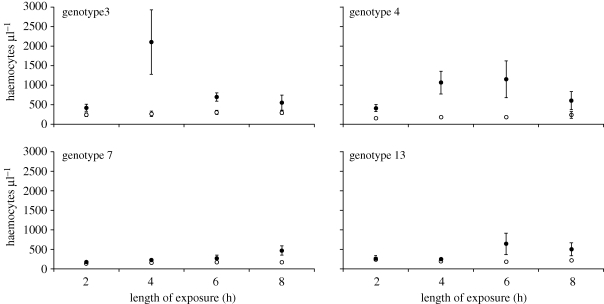
Linking measures of immune function with infection, and ultimately, host and parasite fitness is a major goal in the field of ecological immunology. In this study, we tested for the presence and timing of a cellular immune response in the crustacean Daphnia magna following exposure to its sterilizing endoparasite Pasteuria ramosa. We found that D. magna possesses two cell types circulating in the haemolymph: a spherical one, which we call a granulocyte and an irregular-shaped amoeboid cell first described by Metchnikoff over 125 years ago. Daphnia magna mounts a strong cellular response (of the amoeboid cells) just a few hours after parasite exposure. We further tested for, and found, considerable genetic variation for the magnitude of this cellular response. These data fostered a heuristic model of resistance in this naturally coevolving host-parasite interaction. Specifically, the strongest cellular responses were found in the most susceptible hosts, indicating resistance is not always borne from a response that destroys invading parasites, but rather stems from mechanisms that prevent their initial entry. Thus, D. magna may have a two-stage defence--a genetically determined barrier to parasite establishment and a cellular response once establishment has begun.
将免疫功能的衡量标准与感染联系起来,并最终将宿主和寄生虫的适应度联系起来,是生态免疫学领域的主要目标。在这项研究中,我们检测了在暴露于杀菌内寄生菌Pasteuria ramosa 后,浮游甲壳动物 Daphnia magna 中是否存在细胞免疫反应以及其出现的时间。我们发现,D. magna 在血淋巴中循环着两种细胞类型:一种是球形的,我们称之为粒细胞,另一种是 125 多年前由梅契尼科夫首次描述的不规则形状的阿米巴细胞。在寄生虫暴露后的几个小时内,Daphnia magna 就会产生强烈的细胞反应(由阿米巴细胞引起)。我们进一步测试并发现,这种细胞反应的幅度存在相当大的遗传变异。这些数据为这种自然协同进化的宿主-寄生虫相互作用中的抗性提供了一个启发式模型。具体来说,在最易受感染的宿主中发现了最强的细胞反应,这表明抗性并不总是来自于破坏入侵寄生虫的反应,而是源于阻止其最初进入的机制。因此,D. magna 可能具有两阶段防御机制——一种是对寄生虫定植的遗传决定的屏障,另一种是一旦定植开始就会产生的细胞反应。