Centre d'Ecologie Fonctionnelle et Evolutive, UMR 5175, Montpellier, France.
J Evol Biol. 2012 Sep;25(9):1888-96. doi: 10.1111/j.1420-9101.2012.02579.x. Epub 2012 Aug 1.
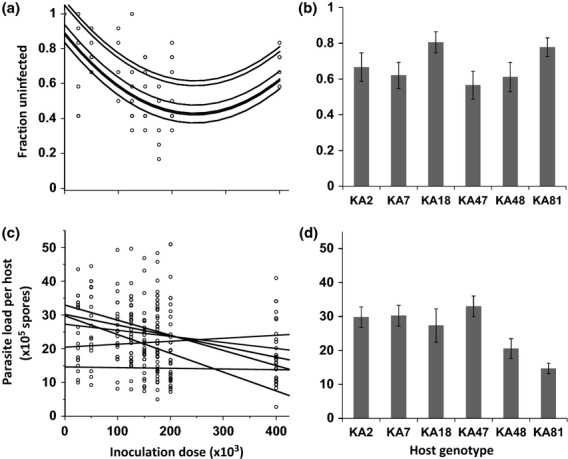
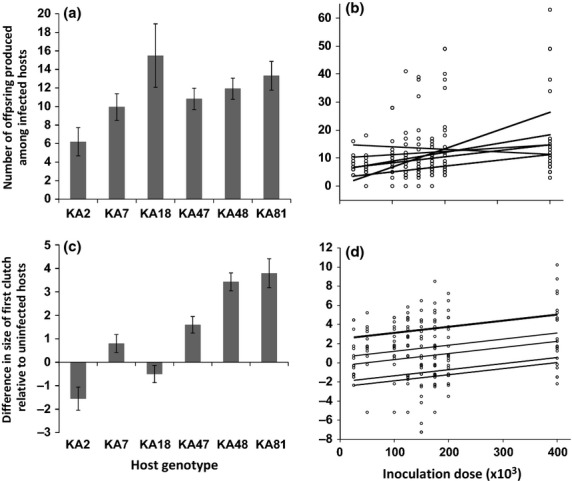
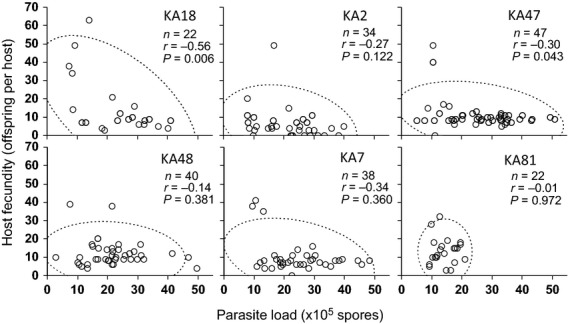
Hosts are armed with several lines of defence in the battle against parasites: they may prevent the establishment of infection, reduce parasite growth once infected or persevere through mechanisms that reduce the damage caused by infection, called tolerance. Studies on tolerance in animals have focused on mortality, and sterility tolerance has not been investigated experimentally. Here, we tested for genetic variation in the multiple steps of defence when the invertebrate Daphnia magna is infected with the sterilizing bacterial pathogen Pasteuria ramosa: anti-infection resistance, anti-growth resistance and the ability to tolerate sterilization once infected. When exposed to nine doses of a genetically diverse pathogen inoculum, six host genotypes varied in their average susceptibility to infection and in their parasite loads once infected. How host fecundity changed with increasing parasite loads did not vary between genotypes, indicating that there was no genetic variation for this measure of fecundity tolerance. However, genotypes differed in their level of fecundity compensation under infection, and we discuss how, by increasing host fitness without targeting parasite densities, fecundity compensation is consistent with the functional definition of tolerance. Such infection-induced life-history shifts are not traditionally considered to be part of the immune response, but may crucially reduce harm (in terms of fitness loss) caused by disease, and are a distinct source of selection on pathogens.
它们可以阻止感染的建立,减少感染后的寄生虫生长,或者通过减少感染造成的损害的机制来坚持下去,这种机制被称为耐受性。动物耐受性的研究集中在死亡率上,而绝育耐受性尚未进行实验研究。在这里,我们测试了当无脊椎动物大型溞受到杀菌性细菌病原体粘孢子虫感染时,在防御的多个步骤中是否存在遗传变异:抗感染抗性、抗生长抗性以及在感染后耐受绝育的能力。当暴露于遗传多样性的病原体接种物的九种剂量下时,六个宿主基因型在平均易感性和感染后的寄生虫负荷方面存在差异。随着寄生虫负荷的增加,宿主繁殖力的变化在基因型之间没有差异,表明在这种繁殖力耐受性的衡量标准上没有遗传变异。然而,基因型在感染下的繁殖力补偿水平上存在差异,我们讨论了繁殖力补偿如何通过在不针对寄生虫密度的情况下增加宿主适应性,与耐受性的功能定义一致。这种感染诱导的生活史变化传统上不被认为是免疫反应的一部分,但可能会极大地减少疾病造成的伤害(以适应性损失为衡量标准),并且是病原体选择的一个明显来源。